


A $24.4 billion contract tells you what the government wants to buy. Production Confidence tells you whether the industrial network underneath it can actually build it.
In short: Production Confidence is the measured likelihood that every critical part of a production network, from the prime contractor down to Tier 3 and Tier 4 suppliers, can support a required output at the required rate and on the required schedule. The Navy’s new SM-6 contract targets more than 500 missiles a year. The real ceiling on that number is set by the weakest critical dependency in the network, which is often a supplier nobody on the program team has ever contracted with.
Key takeaways
- A production award creates demand. It does not create capacity. Factories, machines, people, materials and sub-tier suppliers do.
- Output is capped by the weakest critical node. If final assembly can support 500 but one component can support 350, Production Confidence is 350.
- Three Tier 1 suppliers can still be one dependency if they all rely on the same Tier 3 manufacturer.
- Supplier importance should be measured by what stops working without it, not by spend.
- Nine signal categories (capacity, demand, capital, workforce, financial health, materials, geography, qualification and leadership) show whether a constraint is getting better or worse.
- Resilience needs two maps: the Current Supply Network and the Potential Capability Network.
What did the Navy buy with the $24.4 billion SM-6 contract?
The Navy bought a multiyear commitment to Standard Missile 6 interceptors worth up to $24.4 billion, with production frameworks that target more than 500 missiles a year. On October 1, 2026, the Navy awarded RTX’s Raytheon unit the contract as the Pentagon works to replenish munitions stockpiles depleted by conflicts in the Middle East, according to Reuters. The award covers a five-year base period with two additional option years.
The Navy said the long-term deal is meant to give industry stable, predictable conditions to expand output. The Pentagon framed it the same way, saying the SM-6 and Tomahawk agreements give industry the predictability to grow its workforce and reinforce vulnerable supply chains. It follows a $20.7 billion provisional deal for AMRAAM missiles in late September and a $58.6 billion Patriot interceptor deal with Lockheed Martin in July.
The ambition is real. So are the open questions. Quantities and delivery schedules for the October contract have not been specified, and industry executives have warned that Congress has not yet appropriated funding for these deals, which means contractors may not be able to invest at scale in components and facilities until lawmakers act.
The contract tells us what the government wants to buy. It does not tell us whether the industrial network can produce it. Those are two very different things.
What is Production Confidence?
Production Confidence measures whether the industrial network underneath a contract can produce the required output, at the required rate, in the required time. It is not confidence that a prime contractor holds a contract.
That distinction matters because a prime contractor can have a signed award, a funded plan and a modernized final assembly line, and still miss the rate. Deloitte makes this point directly about munitions: even when primes have signed contracts and expanded final assembly capacity, output may still fall short because of bottlenecks at Tier 2 and Tier 3 suppliers.
Answering the Production Confidence question requires looking much deeper than the prime. It is the same logic we applied to industrial capacity in The Defense Industrial Base Doesn’t Have a Demand Problem. It Has a Capacity Intelligence Problem. Stated capacity and executable capacity are not the same number.
Why is 500 missiles not really one number?
A production target of 500 missiles a year creates hundreds of other production requirements, and the network can only deliver what its weakest critical node can support. At the top of the supply chain, the math looks simple. Required output is 500. But a missile is not produced by one company. It is the output of a system.
That system includes propulsion, guidance, electronics, structures, energetic materials, specialized metals, sensors, manufacturing equipment, skilled labor and hundreds or thousands of components and processes underneath them. So the real question is this: can every critical part of that system support 500?
- If final assembly can support 500 but a critical component can support only 350, Production Confidence is not 500. It is constrained by 350.
- If that component’s Tier 2 supplier can support only 275, the answer changes again.
- If three Tier 1 suppliers all rely on the same Tier 3 manufacturer, the apparent diversification may disappear entirely.
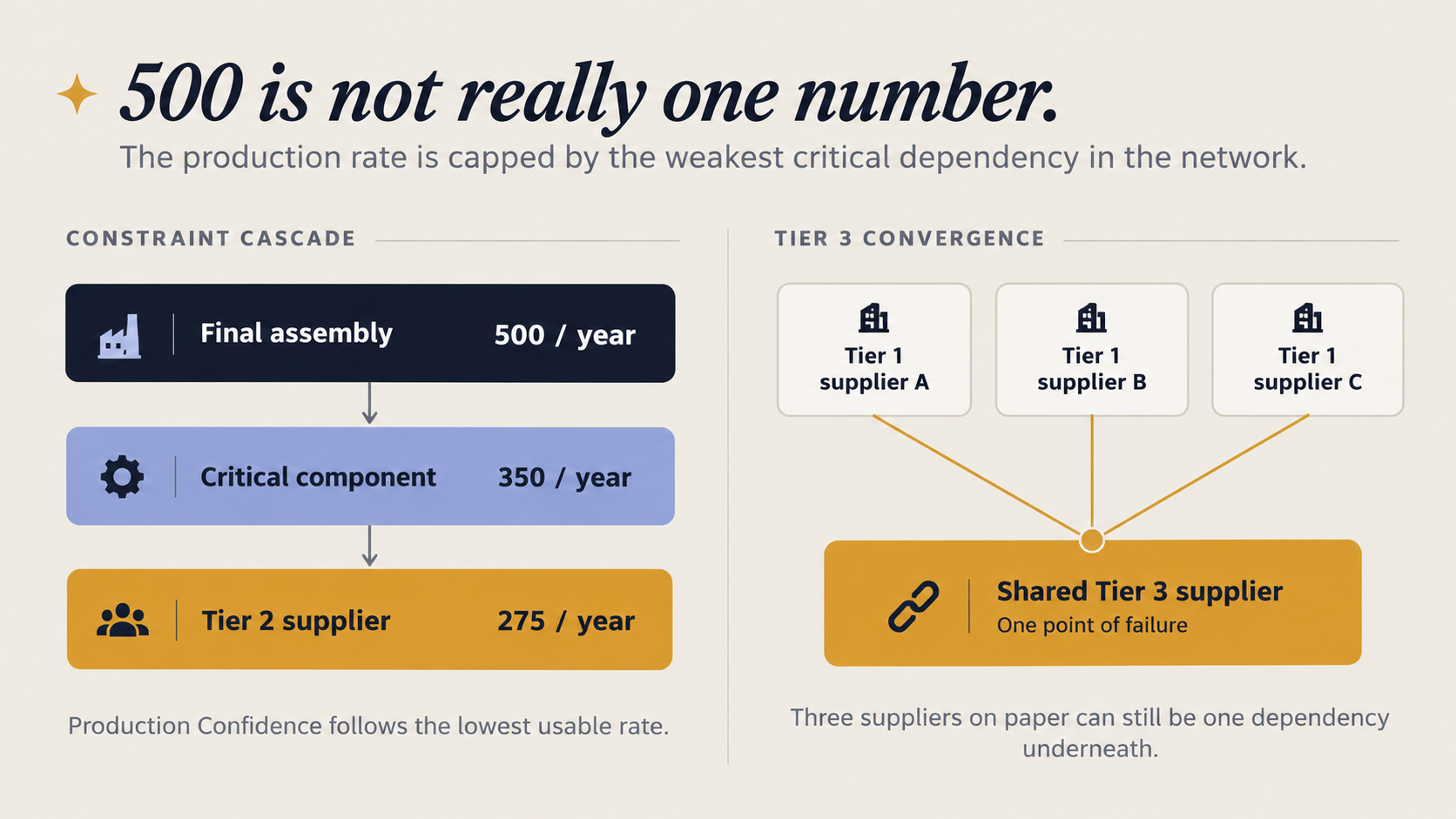 The plan is written at the top of the network. The ceiling is set at the bottom, and it is usually set by a company that does not appear on the program dashboard.
Where do production constraints actually start?
Production constraints usually start several tiers below the prime, at a supplier that represents almost none of the government’s direct spend. Most organizations know Tier 1. They have contracts, supplier scorecards, procurement systems and program reviews. The disruption that ultimately affects production can begin much farther down: a foundry, a specialty chemical producer, a casting operation, a machine manufacturer, a logistics provider, a processor or a raw material.
We wrote about this failure pattern in The Delay You Never Saw Coming Was Never About Your Tier 1 Supplier. The missile industrial base offers one of the clearest current examples.
Solid rocket motors show the pattern in practice. Deloitte notes that solid rocket motors are critical for munitions like the Standard Missile family, that the supplier base has consolidated, and that energetics capacity is constrained. Underneath those motors, the dependency gets narrower still:
- One domestic source for a key propellant ingredient. Govini analysis reported by Breaking Defense identifies American Pacific Corporation (AMPAC) as the only US-based source of ammonium perchlorate, creating a single point of failure in the missile supply chain.
- Shared sub-tier suppliers across “competing” primes. The same analysis found both domestic solid rocket motor producers, Northrop Grumman and L3Harris, are tied to a handful of shared suppliers, so a disruption at one of them could cripple the capacity of the entire solid rocket motor enterprise.
- Limited visibility below Tier 1. War on the Rocks reports that 84 percent of primes have no visibility beyond their Tier 1 supplier, and a June 2026 CSIS study of solid rocket motors cites the Department’s own lack of visibility into sub-tier supply chains as a core challenge.
The government is already acting on this. In January 2026 the Department of War announced a $1 billion direct-to-supplier investment in the solid rocket motor supply chain, a sign that the constraint is understood to sit below the prime.
That is why supplier importance cannot be measured only by spend. The better question is: what stops working without it?
How far down the supply chain should you look?
Follow the dependency chain until the credible alternatives disappear, because those final nodes are where Production Confidence is won or lost. We explored this method in Follow the Supply Chain Until the Alternatives Disappear and in Your Supplier Map Probably Stops Two Tiers Too Early.
Start with the mission requirement, then trace each layer beneath it:
- Mission requirement
- Platform
- Critical system
- Subsystem
- Tier 1 supplier
- Tier 2 supplier
- Tier 3 supplier
- Specialized material or process
At every level, ask one question: if this disappears, what is the alternate path? The answers usually fall into one of five patterns.
| What you find | What it means for Production Confidence |
| Five qualified alternatives | Low concentration. Monitor normally. |
| Two qualified alternatives | Moderate concentration. Check whether both share the same inputs underneath. |
| An alternative exists but cannot produce enough | Technical substitute, not a volume substitute. The rate is still capped. |
| An alternative could produce enough but needs three years to qualify | A future option, not a current one. |
| No alternative inside the decision window that matters | A non-substitutable dependency. This node deserves disproportionate attention. |
The last row is where we focus first. An alternative that exists on paper but cannot reach usable production before the mission requirement does is not an alternative at all.
What signals determine Production Confidence?
Production Confidence depends on nine categories of external signals that show whether a supplier’s ability to support the required output is strengthening or weakening. This is where Production Confidence becomes Decision Intelligence rather than supply chain mapping. Knowing that a supplier exists is not enough. A decision maker needs to know which direction it is moving.
| Signal category | What to watch | Why it matters |
| Capacity | New equipment, plant expansions, additional facilities, added shifts, production hiring, automation, throughput, or quiet reductions | Shows whether usable output is growing or shrinking |
| Demand | Major new contracts, commercial markets competing for the same material or process, other defense programs drawing on the same resource | A healthy supplier can still become a constraint because someone else bought the capacity first |
| Capital | Secured financing, delayed expansions, capital redirected to other priorities | A purchase order does not create capacity. Someone has to fund the equipment, facilities and people |
| Workforce | Specialized engineering hires, skilled positions staying open longer, rising turnover, second or third shifts | Physical capacity without the people to run it is not usable capacity |
| Financial health | Profitability, liquidity, rising debt, slow customer payments, restructuring, ownership change | A critical supplier can become a program risk long before it misses a delivery |
| Materials | Dependence on specialty metals, rare earths, chemicals, energetics, semiconductors, castings and forgings, and where those come from | This is where Tier 2 becomes Tier 3 and Tier 3 becomes Tier 4 |
| Geography and logistics | Production concentration, critical ports, shipping lanes, countries, regulatory regimes, energy sources, single facilities | Two suppliers in different states may depend on the same overseas processor |
| Quality and qualification | Whether an alternate meets the requirement, testing needed, redesign risk, time to usable production | An alternative that takes four years to qualify is not an alternative when the requirement is next year |
| Leadership and ownership | CEO changes, acquisitions, private equity investment priorities, divestitures, departures of key technical leaders | Ordinary corporate events can matter enormously inside a critical dependency network |
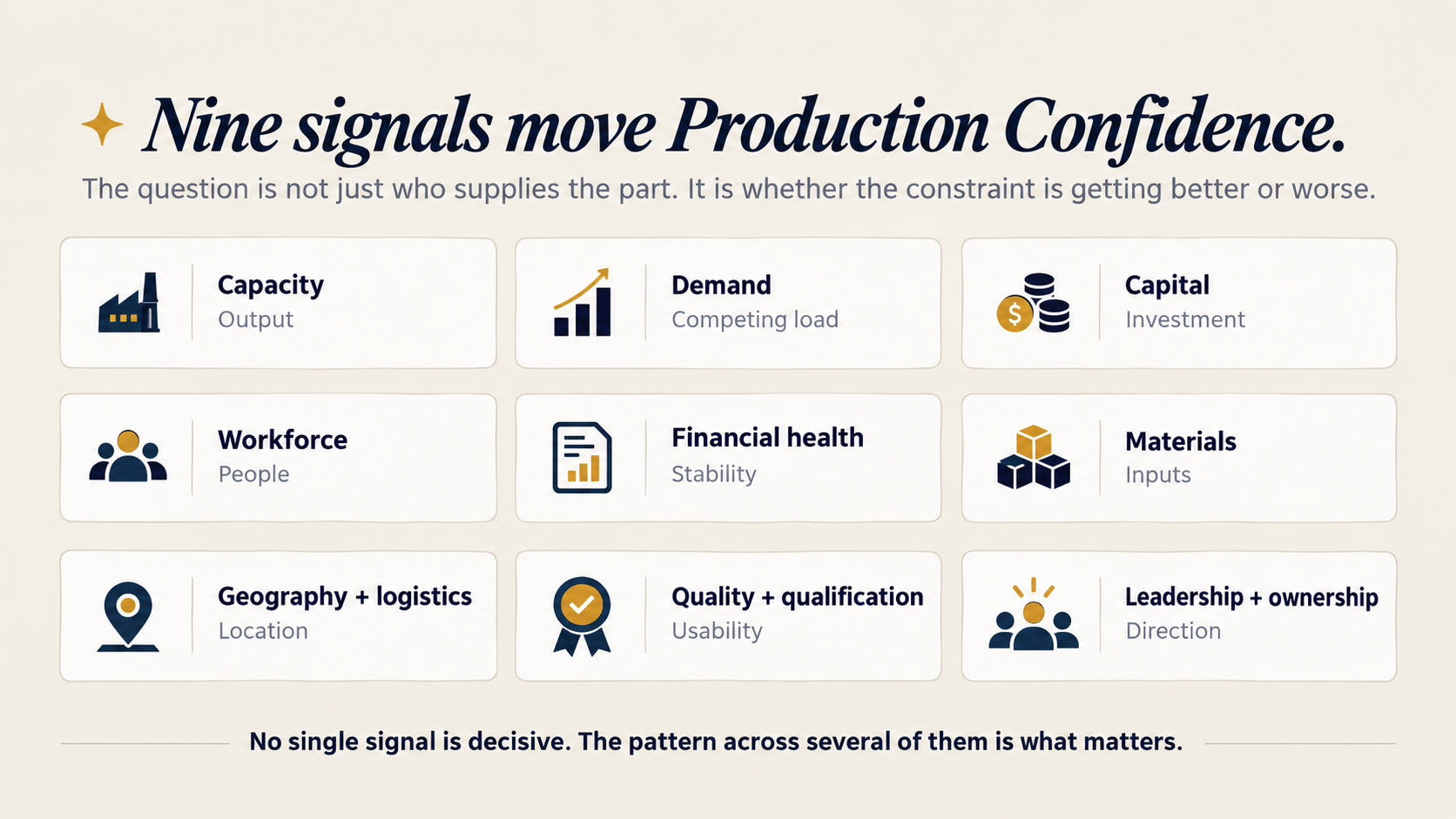 No single signal is decisive. A Tier 3 supplier that wins a large commercial contract, loses two experienced technicians and delays a planned expansion is telling you something none of those events would tell you alone. That is the pattern Polaris I/O is built to detect, moving from Signal Monitoring to the Pattern Engine to Decision Activation. We covered why the metrics most organizations track miss this in The Real Metric is the One Nobody is Tracking Yet.
What can you do when a supplier cannot support the rate?
Once a constraint is visible, Decision Intelligence shifts the question from “what is at risk?” to “what can we do about it?” and ranks the interventions by cost, speed and how much they change the outcome. Suppose the analysis identifies a critical Tier 3 supplier that can produce only 60 percent of the output the production plan requires. The options escalate in commitment and time:
- Monitor. Watch the signals that would show the constraint getting better or worse.
- Reserve capacity. Lock in the supplier’s available output before another program takes it.
- Increase inventory. Buy time with buffer stock of the constrained input.
- Fund additional capacity. Pay for equipment, tooling or shifts the supplier cannot finance alone.
- Qualify another supplier. Start the qualification clock on a second source now.
- Partner. Form a joint arrangement that shares the cost of expansion.
- Invest. Take an equity or financing position in the supplier.
- Acquire. Bring the capability in house.
- Redesign the dependency. Change the design so a different input or process can do the job.
- Eliminate it. Remove the dependency from the system entirely.
The government is already working several rungs of this ladder at once. The $1 billion solid rocket motor investment sits at rung four. Small businesses like Helicon Chemical Company, which is trying to become a second supplier of a binding component used in most solid rocket motors, represent rung five.
The right answer depends on the constraint and on how much time remains. That is the question we explored as Intervention Intelligence in Follow the Supply Chain Until the Alternatives Disappear: where would the next dollar of investment most increase mission resilience?
But the ladder above assumes the answer lies inside the current supply chain. There is another possibility.
What is Latent Capability Discovery?
Latent Capability Discovery is the practice of finding production capability, feedstock or process know-how that exists outside today’s approved supplier base and could be activated to relieve a constraint. Your next supplier may not be a supplier yet.
The energy transition is already demonstrating the idea. Critical materials do not have to come only from the supply chains that produced them yesterday:
- Old batteries can become sources of lithium, nickel, cobalt and copper.
- Retired electrical infrastructure can become a source of copper and other metals.
- Solar panels can become a source of silver and silicon.
- Materials that sat at the end of one product lifecycle can become feedstock for the next.
Policy is moving in the same direction. The GAO found that mature battery recycling technologies offer a pathway to reduce imports of copper, cobalt, lithium and nickel within 2 to 3 years, though it also notes that recyclers currently lack capacity. The FY 2026 NDAA added an exception for recycled material within defense sourcing restrictions to encourage recycling as a way to diversify supply. The Department of Energy opened $500 million in funding that includes recovery of battery minerals from manufacturing scrap and end-of-life batteries.
The pattern extends well beyond materials. Instead of asking only “who supplies this today?” we can ask “where else could this capability come from?” That is a fundamentally different search:
- A company that is not an approved supplier may have adjacent manufacturing capability.
- A recycler may hold feedstock.
- A commercial manufacturer may have equipment applicable to a defense requirement.
- A facility producing one component may have the machinery and workforce to produce another.
- A material substitution may remove the dependency altogether.
Propulsion offers a live example. Ursa Major, a company outside the traditional solid rocket motor duopoly, is working to become an independent propulsion supplier, including on a motor that powers portions of the Standard Missile portfolio. We made the broader case in The Next Defense Supplier May Not Be a Defense Supplier and The Capability You Need Already Exists. You Just Cannot See It.
How is potential supply different from current supply?
Current supply is what the network produces today. Potential supply is what the network could produce if the right capability were found and activated in time. Resilience needs both, mapped from the same mission requirement.
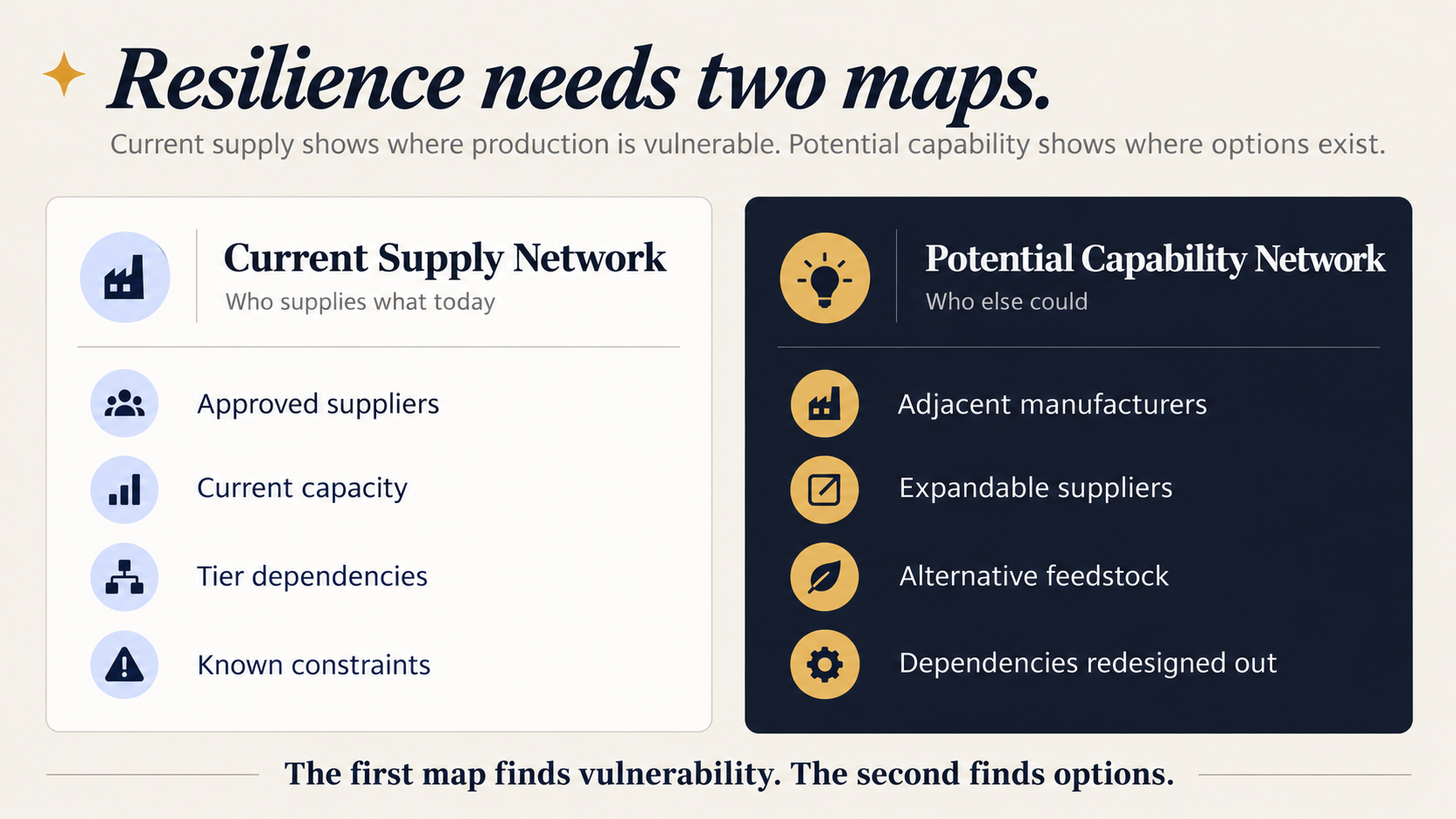 The Current Supply Network answers who supplies what, where, at what capacity, through which tiers and with which dependencies. That map is essential. It shows where you are exposed.
The Potential Capability Network answers who else could. It covers adjacent manufacturers with relevant equipment, facilities with similar processes, commercial companies with transferable capability, recyclers that could create another source of critical material, suppliers that could expand, capabilities that could be activated with capital, and dependencies that could be redesigned out.
The second map is not theoretical. When Lockheed Martin needed more housing components for PAC-3 MSE Patriot interceptors, GM Defense delivered its first shipment 22 days after the agreement was signed. GM already had the plants, the precision fabrication and the engineers. Someone connected an existing capability to a new mission.
Now the conversation changes. We are no longer simply identifying vulnerability. We are identifying options.
Why is Production Confidence a living number?
Production Confidence changes every time the industrial network changes, which is why it cannot live in a quarterly supplier review. A production plan may say 500 missiles per year. Production Confidence should continuously ask:
- How much output can the industrial network support today?
- What is the weakest critical dependency?
- How concentrated is it?
- What else competes for the same capacity?
- How long would an alternative take to activate?
- What signals suggest the constraint is getting better or worse?
- How much time remains to change the outcome?
That number moves as the world moves.
| Event | Effect on Production Confidence |
| A supplier expands capacity | Increases |
| A Tier 3 supplier wins another large contract | Changes, often down |
| A critical material becomes constrained | Changes, often down |
| A second source qualifies | Increases |
| A facility closes | Decreases |
The underlying system moves every day. A supplier review that runs once a quarter will always be describing a network that no longer exists. We laid out why this speed problem matters in Moving as Fast as the World Outside.
The contract is the beginning, not the answer
A $24.4 billion contract creates demand, certainty and a reason to invest, but it does not manufacture a missile. Factories do. So do machines, people, materials, and the suppliers beneath those suppliers.
The real question after a major production award should not simply be “how many did we buy?” It should be three questions, asked in order:
- How confident are we that the entire industrial network can produce them?
- What is preventing that confidence from being higher?
- What can we do about it while there is still time?
That is Production Confidence. And that is where supply chain visibility becomes Decision Intelligence.
See how Polaris I/O measures Production Confidence across every tier of your industrial network. Explore Supply Chain Risk solutions, see our work in Defense, Intelligence, and National Security, or schedule a demo.
Frequently asked questions
What is Production Confidence?
Production Confidence measures whether the industrial network underneath a contract can produce the required output, at the required rate, in the required time. It is measured across every critical tier of the supply chain, not just the prime contractor, and it is set by the weakest critical dependency in that network.
How much is the Navy’s SM-6 contract worth?
The US Navy awarded Raytheon, an RTX business, a multiyear contract worth up to $24.4 billion on October 1, 2026, to produce Standard Missile 6 interceptors. It covers a five-year base period with two option years, and the related production frameworks target more than 500 missiles a year.
Why can a small sub-tier supplier limit missile production?
A missile depends on propulsion, guidance, energetics, specialized metals and thousands of components. If one critical input, such as a propellant ingredient with a single domestic source, can only support a lower rate, the whole program is capped at that rate regardless of how much final assembly capacity the prime builds.
What signals indicate a supplier is becoming a production constraint?
The most useful signals fall into nine categories: capacity, demand, capital, workforce, financial health, materials, geography and logistics, quality and qualification, and leadership and ownership. No single signal is decisive. Patterns across several of them, such as a new competing contract plus unfilled skilled positions plus a delayed expansion, are what reveal a tightening constraint.
What is Latent Capability Discovery?
Latent Capability Discovery is the practice of finding production capability, feedstock or process know-how outside the approved supplier base that could be activated to relieve a constraint. Examples include commercial manufacturers with transferable equipment, recyclers holding critical material feedstock, and suppliers that could expand with capital.
What is the difference between the Current Supply Network and the Potential Capability Network?
The Current Supply Network shows who supplies what today, where, at what capacity and through which tiers. The Potential Capability Network shows who else could, including adjacent manufacturers, recyclers, expandable suppliers and dependencies that could be redesigned out. The first map identifies vulnerability. The second identifies options.
How does Polaris I/O help measure Production Confidence?
Polaris I/O continuously monitors the external signals around a production network, connects related developments across suppliers and tiers through its Pattern Engine, and uses Decision Activation to surface where intervention would most change the outcome while there is still time to act.
Sources
Reuters via NTD, US Navy Awards RTX’s Raytheon $24.4 Billion Contract for Standard Missile 6 Amid Stockpile Concerns, October 1, 2026
Baird Maritime, US Navy Awards $24b Multiyear Contract for Expanded SM-6 Missile Production, October 2026
ANI via The Tribune, US Navy Awards $24.4 Billion to Accelerate Production of Standard Missile 6, October 2, 2026
Rallies, US Navy Awards Raytheon $24.4 Billion Contract for Standard Missile 6, October 1, 2026
Deloitte Insights, Throughput, Not Just Innovation, May Define the Future of US Defense Manufacturing, 2026
Breaking Defense, With the Boom for Solid Rocket Motors for Missiles, a Perilous Crunch in the Supply Chain, January 2026
War on the Rocks, The Primes Aren’t the Real Bottleneck in US Weapons Production, 2026
CSIS, Solid Rocket Motors for Missile Defense, June 2026
US GAO, Critical Minerals: Reducing US Import Reliance with Substitution and Recycling Technologies, 2026
Pillsbury, FY 2026 NDAA Expands Sourcing Restrictions for Critical Minerals and Batteries, 2026
US Department of Energy, Energy Department Announces $500 Million to Strengthen Domestic Critical Materials Processing and Manufacturing, March 13, 2026
Defense Tech Signals, Ursa Major and the Real Solid Rocket Motor Bottleneck, 2026

Related Posts
Nothing found.