In short: Demand for U.S. defense production is no longer in question. The backlog is approaching $900 billion. What is in question, according to a May 2026 Oliver Wyman survey of more than 160 defense manufacturers, is whether the industrial base can actually build against that backlog.
Forty-five percent of respondents said doubling production would take more than a year or would not be feasible without significant new investment. The gap isn’t demand. It’s knowing where capacity really exists, what is constraining it, and which intervention would change the outcome. That is what Polaris I/O calls Capacity Intelligence.
For years, the defense industry worried about whether demand would materialize. That question has largely been answered. Defense spending is rising, munitions need replenishment, and production rates must increase across a supply chain that was built for peacetime and is now being asked to operate at something closer to wartime speed.
Oliver Wyman’s research, published in July 2026, points to a more uncomfortable question underneath all of that demand: knowing that demand exists does not mean knowing whether the industrial base can deliver it.
So what does the research actually say?
Oliver Wyman surveyed more than 160 U.S. defense companies, including prime contractors, Tier 1 suppliers, and companies deeper in the supply chain. Its conclusion: the industrial base is not currently prepared for the production ramp being asked of it, and 45 percent of respondents said doubling production would take more than a year or would not be feasible without significant investment. Among primes and OEMs specifically, many expected the process to take 13 to 24 months or longer.
The problem isn’t money, and it isn’t simply orders. It’s understanding capacity itself: where it exists, where it can expand, how quickly, what is preventing that expansion, and what dependency sits underneath the constraint.
Now what: A $900 billion backlog is not automatically a strength. It’s an obligation. Something eventually has to get built, and treating backlog as a revenue guarantee rather than a delivery risk is the first mistake worth correcting.
Why is production capacity so hard to move quickly?
Production capacity is not a switch. It’s an ecosystem. Increasing the output of a missile, aircraft component, or weapons system can require specialized tooling, additional machines, cleared labor, certified operators, more material, additional suppliers, quality approvals, engineering changes, capital investment, and sub-tier capacity, often all at once.
A prime contractor may say it’s ready to ramp. A Tier 1 supplier may say it can support the increase. But a specialized company three levels down the supply chain may have one machine, one qualified operator, and a 20-month lead time for the equipment required to add another production cell. That supplier rarely shows up on an executive dashboard. Until it stops the program.
Now what: Ramp readiness has to be assessed below the Tier 1 level, not just confirmed at it. If your visibility ends at your direct suppliers, you are missing the point in the chain most likely to break first.
What is the “hollow middle” in the defense supply chain?
Oliver Wyman’s research identifies what it calls the hollow middle: Tier 2 and deeper suppliers that often have the least financial, operational, and digital capacity to absorb sudden growth. Seventy-nine percent of Tier 2+ respondents cited workforce barriers, and 61 percent cited tooling barriers. These suppliers also showed meaningfully less financial resilience and far less multi-sourcing than primes and Tier 1 companies.
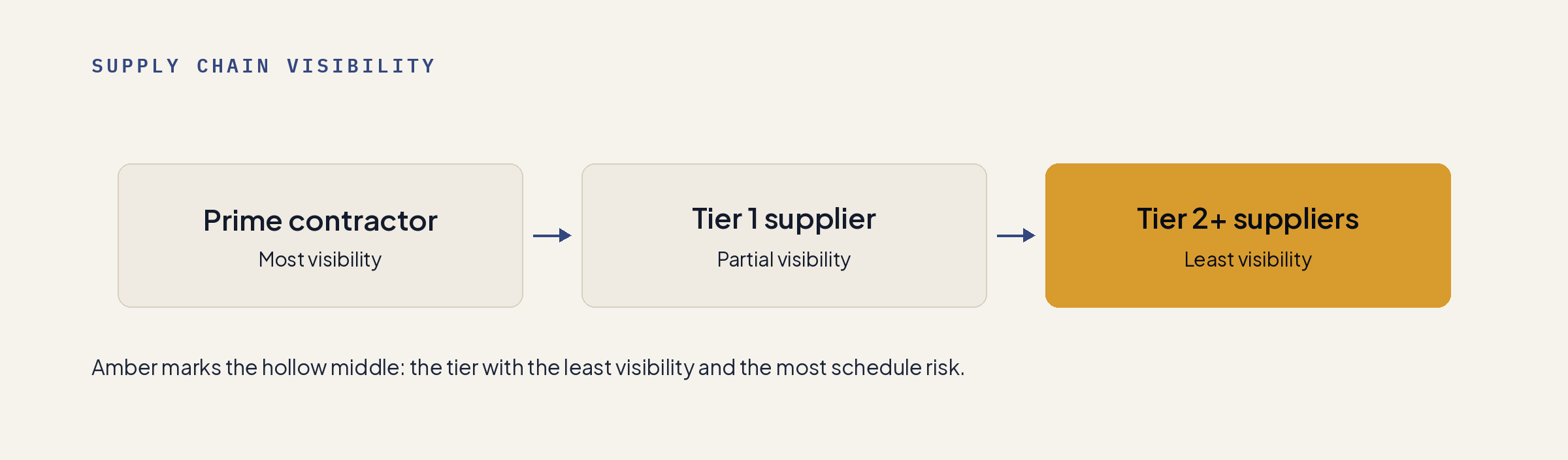 That creates a real paradox: the companies with the greatest ability to disrupt production are often the companies receiving the least strategic attention, because traditional supply chain management tends to organize visibility around spend rather than mission risk. A supplier responsible for a $40,000 specialized component can stop delivery of a multimillion-dollar weapons platform just as easily as a major Tier 1 can.
Oliver Wyman argues the industry should instead map suppliers around schedule criticality, substitutability, qualification lead time, ramp risk, tooling limitations, workforce gaps, material availability, and quality constraints.
Now what: Stop asking “who are our largest suppliers?” Start asking “which supplier can break the mission.” Those are two different maps, and most organizations have only built the first one.
What is the “trust tax,” and why is it slowing everyone down?
Oliver Wyman also identifies a phenomenon it calls the trust tax. Ninety-two percent of respondents reported maintaining at least some reserve capacity because of concerns about sub-tier supplier delivery, and 36 percent reported keeping more than 10 percent reserve capacity.
Economically, that means machines sit partially unused, inventory buffers grow, and working capital gets trapped, because companies are hedging against each other rather than trusting the system around them. Suppliers see enormous demand, but they don’t necessarily know how much of it is truly committed, when it will arrive, or whether it will survive the next funding or program change. Oliver Wyman found that this uncertainty is itself preventing investment: suppliers understand demand is rising without having enough confidence to buy equipment, hire workers, or expand facilities against it.
That produces a self-reinforcing cycle: uncertain demand leads to restrained investment, which constrains capacity, which increases buffers, which erodes trust, which increases uncertainty again.
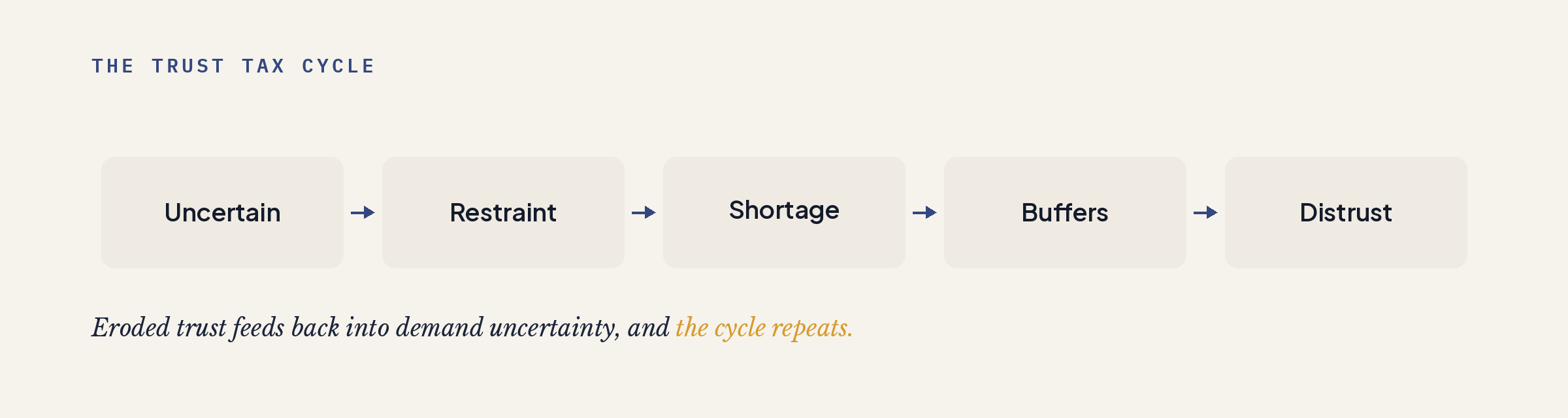 So what: The core problem isn’t visibility. It’s confidence in the intelligence being used to make capacity decisions.
Why isn’t a supplier saying “yes” the same as having capacity?
Imagine asking 40 suppliers whether they can increase production by 30 percent. Thirty-five might say yes. That answer is interesting. It is not intelligence.
The better questions get more specific: What equipment would you need? What is current utilization? How many qualified operators do you have? How quickly could another shift be added? Which of your own suppliers constrains your output? What is the lead time for additional tooling? Which material becomes scarce first? What capital investment is required? What confidence do you actually have in the forecast?
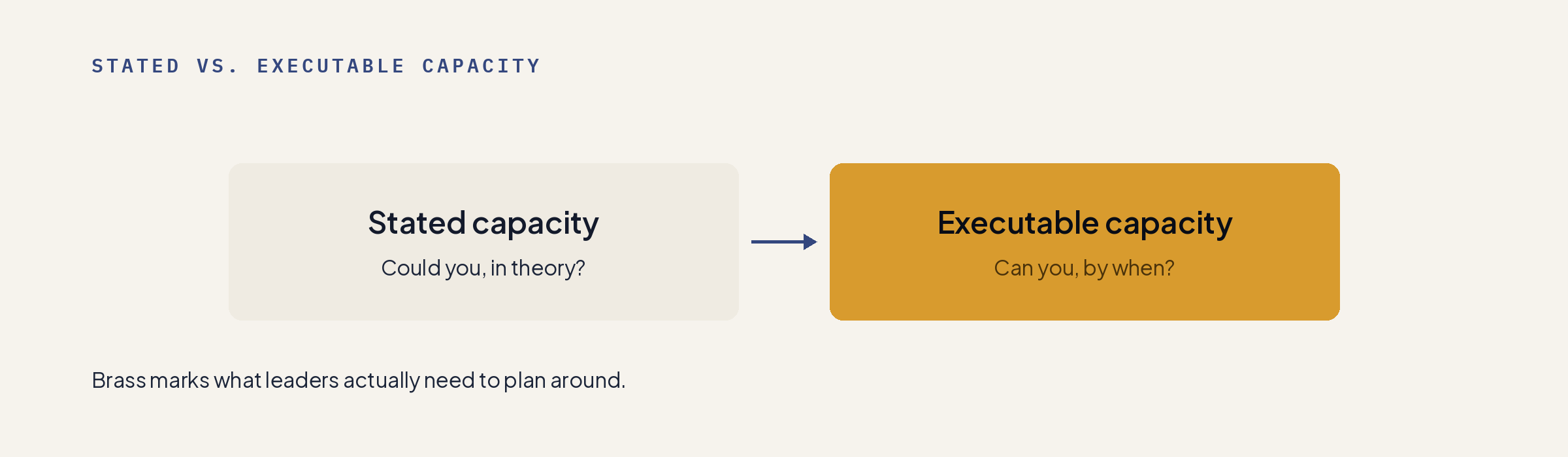
That distinction is the difference between stated capacity, which answers “could you theoretically produce more,” and executable capacity, which answers “can you actually produce more, by when, under what assumptions, and what could stop you.” Executable capacity is the intelligence decision makers actually need.
 What is Capacity Intelligence?
Capacity Intelligence is a continuous, evidence-based view of five questions, applied across every tier of a supply chain rather than just the ones an organization contracts with directly:
What capacity exists? Not published plant capacity, but actual productive capacity based on current utilization, equipment, labor, materials, and competing demand.
What capacity could be created? Could another shift be added, an adjacent manufacturer be qualified, tooling be replicated, or capacity from another program be reallocated?
What is constraining that capacity? Oliver Wyman’s research points to workforce, tooling, financing, sub-tier suppliers, and material availability. Seventy-seven percent of respondents identified specialized long-lead machinery and tooling as a hard constraint, and 71 percent cited shortages of cleared or specialized local labor.
What depends on that constraint? A shortage matters differently depending on what sits downstream, from supplier to component to subsystem to platform to program to mission.
What action changes the outcome? Financing, volume guarantees, qualifying an alternate supplier, funding tooling, workforce investment, a specification change, or reallocating inventory. Without understanding the constraint, even a large intervention can solve the wrong problem.
Can AI solve the production ramp on its own?
No, and Oliver Wyman’s research is direct about this. AI adoption has begun across the industrial base, but remains too uneven to solve the ramp by itself. The firm points to promising applications including digitized work instructions, faster worker training, expert knowledge capture, AI-guided troubleshooting, and copilots for quality, maintenance, and production engineering, all of which can increase output from existing people and assets.
But an AI model cannot eliminate a 20-month tooling lead time. It cannot manufacture a missing specialty material, produce a cleared machinist, or create financial confidence where a supplier doesn’t trust the demand forecast. Sometimes the most useful thing intelligence can tell you is that the AI is not the constraint. That’s why decision intelligence needs to understand the operating environment around the technology, not just the technology itself.
Why does the defense supply chain need an outside-in view?
Most production systems are very good at showing what is happening inside an organization’s own operations: orders, schedules, inventory, supplier commitments, work in progress, delivery performance. Those are essential, but a capacity decision also depends on what is changing outside those systems.
A supplier may be hiring aggressively, losing key executives, raising capital, expanding a facility, receiving government funding, winning another major program, experiencing financial stress, losing skilled workers, facing local permitting delays, being exposed to a material shortage, acquiring another manufacturer, or becoming dependent on a geopolitically vulnerable supplier of its own. No single signal answers the question of whether that company can deliver what you’ll need six months from now. The intelligence comes from connecting them.
I’ve spent the past several years advising private equity firms, operators, and technology platforms on where value gets created or lost inside complex, long-lived contracts and capital deployment decisions, mostly in energy and infrastructure. The pattern I keep running into is the same one Oliver Wyman just documented in defense: the constraint almost never shows up where the money or the headlines are. It shows up two or three tiers down, in a place nobody built a reporting line to. That’s the gap this piece is really about, and it’s why I think this is where Polaris I/O’s approach differs from a supplier database. Polaris I/O monitors the external environments, suppliers, markets, and organizations that matter, connects individual Signals into emerging Patterns, and helps teams understand where change may affect a decision before that change shows up in traditional internal reporting. For defense production, the goal isn’t another dashboard. It’s forming an evidence-backed opinion about where capacity is strengthening, where it’s deteriorating, and where the next constraint is likely to appear. Nothing Gets By You.
What does six months of lead time actually look like?
Scenario A, without Capacity Intelligence: A sub-tier supplier misses a delivery. The prime identifies the delay after production has already slipped. Leadership investigates and learns the supplier’s specialized machine has been running near maximum utilization for nine months and recently lost two experienced technicians. A replacement machine is on order, but it’s 14 months out. Everyone now understands the constraint. Too late to change it.
Scenario B, with Capacity Intelligence: Six months earlier, a set of individually minor signals appears: overtime is rising, specialized machinist openings sit unfilled, capital expenditure isn’t increasing, a second customer announces a similar production ramp, an equipment supplier reports longer lead times, and employee reviews start flagging retention pressure. None of these alone is decisive. Together, they describe a supplier whose demand is approaching its executable capacity faster than that capacity is expanding. Leadership now has time to qualify another supplier, fund tooling, reallocate volume, or invest in workforce training before the platform is at risk.
That is the entire difference between seeing a problem and having enough lead time to change its outcome.
Frequently asked questions
Is the defense industrial base capacity constrained in 2026? Yes. Oliver Wyman’s May 2026 survey of more than 160 U.S. defense companies found that 45 percent of respondents could not double production within a year without significant new investment, and the figure was higher among prime contractors and OEMs specifically.
What is the “hollow middle” in defense manufacturing? It refers to Tier 2 and deeper suppliers, the companies with the least financial, operational, and digital capacity to absorb sudden demand growth, even though they are often the ones capable of stopping a program.
What is the difference between stated capacity and executable capacity? Stated capacity is what a supplier says it could theoretically produce. Executable capacity is what it can actually produce, by when, under what real-world assumptions, and what could realistically stop it.
Can AI fix the defense production ramp problem? AI can improve output from existing people and assets through better training, work instructions, and troubleshooting, but it cannot manufacture missing materials, eliminate multi-year tooling lead times, or replace cleared and certified labor.
The next defense advantage is knowing where the industrial base breaks first
Oliver Wyman’s own conclusion is that orders, funding, and optimism alone will not solve the ramp. The industry needs better forecasting, stronger communication, multi-tier visibility, better constraint management, and higher productivity from the assets and workforce already in place.
I’d add one requirement to that list: decision makers need to know where capacity is likely to fail before the failure shows up in delivery performance. That means moving beyond static supplier records, spend analysis, and periodic capacity surveys, toward an intelligence model that continuously connects signals, suppliers, dependencies, constraints, capacity, mission consequences, and interventions.
The Pentagon’s next problem isn’t finding more demand. The demand is already there. The next problem is determining who can actually build more, what’s preventing everyone else from doing so, and what should happen now, while there’s still time to change the answer.
Let us show you where the gap is in your supply chain.
Leo Sayavedra is a senior advisor working at the intersection of energy, infrastructure, and AI, helping private equity firms, operating companies, and technology platforms originate, structure, and execute high-impact opportunities. He spent more than 20 years in oil and gas operations, engineering, and digital transformation, including 13 years at Halliburton, where he led global consulting and project management for mature field revitalization and digital oilfield technology. He holds an MBA in International Business from Georgetown University’s McDonough School of Business and a degree in Mechanical Engineering from the University of Texas at Austin.
Sources: Oliver Wyman, “US defense supply chain: 6 reasons it is falling behind,” July 2026, https://www.oliverwyman.com/our-expertise/insights/2026/jul/us-defense-industrial-base-production-ramp.html. Additional reporting via Inside Defense, “U.S. defense supply chain unready for $900B backlog,” https://insidedefense.com/share/228258.