Polaris I/O connects related Signals and supporting evidence over time—revealing the larger risks, opportunities, market shifts, and operational issues taking shape.
See the bigger story
Individual signals rarely tell the whole story.
Important developments often appear as disconnected events across different sources and timeframes. Polaris I/O connects that evidence so teams can understand the larger situation developing beneath the surface.
Persistent Intelligence
No signal is treated as an isolated event.
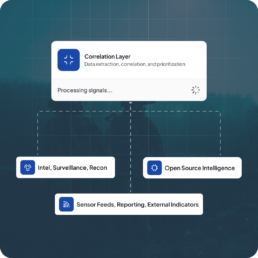
The Polaris I/O Pattern Engine connects new and historical Signals into evolving narratives. It preserves the context, entities, relationships, and evidence behind the Pattern as the situation develops.

Connect Related Evidence
Bring together Signals associated with shared entities, topics, relationships, and timeframes.

Preserve Context Over Time
Evaluate new developments alongside previous activity rather than starting over with every event.

Strengthen the Narrative
Include supporting evidence that may appear insignificant alone but becomes meaningful within the larger Pattern.
Track Meaningful Change
See whether a development is gaining momentum or losing strength.
Polaris I/O tracks how Patterns evolve as new evidence appears, helping teams understand whether a situation is emerging, accelerating, holding steady, or fading.
- Emerging: Early evidence suggests a larger development may be forming.
- Accelerating: Related evidence is increasing in frequency, relevance, or strength.
- Steady: The Pattern remains active, but its momentum is relatively stable.
- Fading: New evidence is slowing or no longer reinforcing the Pattern
Explainable Intelligence
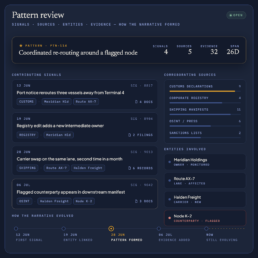
Every Pattern remains connected to the evidence behind it.
Teams can review the Signals, sources, entities, and supporting evidence contributing to a Pattern—providing visibility into how the narrative formed and how it continues to evolve.
Tangible Outcomes
Understand the larger development behind the evidence.
See the complete story
Connect related events instead of interpreting every Signal independently.
Recognize momentum earlier
Identify when a risk, opportunity, or strategic shift is beginning to take shape.

Focus deeper analysis
Understand which Patterns deserve closer review or advancement into Decision Support.
Built for Multiple Intelligence Needs
Reveal the patterns affecting the areas that matter most.
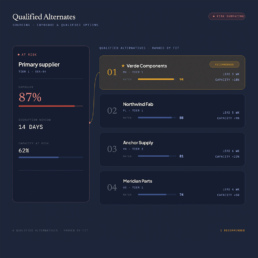
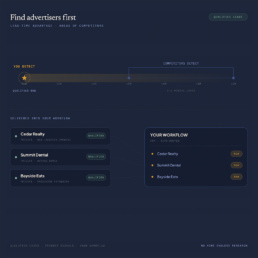
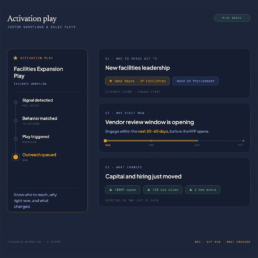
We were able to get in front of key individuals as a result of Polaris I/O's recommendations.
Amanda McBride, Vice President, Global Revenue Office

Polaris I/O has streamlined our access to key industry data, helping us make faster, smarter decisions.
Leslie Lagan, Sr Director, Fraud Management

Pattern Engine FAQs
A Pattern is an evolving narrative formed by connecting related Signals and supporting evidence over time.
A Signal represents an individual development or piece of evidence. A Pattern connects related Signals to reveal the larger situation taking shape.
Persistent memory allows Polaris I/O to connect new activity with historical evidence so events are not evaluated in isolation.
Yes. It can consider supporting “watch” evidence that may not be strong enough to qualify as a standalone Signal but may strengthen a larger Pattern.
Polaris I/O evaluates new Signals and supporting evidence against the Pattern’s existing history, preserving one continuous narrative as the situation changes. Patterns move through lifecycle states—including emerging, accelerating, steady, fading, gone, and archived—so teams can see whether momentum is building, holding, weakening, or no longer active. Related Patterns can also be merged when they are determined to represent the same underlying development.
Yes. Patterns remain connected to their contributing Signals, sources, entities, and supporting evidence.
The Next Layer
Patterns reveal the story. Decision Activation helps your team respond.
When a Pattern becomes relevant and ready for action, Polaris I/O helps teams prioritize the situation, evaluate its implications, and develop the appropriate response.