Why the most important dependency in a mission, market, or supply chain may sit several layers below the company everyone is watching.
In short: When a critical input, whether a raw material like tungsten or a machine like ASML’s EUV lithography systems, has no viable substitute inside the decision window that matters, ordinary supplier monitoring is not enough. Organizations need to measure Dependency Power, trace Dependency Depth, and calculate Days of Mission Coverage to know where a single point of failure could take down a mission, a program, or a market position, and where intervention would matter most.
Two stories this week illustrate the same problem from opposite directions.
The U.S. government awarded roughly $2 billion to help rebuild America’s tungsten stockpile and strengthen the domestic tungsten supply chain.
At almost exactly the same time, the global semiconductor industry is increasingly committing to the next generation of machines from ASML, whose current EUV technology already occupies one of the most extraordinary positions in modern industrial supply chains.
One is a raw material. The other is a machine costing hundreds of millions of dollars. Both raise the same question:
What happens when something the entire system depends upon has very few viable alternatives?
That is a different kind of supply chain risk. And it may be one of the most important forms of strategic intelligence an organization can build.
A stockpile is not really measured in tons
The Defense Logistics Agency has awarded an Elmet Group subsidiary a contract worth approximately $2 billion to support reconstruction of the National Defense Stockpile and strengthen the U.S. tungsten supply chain.
Tungsten matters because of what sits above it. Its extreme hardness, density, and heat resistance make it critical across defense and advanced industrial applications.
So the strategic question is not simply:
How many tons of tungsten do we have?
It is:
How much mission capability does that tungsten protect, for how long, under the conditions that actually matter?
Answering that requires connecting information that traditionally lives in different places: inventory, normal consumption, surge consumption, domestic production, processing capacity, import dependency, supplier concentration, alternative materials, replenishment time, and the programs that depend on the material.
Connect all of it and a static number like 12,000 tons available turns into something a decision maker can actually act on: at projected surge consumption, available supply provides X months of protection for these priority programs before replenishment becomes the constraint.
That is not inventory reporting. That is Decision Intelligence.
The question underneath the supplier question
A few days ago, we wrote about Capability Intelligence in Technology Is Not Capability. Capability Is a System. and argued that technology alone does not create capability.
A missile is not simply a missile. A semiconductor is not simply a semiconductor. A jet engine is not simply an engine. Each depends on a network of technology, suppliers, materials, people, capital, facilities, logistics, and specialized know-how.
The natural next question is:
How far down that network do you have to go before the alternatives disappear?
That is where today’s ASML story becomes interesting.
The most important AI company may not make AI
ASML does not build AI models. It does not operate hyperscale data centers. It does not manufacture Nvidia GPUs.
But it produces one of the machines without which the most advanced semiconductors cannot be manufactured at scale.
ASML’s existing EUV systems cost roughly $200 million each and are essentially sold out through 2027. Its next-generation High Numerical Aperture systems cost approximately $400 million each and can print features around 40% smaller than conventional EUV systems.
TSMC, Samsung, SK Hynix, and Intel are all moving toward the technology. JPMorgan estimates ASML held approximately 94% of the lithography market in 2025, and no competitor currently offers a commercially viable alternative to ASML’s EUV technology.
Think about what that means. Start with AI. Follow the chain.
AI models → Compute → GPUs → Advanced semiconductors → Leading-edge fabs → EUV lithography → ASML
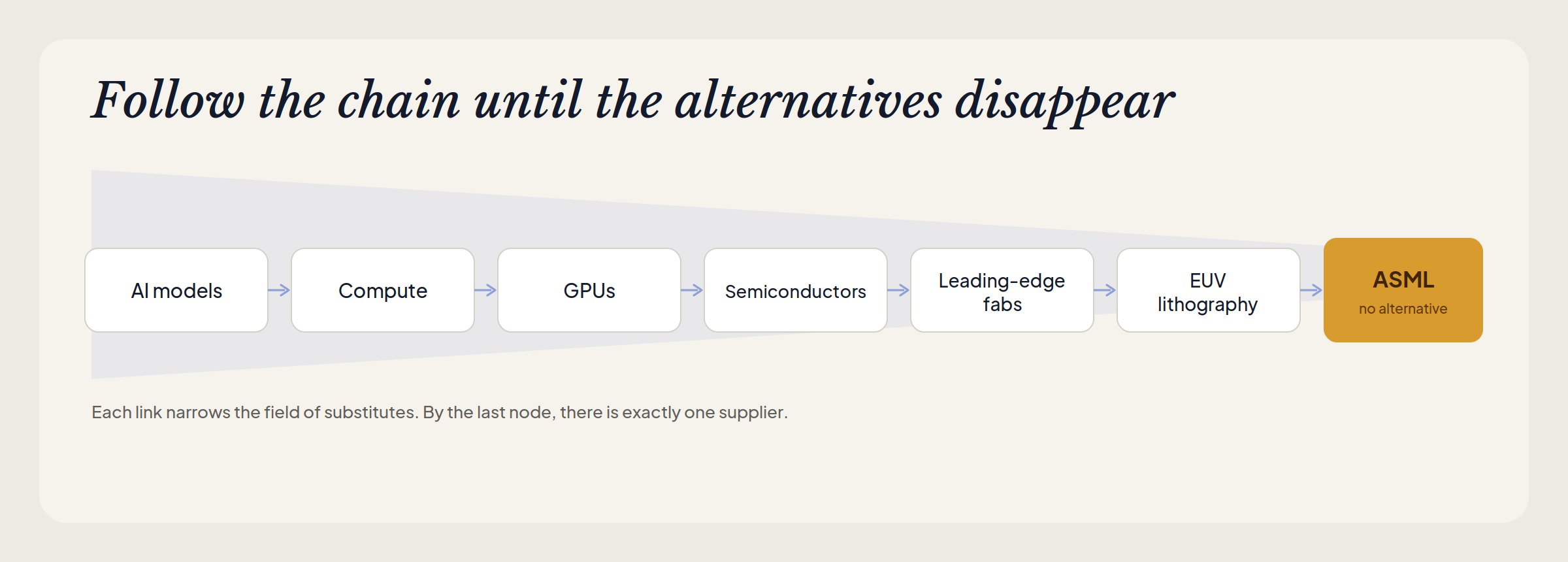 Eventually, you arrive at a point where the alternatives largely disappear. That node deserves a very different level of attention than an ordinary supplier.
Dependency Power
We have been thinking about this at Polaris I/O as Dependency Power.
Not every dependency matters equally. A supplier becomes strategically powerful when several conditions converge:
Criticality. How important is it to the ultimate outcome?
Concentration. How few alternatives exist?
Replacement time. How long would substitution or qualification take?
Capacity. Could alternatives actually absorb the required volume?
Downstream consequence. How much capability disappears if this node fails?
A supplier representing 1% of spend can therefore create more strategic exposure than one representing 20%. That leads to a simple principle:
Do not rank suppliers only by how much you spend with them. Rank them by what stops working without them.
We saw exactly this dynamic recently when GE Aerospace agreed to pay nearly $12 billion for Consolidated Precision Products, acquiring greater control over a specialized precision casting capability that has constrained jet engine production. We explored that broader system in Technology Is Not Capability. Capability Is a System.
But there is another dimension we need to understand.
Dependency Depth
Knowing that Nvidia depends on TSMC is useful. But it is incomplete.
Who does TSMC depend on? Who do those companies depend on? Where do those dependencies converge? And where does the ability to substitute disappear?
That is Dependency Depth.
Imagine a mission dependency map:
Mission → Capability → Platform → Critical subsystem → Component → Tier 1 supplier → Tier 2 supplier → Specialized material → Processing capability
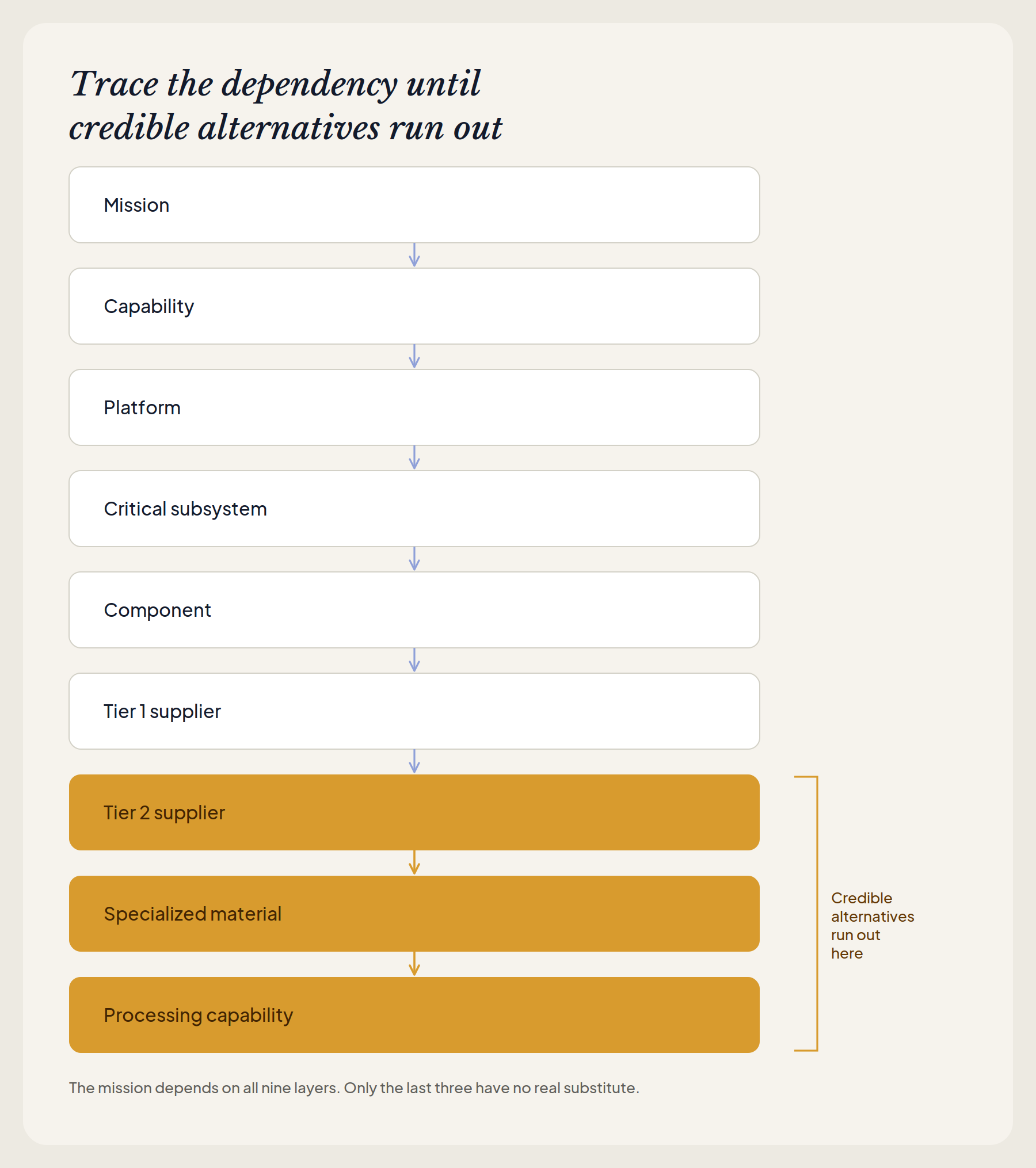 At each layer, ask:
If this disappears, what is the alternate path?
Sometimes there are five. Sometimes there are two. Sometimes there is effectively none. Those final nodes deserve disproportionate attention, which is exactly the blind spot we unpacked in The Delay You Never Saw Coming Was Never About Your Tier 1 Supplier and in Your Supplier Map Probably Stops Two Tiers Too Early. Here’s How to Tell.
Non-Substitutable Dependencies
This suggests a category that should matter enormously to executives and government leaders: Non-Substitutable Dependencies.
A dependency becomes strategically different when there is no credible alternative inside the decision window that matters. Notice the importance of those last four words.
An alternative that can be qualified in four years is not necessarily an alternative when the mission requirement exists next year. A second supplier producing 5% of required volume is not a true alternative to a supplier producing 70%. An alternate material requiring a complete product redesign may technically exist while being operationally irrelevant.
So substitutability needs to account for alternative sources, available capacity, qualification time, switching cost, technical equivalence, geographic correlation, and time to usable supply.
The answer is not simply:
Supplier B exists.
The question is:
Can Supplier B replace Supplier A in the time and quantity required to protect the outcome?
That distinction changes risk dramatically.
Why supply chain mapping alone is not enough
Most large organizations have enormous amounts of supply chain information: ERP systems, procurement systems, supplier databases, risk feeds, contracts, news alerts, commodity data, and third-party reports.
The problem is increasingly not access to information. As we wrote in Moving as Fast as the World Outside: Why Supply Chain Resilience Requires External Foresight, the harder problem is determining which signals matter, how they connect, where exposure exists, and whether enough time remains to change the outcome. The Real Metric is the One Nobody is Tracking Yet digs further into why the metrics most organizations track are not the ones that predict failure.
A conventional supplier map might tell you:
Here are 2,000 suppliers.
A Decision Intelligence system should help answer:
Which ten dependencies could disproportionately change the outcome?
That is a radically different question.
From supplier visibility to mission coverage
Return to tungsten. Knowing the supplier network is useful. Knowing inventory is useful. Knowing geopolitical exposure is useful. But a mission leader ultimately needs something simpler:
How long are we protected?
That suggests another way to think about strategic materials: Days of Mission Coverage.
Connect available supply, expected production, and reliable imports against normal demand and surge demand. Then connect that material to the programs and capabilities depending upon it. Now leadership can understand not simply whether a material is “critical,” but the timing of the exposure.
For example:
| Scenario | Coverage |
|---|---|
| Normal environment | 28 months |
| Two-source disruption | 14 months |
| Surge production | 9 months |
| Surge plus import disruption | 5 months |
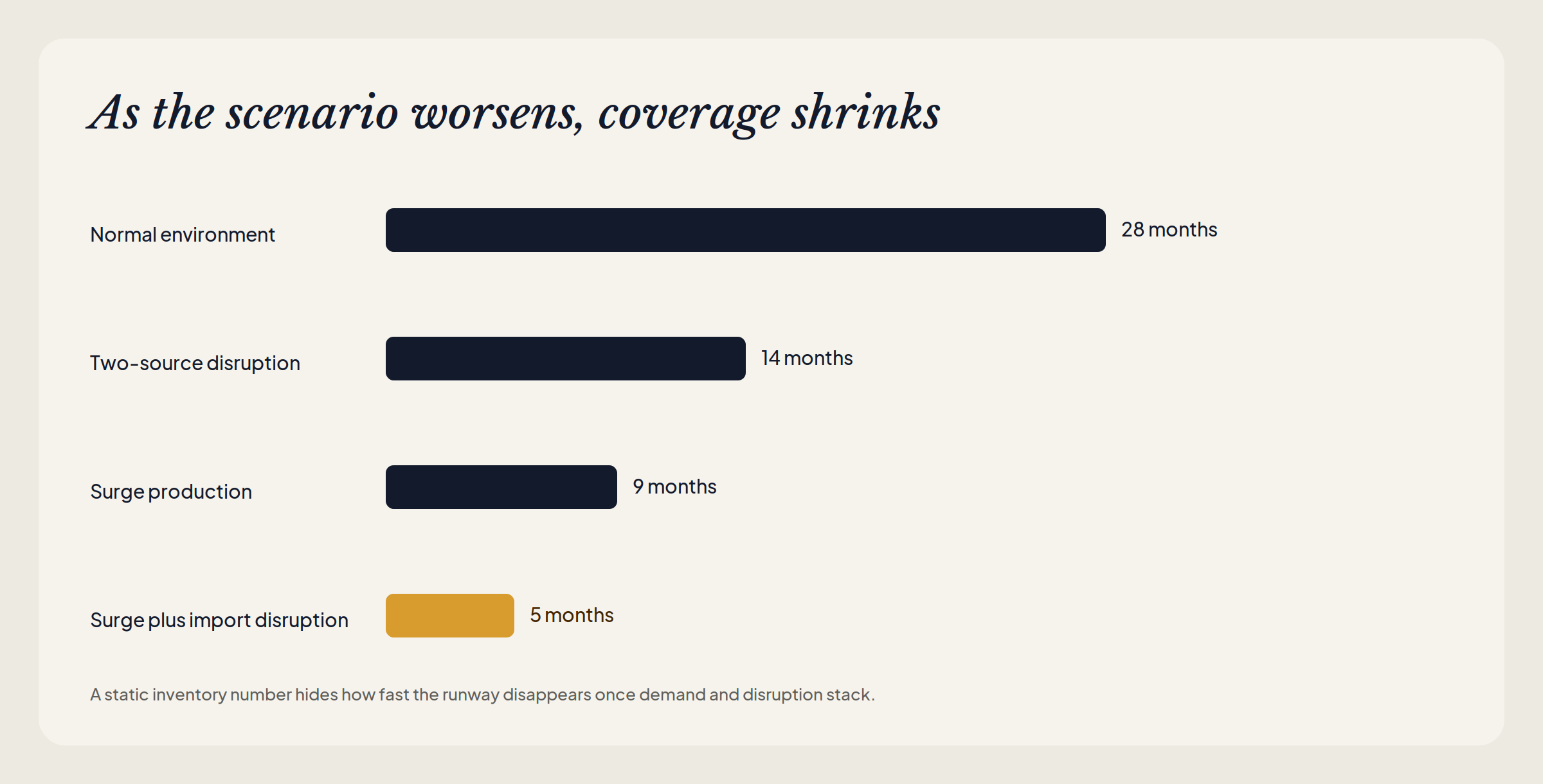 That completely changes how someone thinks about the stockpile. A static inventory becomes a dynamic readiness variable.
Capacity Intelligence needs an outside-in view
We made a related argument in The Defense Industrial Base Doesn’t Have a Demand Problem. It Has a Capacity Intelligence Problem.
Internal production systems are excellent at showing orders, schedules, inventory, commitments, and work in progress. But whether capacity will actually exist six or twelve months from now can depend on changes occurring outside those systems: a supplier raising capital, another customer absorbing capacity, a facility expansion, leadership turnover, a material shortage, a labor constraint, a government award, a regulatory delay, or a sub-tier supplier nobody was watching.
The same principle applies to strategic dependencies. The constraint often begins changing long before the dependent organization reports a problem. That is the intelligence window.
The most valuable signal may occur four layers away
Imagine a critical defense platform. Its Tier 1 supplier appears healthy. Deliveries are on schedule. Financial performance is normal. Traditional supplier monitoring shows green.
But several layers underneath, a specialized processor loses skilled employees, another customer announces a major capacity expansion, the supplier begins extending delivery times, local permitting delays a planned facility expansion, and commodity prices begin climbing.
No individual development necessarily stops production. But together they may form a pattern:
A non-substitutable dependency is becoming constrained.
By the time the Tier 1 supplier misses delivery, the useful decision window may already have disappeared. That is exactly why Polaris I/O is built around the progression from Signals to Patterns to Decision Activation rather than simply delivering another stream of alerts. Polaris I/O continuously monitors the external environments that matter, connects related developments over time, and provides the context needed to determine where action may be required.
Knowing the dependency is not enough
The $2 billion tungsten contract introduces one final question. Suppose we identify a critical dependency. What should we do about it?
There are many possible interventions: stockpile more, expand domestic production, fund processing capacity, qualify another source, redesign around another material, guarantee demand, provide supplier financing, acquire the capability, or develop allied capacity.
The correct answer depends on the constraint. That leads to another evolution: Intervention Intelligence.
Instead of merely asking:
Where are we vulnerable?
ask:
Where would intervention most materially change the outcome?
Imagine ranking dependencies using variables such as Dependency Power, probability of disruption, mission consequence, time to failure, cost to mitigate, time to mitigate, and expected capacity improvement.
Now the decision becomes much more actionable. The government does not simply receive a list of critical materials. It can begin answering:
Where does the next dollar of investment create the greatest increase in mission resilience?
That is the difference between identifying risk and deciding what to do about it.
Follow the dependency until the alternatives disappear
Today’s tungsten and ASML stories look completely different. One involves the Defense Logistics Agency rebuilding a strategic stockpile. The other involves $400 million semiconductor manufacturing machines.
But the intelligence problem is identical. A complex system can appear highly diversified at the surface while depending on a tiny number of irreplaceable capabilities underneath. Those are the nodes that matter.
The strategic questions become: What does the mission depend upon? What sits underneath those dependencies? Where do multiple dependencies converge? Where are alternatives genuinely viable, and where are they not? How much time do we have if access disappears? What intervention would change that outcome?
That is considerably more than supply chain visibility. It is Decision Intelligence applied to the systems that determine whether a capability actually exists when it is needed.
At Polaris I/O, we think that is where the opportunity lies. Not another supplier list. Not another alert. Not another dashboard showing what already happened. But a continuously evolving understanding of what controls the outcome, what is changing around it, and where there is still time to act.
Because in a complex supply chain, the most important company may not be the company you know. The most important material may not be the one you buy the most of. And the most important dependency may be buried several layers below anything visible in your own systems.
So follow the dependency. Then follow the dependency beneath it. And keep going.
Until the alternatives disappear.
That is usually where the real risk, power, and decision advantage begin.
See how Polaris I/O maps dependency risk before it becomes mission failure. Explore Supply Chain Risk solutions or schedule a demo.
Frequently Asked Questions
What is Dependency Power?
Dependency Power is a way of ranking suppliers and inputs by what stops working without them, rather than by how much an organization spends with them. It weighs criticality, concentration of alternatives, replacement time, available capacity elsewhere, and downstream consequence if the node fails.
What is Dependency Depth?
Dependency Depth is the practice of tracing a dependency chain down through every layer: mission, capability, platform, subsystem, component, Tier 1 supplier, Tier 2 supplier, specialized material, and processing capability, to find the layer where credible alternatives run out.
What is a Non-Substitutable Dependency?
A Non-Substitutable Dependency is an input with no credible alternative inside the decision window that matters. A technically possible substitute that takes years to qualify, or that can only supply a small fraction of required volume, does not count as a real alternative for near-term needs.
What is Days of Mission Coverage?
Days of Mission Coverage connects available supply, expected production, and reliable imports against normal and surge demand to show how long a stockpile or supply position protects a mission or program, rather than reporting a static inventory number.
How is this different from ordinary supply chain mapping?
A conventional supplier map answers “here are our suppliers.” A Decision Intelligence approach answers “which ten dependencies could disproportionately change the outcome,” which requires connecting signals across tiers rather than monitoring each supplier in isolation.
How does Polaris I/O help organizations manage this kind of risk?
Polaris I/O is built around a progression from Signals to Patterns to Decision Activation. The platform continuously monitors the external environments that matter, connects related developments across suppliers and tiers over time, and surfaces the context leaders need to act before a Non-Substitutable Dependency becomes a mission failure.