
The next competitive advantage is not having stronger convictions. It is knowing which convictions no longer match reality.
Key takeaway: AI does not remove bias from business decisions. It makes confident, well-organized answers to biased or outdated questions available in seconds. The leaders who win in an AI-first world will be the ones who build systems that test their beliefs against outside evidence, not just the ones who generate answers fastest.
Stephen Messer recently made an argument that stayed with me: belief, amplified by AI, may be becoming one of the greatest risks in every senior leadership seat.
That sounds counterintuitive. AI is supposed to make decisions more objective. It can process more information, analyze more scenarios, and produce an answer in seconds. But AI can also do something far more dangerous: it can make an outdated belief sound intelligent.
Give a capable AI system a premise, and it can build a persuasive argument around it. It can find supporting examples, organize the logic, and present the conclusion with extraordinary confidence. If the original premise is wrong, incomplete, or five months out of date, the output may still look impeccable.
The machine did not remove the bias. It industrialized it. That is the leadership challenge of the AI era.
Why AI Makes Confidence Cheap, Not Just Answers
Last week, I wrote that AI is making answers cheap and the advantage now belongs to companies that ask better questions. There is a second consequence: AI is also making confidence cheap.
Leaders have always operated with beliefs:
- This customer is healthy.
- This market is slowing.
- This supplier is reliable.
- This region is stable.
- This competitor will not enter our category.
- This asset is performing according to plan.
- This mission has the resources it needs.
Historically, those beliefs were challenged through meetings, periodic reports, analyst work, and personal experience. The process was slow, but the friction sometimes forced people to debate the assumptions underneath the conclusion. AI removes much of that friction — a leader can now turn an assumption into a polished answer almost instantly. That speed is valuable when the premise is sound; it is dangerous when the world has changed.
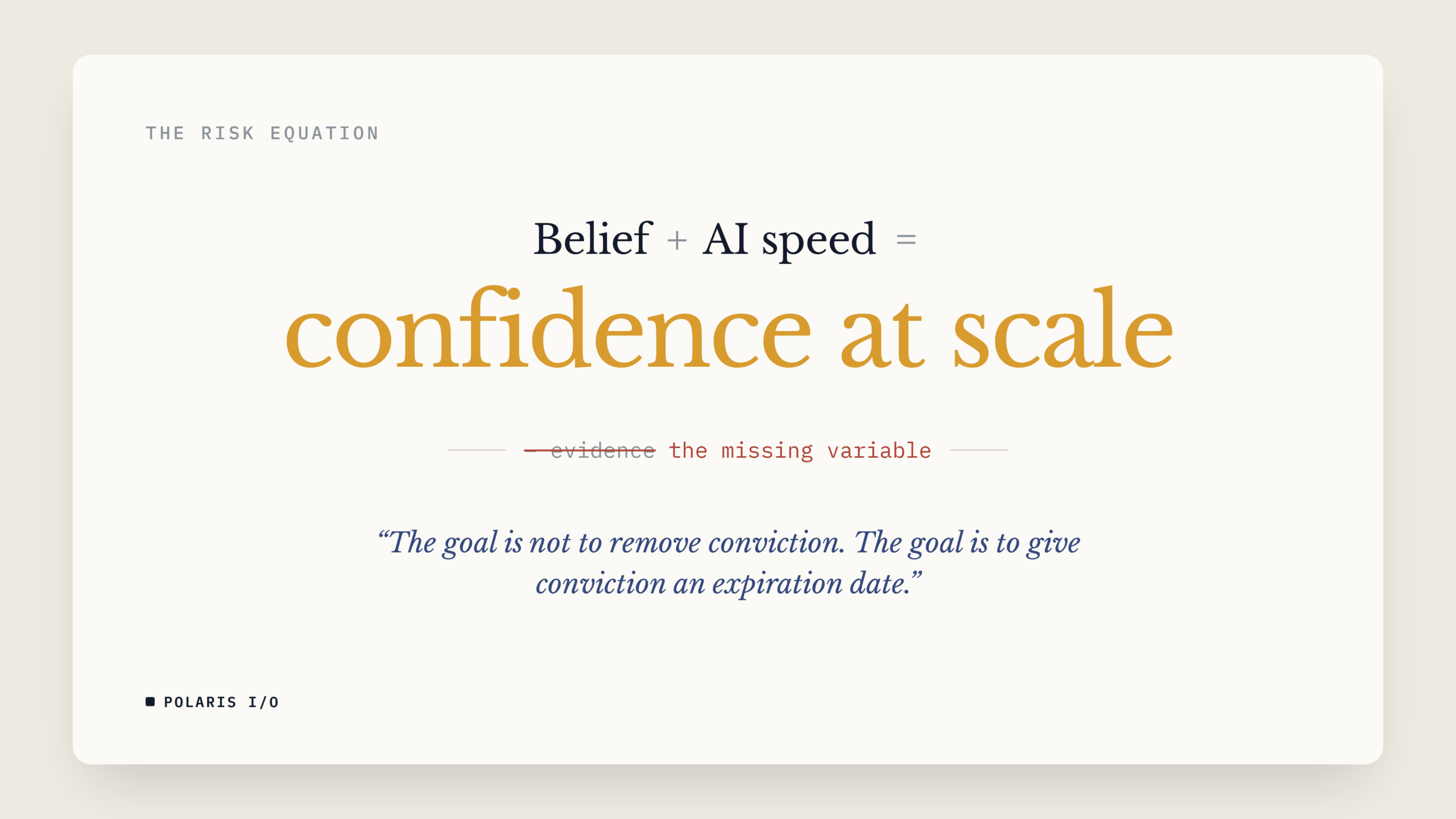
The new risk equation is simple:
Belief + AI speed = confidence at scale
The missing variable is evidence.
 The Most Dangerous Data Is the Data You Never Thought to Look For
Most companies do not lack information. They lack a system for recognizing which change in the outside world should alter an internal decision.
Their CRM may say the account is healthy. Their ERP may say inventory is available. Their operational dashboard may say the program is on schedule. Their intelligence systems may show no active threat. Each system may be technically correct, and the decision may still be wrong.
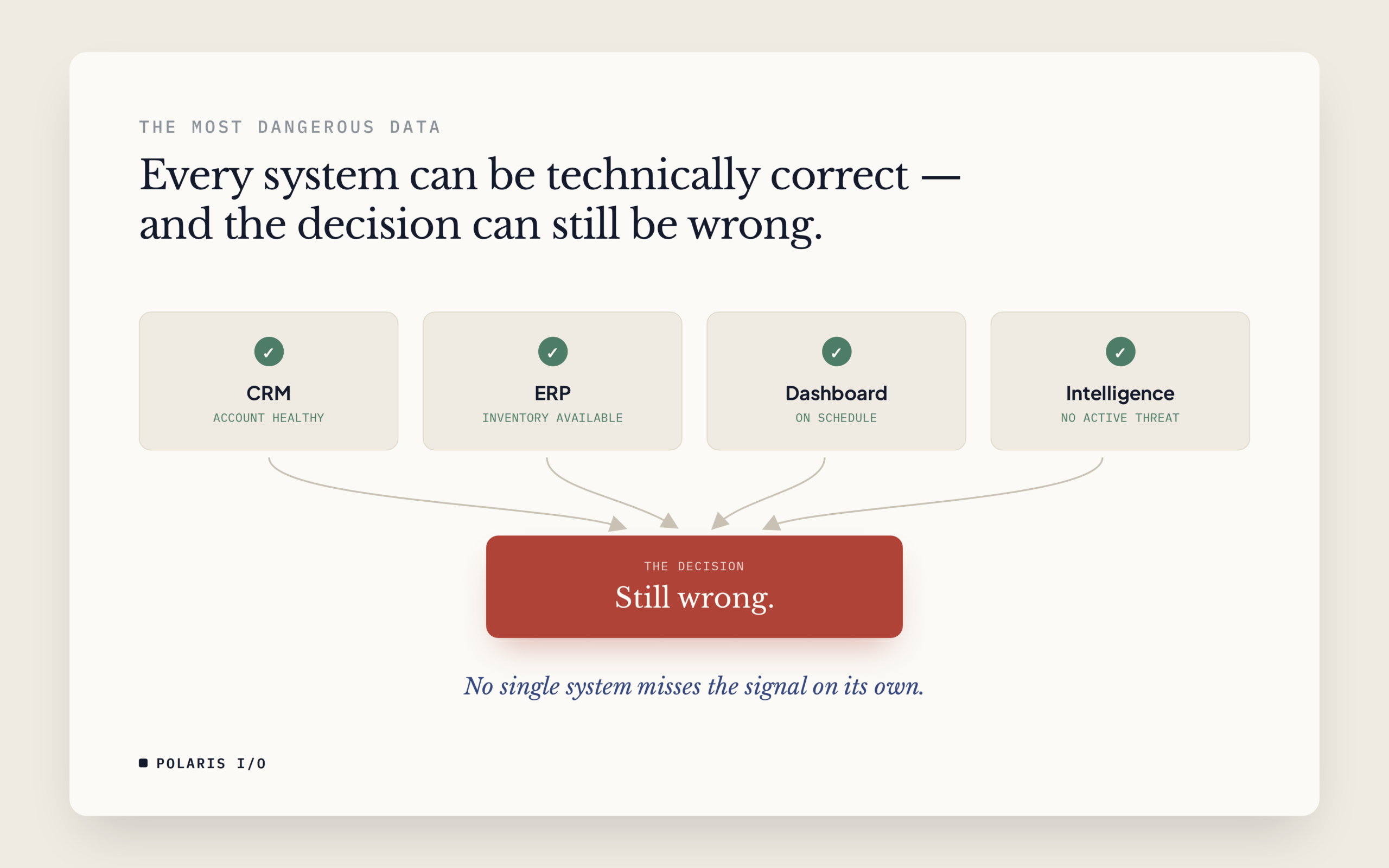 Why? Because the most important evidence may be forming outside those systems:
A customer quietly changes leadership and begins hiring for a new capability. A supplier’s financial pressure starts appearing across local reporting, hiring patterns, and shipment activity. A competitor enters a geography before it makes a formal announcement. A policy change alters the economics of an industry. A developing threat changes the readiness requirements for a mission. Several individually weak signals combine into one material pattern.
No single signal tells the entire story. The advantage comes from connecting them early enough to challenge what the organization currently believes. This is the foundation of what we call pre-intent signal intelligence: surfacing what is changing before it shows up as a lagging metric in an internal system.
This is why we do not have a data problem. We have a signal problem.
From Answer Engines to Evidence Engines
The first phase of enterprise AI has focused heavily on answer generation. Ask a question. Summarize a document. Draft a response. Produce a recommendation.
The next phase must focus on continuous evidence.
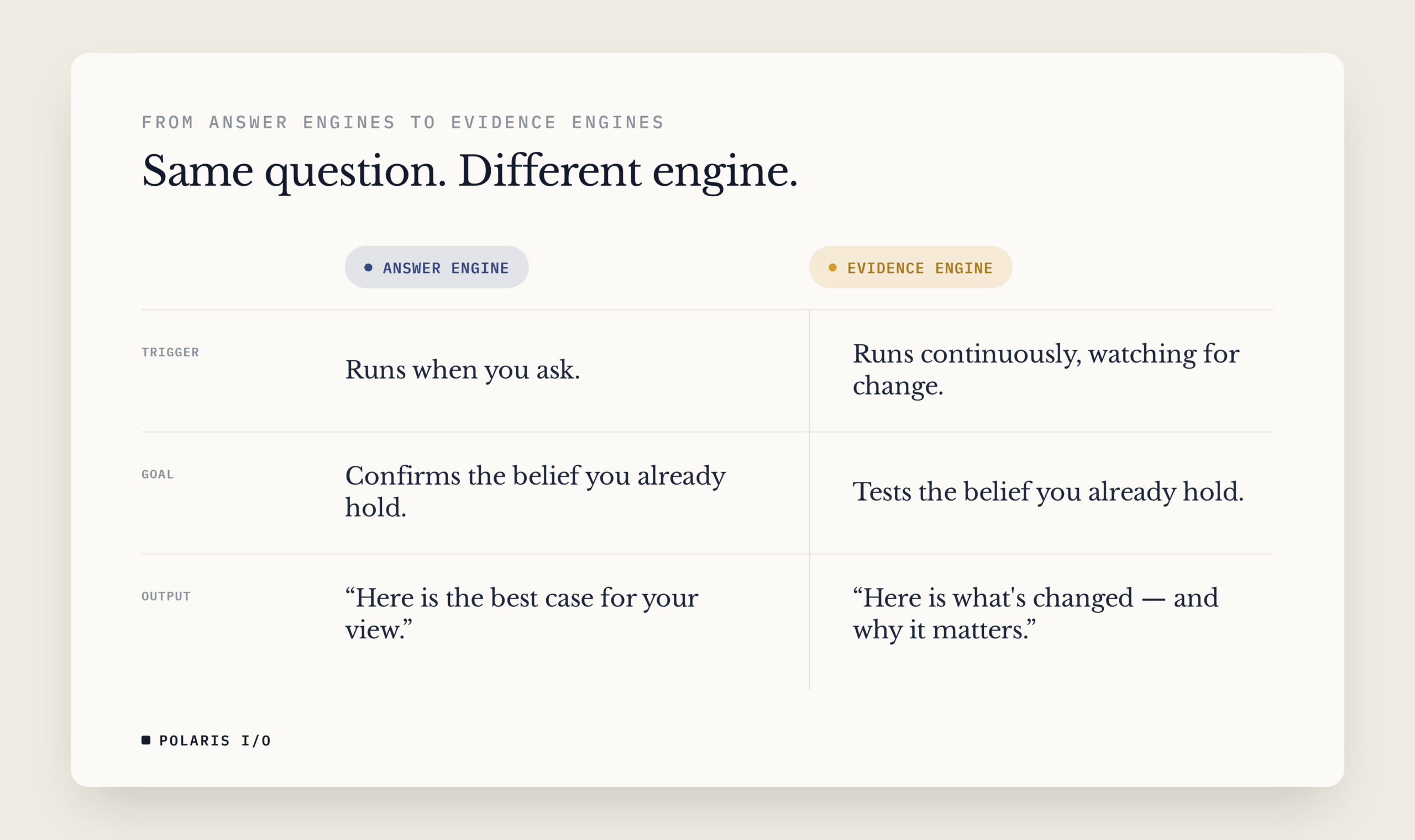
An evidence engine does not simply answer the question a leader asks. It monitors for changes that should cause the leader to ask a different question. That distinction matters.
An answer engine says: “Here is the best case for your current view.”
An evidence engine asks:
- What has changed since this view was formed?
- What evidence contradicts it?
- Which weak signals become meaningful when connected?
- What are we missing because it sits outside our existing systems?
- What decision should be reconsidered now?
 This is where AI and human judgment become most powerful together. AI provides the monitoring breadth and pattern-detection speed no human team can match. People provide context, accountability, and the judgment to determine what the evidence means. I have described this before as Human Judgment + AI Speed = The Control Point Advantage.
The goal is not to remove human conviction. Strong leaders need conviction. The goal is to give conviction an expiration date.
In Critical Missions, Stale Beliefs Carry a Higher Cost
This challenge becomes even more important in the public sector. This is the problem we built Polaris I/O to solve for Federal, Defense, and Intelligence agencies specifically — where the volume of mission data, the number of fragmented sources, and the speed of changing conditions are all higher than almost anywhere else.
Federal, Defense, and Intelligence agencies operate amid growing volumes of mission data, fragmented sources, and rapidly changing conditions. Their decisions can involve supply chain visibility, mission readiness, threat detection, operational planning, and resource allocation.
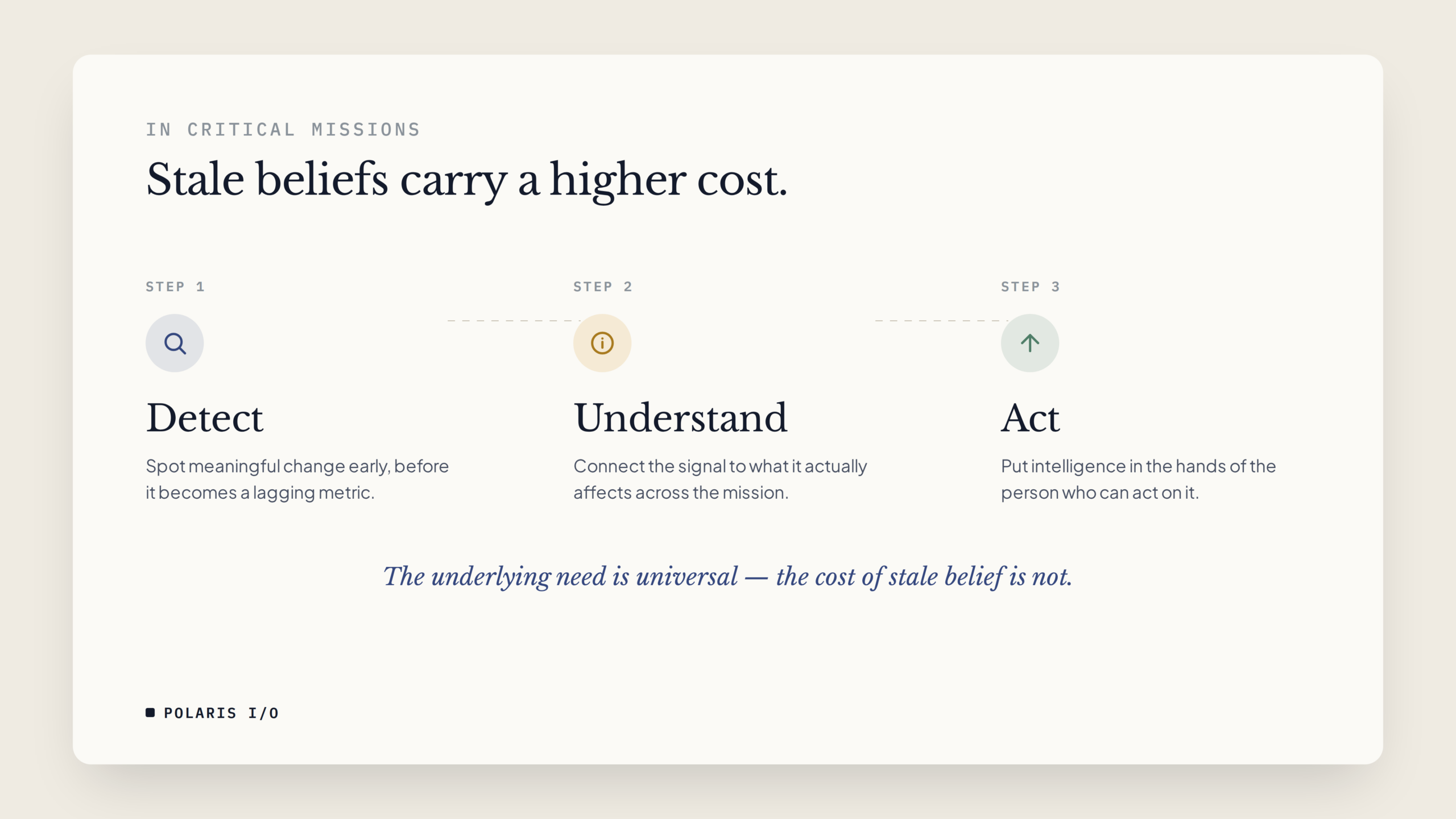
In those environments, the question is not whether more data exists. It is whether the right evidence can be connected, understood, and delivered before a decision becomes irreversible. The number of potential use cases is enormous because the underlying need is universal: detect meaningful change early, understand what it affects, and put intelligence in the hands of the person who can act.
 In the coming weeks, Polaris I/O will share a significant expansion in how Federal, Defense, and Intelligence agencies can access our decision intelligence capabilities, including new paths through public sector contract vehicles and reseller partnerships built for how these agencies actually procure technology. I cannot share the specifics yet, but the goal is straightforward: put outside-in intelligence into the hands of mission owners faster, without adding another system for them to manage.
The Leadership Question Has Changed
For years, leaders were rewarded for having the right answer. In an AI-first world, answers will be abundant, and confident answers will be nearly free. The more important leadership capability will be building a system that continuously tests the assumptions behind those answers.
Before the next major decision, ask:
- What must be true for our current belief to remain valid?
- What external signals would tell us it is beginning to fail?
- Who will see those signals, connect them, and act before the rest of the market does?
The future will not belong to the organizations with the strongest beliefs. It will belong to the organizations that learn fastest when their beliefs stop being true. That is the difference between using AI to sound more certain and using intelligence to see what comes next.
Frequently Asked Questions
Does AI eliminate bias in business decision-making? No. AI does not remove bias. It can take an outdated or incomplete belief and generate a confident, well-organized answer around it in seconds. The bias is not removed — it is scaled and delivered faster — which is why leaders need an independent way to test assumptions against outside evidence.
What is the difference between an answer engine and an evidence engine? An answer engine generates the best possible case for a question a leader already believes. An evidence engine continuously monitors for change and surfaces evidence that challenges the current belief, including signals that sit outside a company’s existing CRM, ERP, or operational systems.
Why is AI making confidence cheap a risk for leaders? Historically, beliefs were tested through slow processes like meetings, analyst reports, and periodic reviews, and that friction forced debate about the assumptions behind a decision. AI removes that friction, so a leader can turn an unexamined assumption into a polished, confident answer almost instantly.
What is pre-intent signal intelligence? Pre-intent signal intelligence is the practice of connecting individually weak external signals — such as leadership changes, hiring patterns, supplier financial pressure, or early competitive moves — into a single material pattern before it appears as a lagging indicator inside internal systems.
Why do stale beliefs carry higher risk in Federal, Defense, and Intelligence missions? These missions involve growing volumes of fragmented data and rapidly changing conditions across supply chains, readiness, and threat detection. When a decision becomes irreversible quickly, the cost of acting on an outdated belief is far higher than in a typical commercial setting.