The instinct is to believe that more data leads to better decisions. It doesn’t, more data often just creates more uncertainty.
The real challenge facing intelligence organizations today isn’t collecting information. It’s determining which information actually matters before it’s too late. That is the difference between information and decision intelligence.
The Mission Has Changed
For decades, intelligence organizations focused on collection. If you could gather enough information, skilled analysts could piece together the story. That model no longer scales.
Today’s mission environments generate millions of new signals every minute. No analyst, regardless of experience, can manually review every report, every image, every transaction, or every alert.
The bottleneck isn’t access to information anymore. It’s attention.
The Signal Hidden Inside the Noise
Imagine standing in the middle of Times Square. Thousands of conversations are happening around you. Somewhere in the crowd, someone quietly says your name. You never hear it.
Now imagine technology that instantly isolates that one voice. That is the challenge intelligence organizations face every day.
One commercial satellite operator alone photographs the entire landmass of Earth every single day, generating well over a million images in a 24 hour period. The director of the U.S. National Geospatial-Intelligence Agency has said openly that no government could hire enough analysts to review all of it. That’s one imagery provider, in one intelligence discipline, feeding into a much larger picture.
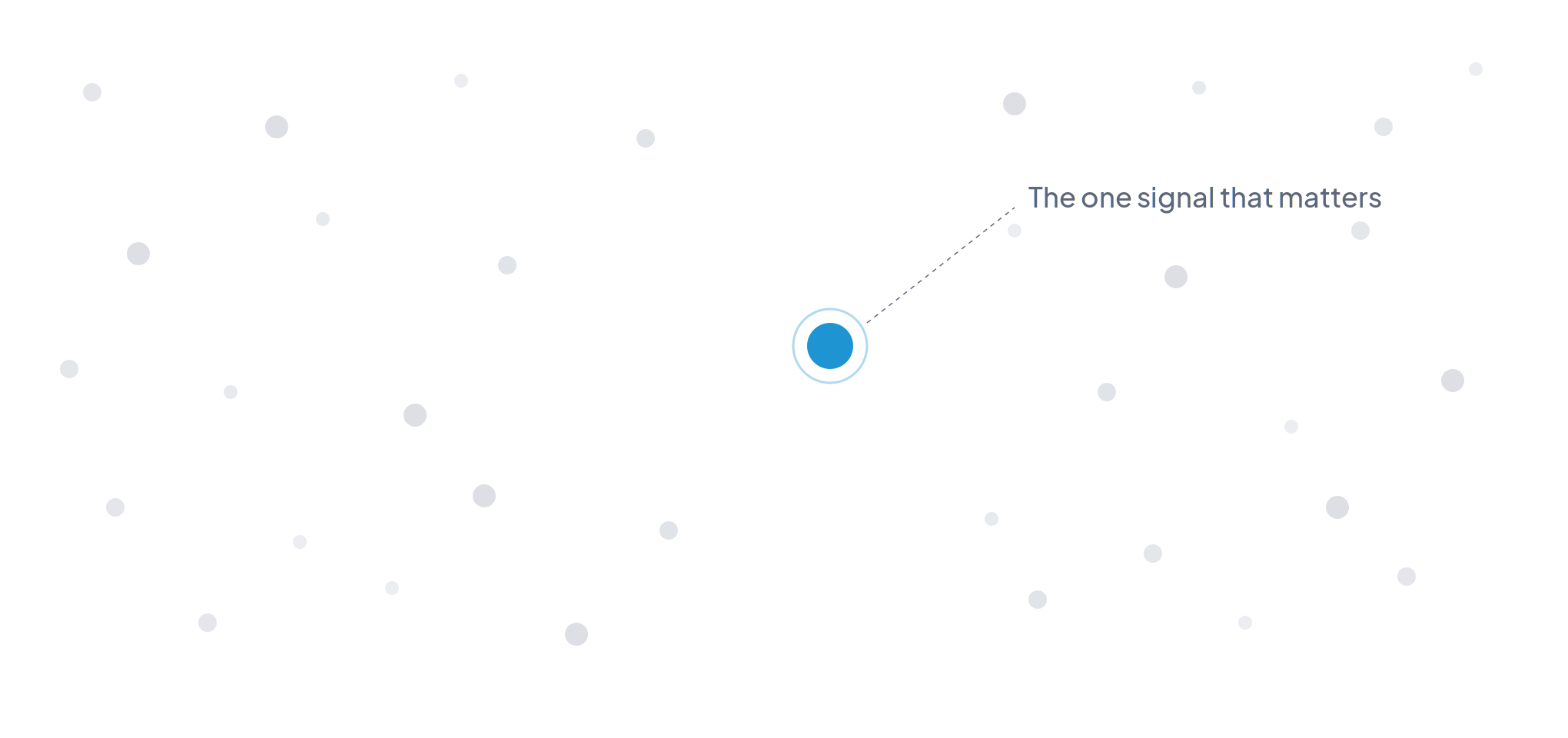 The critical signal is almost never the loudest one. It is often the smallest change hidden inside millions of ordinary events: a sudden change in procurement behavior, an executive unexpectedly traveling overseas, a shift in hiring for highly specialized technical roles, a supplier quietly changing ownership.
None of these events matter on their own. Together, they may reveal something far more significant. Finding those relationships is where decision advantage begins.
Context Changes Everything
One piece of information rarely tells the whole story. A cargo ship leaving port is routine. A cargo ship carrying fertilizer is still routine. That same vessel traveling to a sanctioned nation, owned by a newly created shell company, immediately after encrypted communications increase across a known network becomes an entirely different story.
This isn’t hypothetical. In 2019, an oil tanker called the M/T Courageous went dark for four months, its location transponder switched off the entire time. Satellite imagery filled the gap the transponder left behind: it showed the tanker conducting a ship-to-ship transfer of more than $1.5 million in oil to a North Korean vessel already under U.S. sanctions. The people behind it had bought the tanker through shell companies and given it a false identity to avoid exactly this kind of detection. None of it worked in isolation, but stitched together, it was enough for the U.S. Department of Justice to seize the vessel and charge the scheme’s organizer with sanctions evasion.
The event didn’t change. The context did.
This is why parsing data at scale is about far more than reading documents or searching databases. It is about continuously connecting people, organizations, assets, locations, behaviors, and time into a living picture of what is actually happening. Context transforms isolated facts into intelligence.
Speed Has Become a Strategic Advantage
Modern threats don’t unfold over weeks. Cyberattacks develop in minutes. Supply chain disruptions ripple across industries in hours. Disinformation campaigns spread globally before traditional reporting cycles even begin.
Waiting for reports is no longer enough. Organizations need systems that continuously monitor millions of signals, identify emerging patterns, and elevate only what deserves immediate attention.
The organizations that recognize change first gain the opportunity to influence the outcome. Everyone else reacts.
Confidence Matters as Much as Speed
Intelligence is rarely black and white. Decision makers aren’t asking whether something is absolutely true. They’re asking how confident they should be before acting.
Confidence isn’t created by a single source. It comes from connecting hundreds of independent signals that reinforce or contradict one another: satellite imagery, commercial activity, financial movement, logistics, cyber events, news reporting, human observations.
The more independent signals converge, the stronger the confidence behind the recommendation. That is the difference between information and evidence.
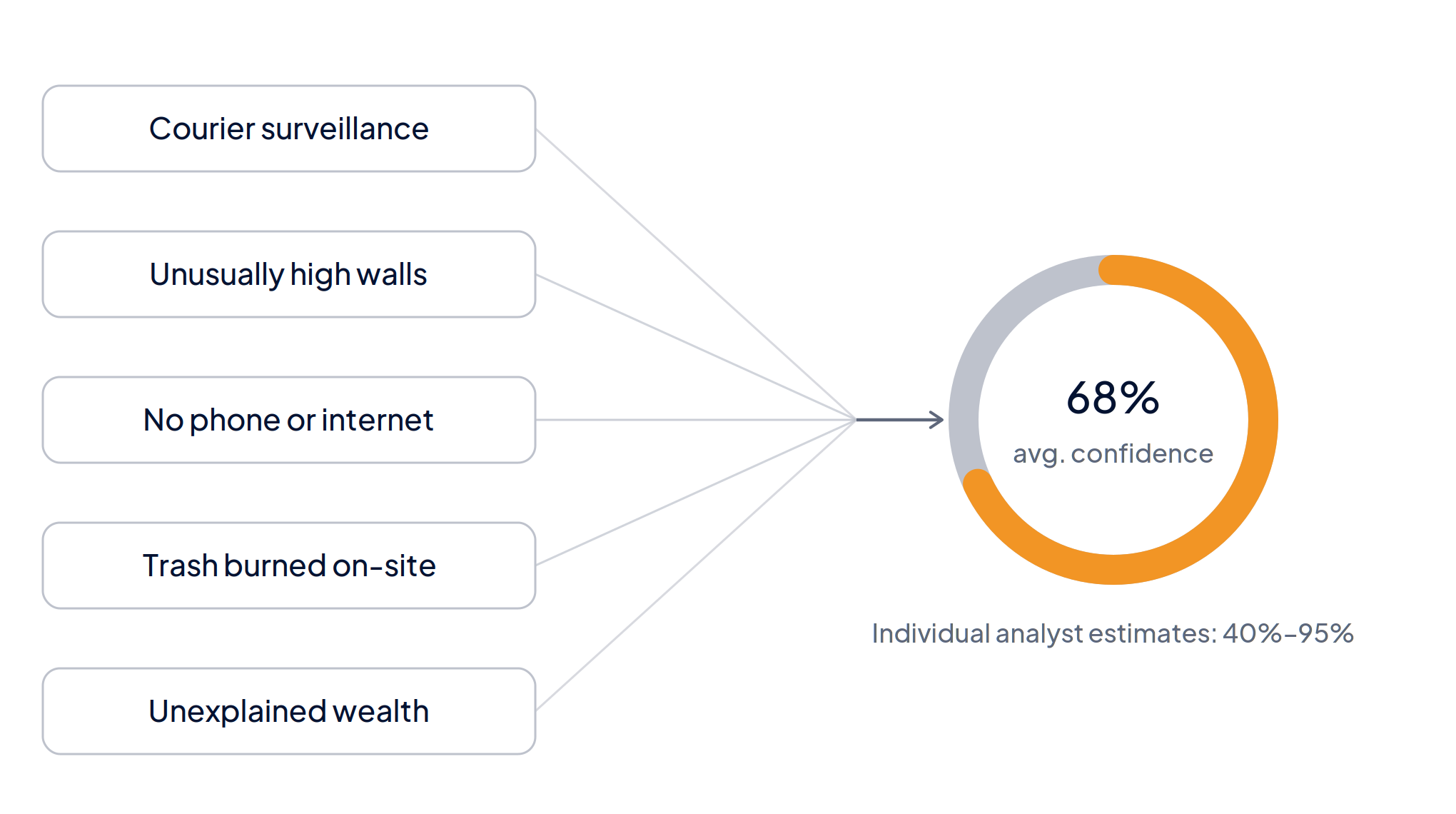
The hunt for Osama bin Laden is a documented example of exactly this. There was never a single piece of proof. What analysts had was a set of individually unremarkable signals: a courier tracked for years, a compound with unusually high walls, no phone or internet lines running to the property, trash burned on-site instead of collected, and owners whose finances didn’t match the size of the house. None of it was conclusive on its own. Together, it was enough for the CIA to assess that the compound was probably sheltering him, even though analysts’ own confidence estimates reportedly ranged from around 40 percent to 95 percent, and the decision to act was made without certainty. That’s the real difference between information and evidence: evidence is what independent signals become once they’ve been connected.
 AI Is Only Part of the Answer
Artificial intelligence has created extraordinary new capabilities. But AI alone cannot solve the intelligence problem.
Before AI can generate meaningful recommendations, enormous amounts of work must already be complete. Data must be collected, normalized, cleaned, linked, deduplicated, enriched. Relationships must be established. Confidence must be calculated. Only then can AI reason effectively.
 Without context, AI is simply responding to disconnected pieces of information. With context, AI becomes a force multiplier for human decision making.
The Next Generation of Intelligence
The question is no longer: What happened?
The better questions are: What is happening now? What matters most? What should I pay attention to first? What is likely to happen next? What decision gives me the greatest probability of success?
These are fundamentally different questions. And they require fundamentally different technology.
The Polaris I/O Perspective
At Polaris I/O, we believe the future of intelligence isn’t about collecting more data. It is about seeing the signals others miss.
We continuously parse millions of internal and external signals, connect them into meaningful context, score their confidence, and surface the handful of developments that actually deserve a decision.
Because in high-consequence environments, the advantage doesn’t belong to the organization with the most information. It belongs to the organization that sees what matters first.
That’s what it means to move from information to Mission Decision Intelligence.
See it all. Spot the signal. Steer the outcome.
Sources: U.S. Department of Justice, “United States Seizes Oil Tanker Used to Violate Sanctions Against North Korea” (2021), justice.gov. Central Intelligence Agency, “The Final Chapter in the Hunt for Bin Ladin,” cia.gov. CBS News, “60 Minutes” segment featuring NGA director Robert Cardillo, cbsnews.com.