
A company recently came to us with what sounded like a technology question.
It was preparing to move from subscription pricing to consumption-based pricing and wanted to know how artificial intelligence could help.
The company already had a formidable commercial technology stack. Salesforce contained its accounts and opportunities. Gong captured customer conversations. LinkedIn Sales Navigator showed relationships and employment changes. ZoomInfo supplied company and contact information.
Surely the answer was already somewhere inside those systems.
But that was the wrong question.
The real question was not: how do we use our existing technology to manage consumption pricing?
It was: what must be true for consumption-based pricing to succeed?
That reframe changed the engagement, and it is worth walking through why.
Start With the Outcome, Not the Software
First-principles thinking means reducing a problem to the fundamental truths that must be addressed, then reasoning forward from there.
For a business moving to consumption-based pricing, the obvious starting point might be the unit of consumption. Should customers pay for users, queries, reports, API calls, transactions, or data consumed?
But that is still starting with the pricing mechanism rather than the customer outcome.
The company should first ask what outcome the customer is trying to create, what customer behavior demonstrates that value is being realized, and what causes that behavior to begin, expand, slow, or stop. Only after answering those questions should it ask what evidence would let it recognize those changes early, and what decision or intervention should follow.
Only then should the company determine what to measure and how to charge for it.
Customers rarely want to consume more data simply for the pleasure of consuming data. They use information to make a decision, enter a market, prioritize an investment, identify an opportunity, reduce risk, or respond to change.
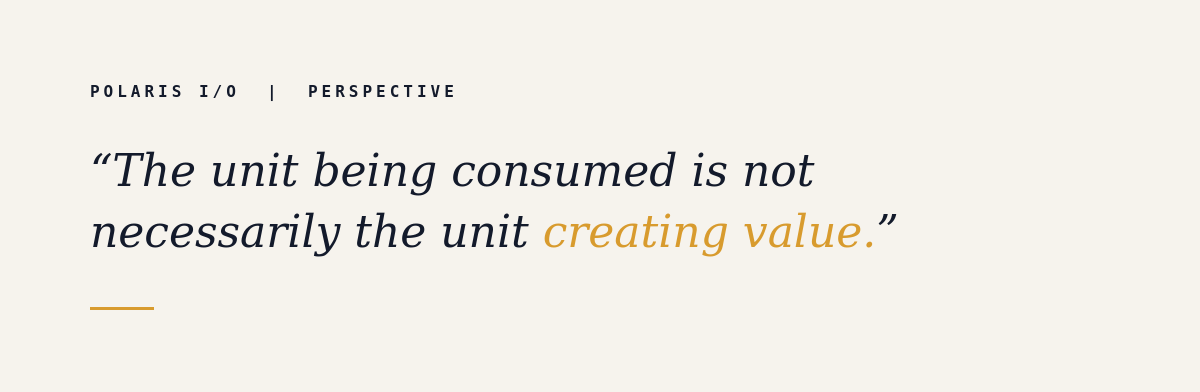
That distinction is critical, and it is the one most consumption pricing models get wrong.
Consumption Pricing Changes Who Carries the Risk
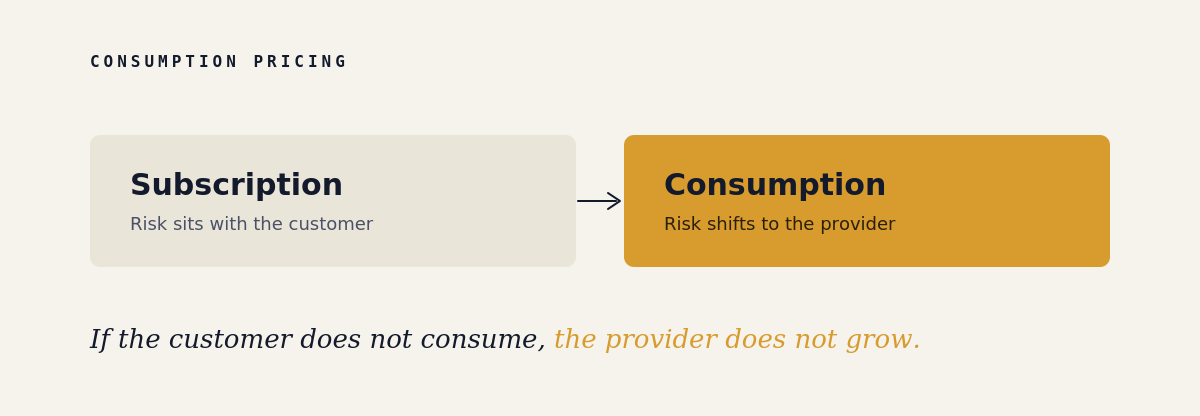
Under a traditional subscription, a customer commits to a defined payment regardless of how extensively the product is used.
Under a consumption model, more of the risk moves to the provider. If the customer does not consume, the provider does not grow.
 This means a consumption business must be capable of answering questions a subscription business can sometimes avoid: which customers are likely to increase consumption, which new use cases are emerging, what external events will create additional need, why consumption has slowed at a given account, and whether an account is underusing the product because it lacks demand, awareness, capability, or urgency.
These are not billing questions. They are questions about causality, customer behavior, and changing market conditions. And this is where many commercial technology stacks reach their limits.
The Rearview Mirror, the Phone Book, and the Dashboard
Salesforce is the company’s commercial system of record. It tells the organization what its people have entered about accounts, opportunities, and pipeline.
Gong records and analyzes conversations that have already taken place.
LinkedIn Sales Navigator helps identify people, roles, and relationships. ZoomInfo provides company and contact information.
Product telemetry measures how much the customer is using.
Each system is valuable. None was designed to determine why a customer’s future need is changing.
Salesforce and Gong are the rearview mirror. They tell you what has already happened inside the commercial process. LinkedIn Sales Navigator and ZoomInfo are the phone book. They help you identify the companies and people you may want to reach. Product telemetry is the dashboard. It tells you how much fuel is being used and how fast the customer is traveling.
But none of them is the navigation system. They do not continuously connect internal customer behavior with what is changing outside the customer. They do not determine where the customer may be going, why its requirements are changing, or what the commercial team should do next.
They record activity. The missing layer recognizes change before it shows up as a number in any of those systems.
Future Consumption Is Decided Outside the CRM
A customer’s future consumption is not determined entirely by what happened inside the vendor’s CRM.
It may be influenced by an acquisition, a product launch, a leadership change, a new regulation, a geographic expansion, a hiring pattern, a competitive move, an infrastructure investment, or a new strategic priority. Those developments can occur months before the customer formally expresses buying intent.
The commercial opportunity appears first as a change in the customer’s reality, not as a data point in a CRM field.
That creates a more complete model for understanding consumption. Internal behavior tells us what the customer has done. External signals help explain why that behavior may change. Artificial intelligence connects the evidence, recognizes patterns, and surfaces possible implications. Human judgment determines what those implications mean and what should happen next.
This is what we mean at Polaris I/O by pre-intent signal intelligence: the discipline of catching the signal before it becomes a stated intent, and connecting it to a decision before a competitor does. Signal, outcome, speed, in that order.
That is not simply better sales intelligence. It is a different way of operating the business, and it is also why the availability of AI raises rather than lowers the value of good judgment.
AI can now process information and generate answers at a pace no analyst team can match. That does not make the human mind less important. It changes where human value resides. If almost anyone can produce an answer, the advantage moves upstream to the person who can determine what problem is actually being solved, which assumptions are being made, what evidence would prove the model wrong, and what the consequences of acting on the answer would be.
The most important AI skill may not be prompt engineering. It may be consequential questioning: knowing what to ask and recognizing when the answer has changed.
Why the Existing Tools Are Not Enough
When organizations encounter a new problem, they naturally ask whether their existing systems can solve it. Can Salesforce do this? Can Gong do this? Can we find it in LinkedIn or ZoomInfo? Can we add an AI assistant to the current workflow?
These are reasonable questions, but they begin too far downstream.
The existence of data does not mean the company possesses intelligence. A contact database may tell you who works at an account. It does not tell you why the account’s need is changing. A conversation platform may identify what the customer said. It cannot hear a conversation that has not happened yet. A usage dashboard may show consumption declining. It does not explain whether the cause is a product problem, a missing use case, an organizational change, or a shift in customer priorities.
Each tool sees a portion of reality. The business problem exists across all of them, and beyond them.
Begin With the Decision
Companies should stop beginning their AI discussions with tools. Do we need a new model? Should we build an agent? Can we add a copilot? Can our CRM vendor provide this feature?
The better sequence starts with a short set of questions:
- What outcome are we trying to create?
- What decisions determine that outcome?
- What must we know to make those decisions?
- What signals would tell us the situation has changed?
- Which parts can machines calculate, predict, or automate?
- Where is human judgment indispensable?
This sequence changes the role of technology. Technology is no longer the destination. It becomes part of an intelligence system organized around a decision.
From Systems of Record to a System of Intelligence
The next generation of enterprise advantage will not come from accumulating more disconnected systems of record. It will come from connecting internal information, external reality, artificial intelligence, and human judgment around the decisions that matter.
Polaris I/O does not replace Salesforce, Gong, ZoomInfo, or LinkedIn. Those platforms continue to perform valuable functions. Polaris I/O connects what is happening inside the company with what is changing outside it. It identifies the early signals that a customer’s needs may be evolving, helps determine why those signals matter, and directs attention toward the decisions that should follow.
In a consumption-based business, that means recognizing which accounts have the conditions for increased consumption, which customers are approaching a new use case, which external developments are making additional consumption economically necessary, which accounts are consuming below their expected potential, and which intervention should happen next, and then measure whether it worked.
The result is a closed loop: signal to intelligence, intelligence to decision, decision to action, action to measured outcome, outcome back into the model.
That is how a company moves from passively measuring consumption to actively understanding what creates it.
Back to the company we opened with. Its instinct was to ask whether Salesforce, Gong, or a new AI layer could manage the shift to consumption pricing. The more useful question turned out to be which accounts already showed the conditions for expanding usage, and why. Once that question was on the table, the pricing mechanism was the easy part.
Don’t Just Meter Consumption. Understand What Creates It.
Consumption-based pricing is only one example. The same first-principles approach applies to supply chain resilience, market expansion, revenue growth, operational risk, investment decisions, and national security.
In every case, the temptation is to begin with the technology already available. But the presence of a tool does not mean the right problem has been defined.
The more powerful starting point is the decision itself: what are we trying to make true, what would prevent it from becoming true, what evidence would tell us reality is changing, and what should we do when it does?
AI can help organizations process more information, recognize more patterns, and evaluate more possibilities than any human team could manage alone. But AI cannot determine an organization’s intent. It cannot decide which outcome matters most. It cannot accept responsibility for the consequences. Those remain human obligations.
The companies that win will not simply have more AI. They will combine machine intelligence with people capable of first-principles reasoning, systems thinking, and consequential judgment, because in a world where almost everyone can generate an answer, the advantage belongs to those who know what to ask, recognize when the answer has changed, and act before everyone else does.
Sources and Inspiration
Stephen Messer with Tony Baer and Matthew Housley: