


The next competitive advantage is not having stronger convictions. It is knowing which convictions no longer match reality.
McDonald’s is modernizing the operating foundation behind its global business: bringing functions together, improving access to enterprise data, accelerating analytics, and creating a more connected environment for decision-making.
In a recent episode of Reinvented with Accenture, McDonald’s Chairman and CEO Chris Kempczinski told Accenture Chair and CEO Julie Sweet: “We make sure that the world inside McDonald’s is moving as fast as the world outside of McDonald’s.”
It is a powerful idea and one with particular implications for supply-chain resilience.
Companies are doing versions of the same thing everywhere: modernizing systems, connecting data, and moving faster inside the enterprise. But resilience depends just as much on how quickly they spot meaningful change outside it.
That means faster internal decisions solve only half the problem. The other half is understanding what is changing outside the enterprise early enough to act.
The outside world does not arrive as a clean data set
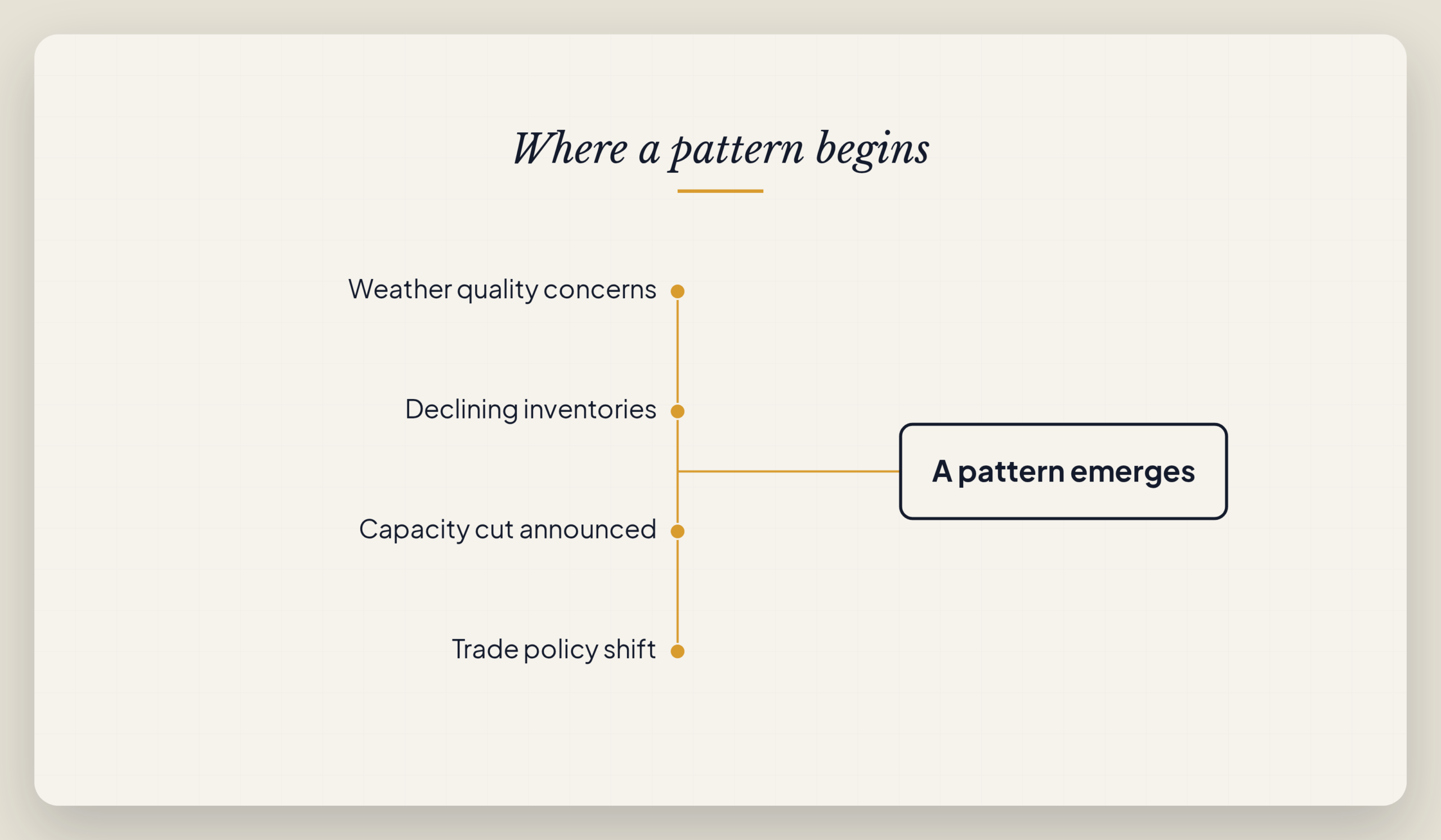
Supply-chain disruption rarely begins with a single obvious event. It usually builds over time, on more than one front, until the pattern becomes clear.
A drought emerges in one agricultural region while crop-quality concerns appear somewhere else. Commodity inventories tighten, a government signals a change in trade policy, transportation costs move, a supplier reduces capacity, disease affects livestock production, or political instability threatens a shipping corridor.
Individually, many of these developments may not justify immediate action. Together, they can signal that the operating environment is changing, and that is where many traditional intelligence approaches struggle.
 Organizations often have no shortage of information. They have news feeds, supplier reports, analyst research, commodity data, internal dashboards, alerts, market intelligence, and increasingly, generative AI tools capable of summarizing all of it.
The harder problem is figuring out which signals actually matter, how they connect, what pattern is forming, where the business is exposed, and whether there is still time to make a different decision.
That is the distinction between information and foresight.
The emerging model: Signal → Pattern → Exposure → Decision
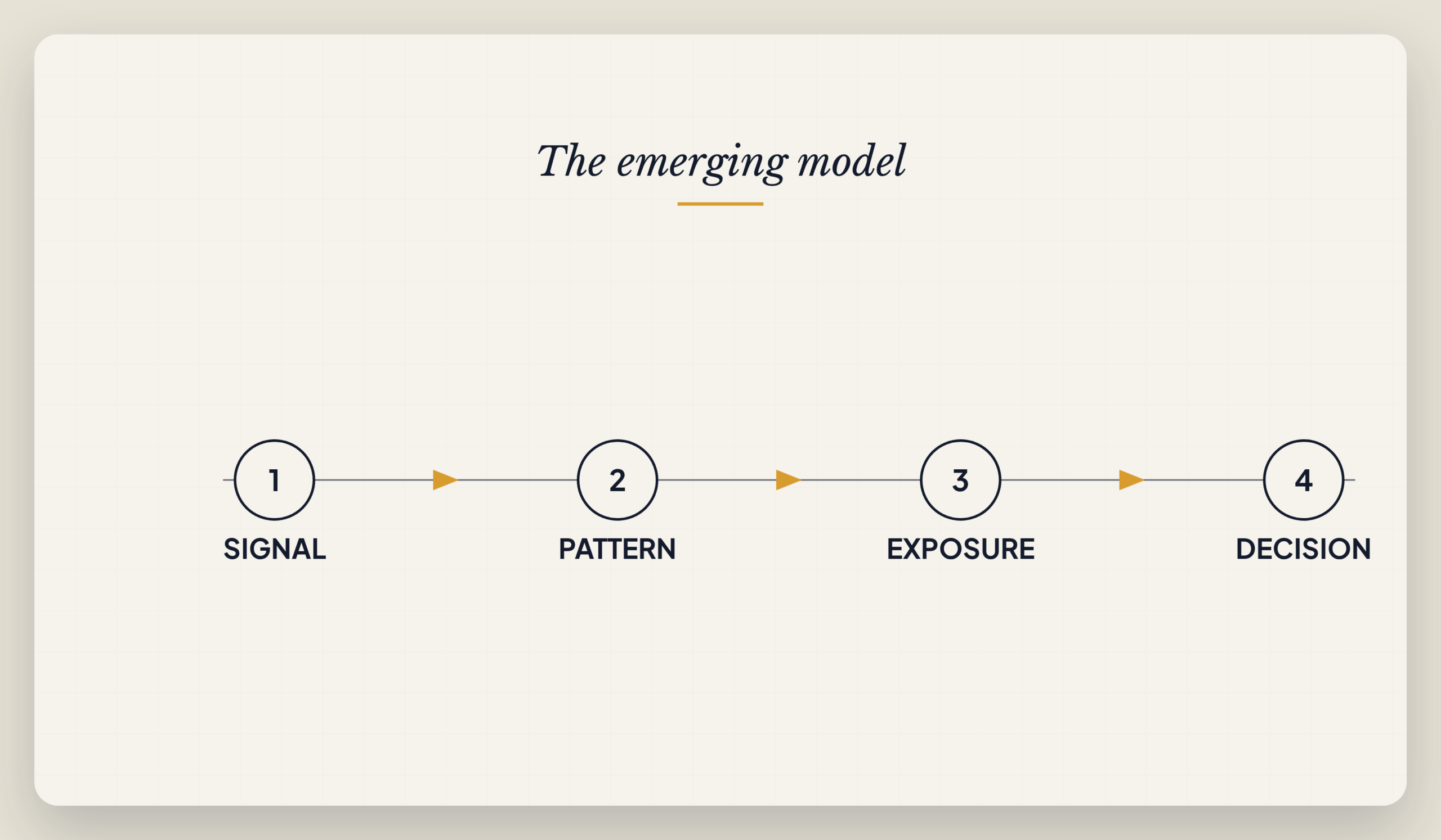 For supply-chain leaders, the most useful intelligence connects potentially relevant developments, determines when multiple signals are beginning to reinforce one another, and identifies where the business may be exposed: across suppliers, commodities, markets, facilities, transportation routes, or customer commitments.
Only then does information become actionable enough to support a decision.
That distinction becomes clearer when applied to real-world supply-chain conditions.
What this looks like in practice
Coffee: when contradictory signals become the insight
A single weather report or inventory update is unlikely to change a sourcing strategy. But when declining Arabica inventories, weather-related quality concerns, shifting production expectations, and improving availability in other coffee varieties occur at the same time, a more useful picture emerges.
The question is no longer simply: “Is coffee supply tightening or improving?”
It becomes: “Where is risk actually increasing, and what does that mean for the products and specifications we buy?”
That insight can prompt earlier conversations around supplier positioning, origin exposure, forward contracting, quality availability, or alternative sourcing, while there are still options.
Geopolitics: when a policy event becomes a supply-chain event
Trade policy provides a very different example.
A tariff announcement initially appears to be political or economic news. Its operational consequences often develop later as buyers reconsider sourcing, suppliers redirect capacity, trade flows shift, transportation patterns change, and prices respond.
The relevant intelligence is therefore not simply: “A tariff was announced.”
It is: “How could this change behavior across our supplier network, and where might we be exposed?”
Connecting geopolitical developments with suppliers, commodities, regions, logistics routes, and alternative sources gives teams an opportunity to assess potential consequences before policy translates into operational disruption.
The difference between knowing and knowing early enough
This distinction matters because most organizations eventually discover a major disruption. The real question is when.
A traditional response often follows the same sequence: disruption, alert, investigation, impact assessment, then mitigation.
By that point, competitors may already be pursuing the same alternatives, supplier capacity may be constrained, transportation options may have narrowed, and prices may already be moving.
A more proactive model reorders that sequence: weak signals connect into a pattern, the pattern reveals potential exposure, and investigation and mitigation happen before disruption instead of after.
The objective is not perfect prediction, or declaring with certainty that a disruption will occur. It is recognizing that enough conditions have changed to justify attention before the consequences become obvious.
That extra decision time can be extremely valuable, and sometimes it is critical.
Why this matters as companies modernize the enterprise
The McDonald’s and Accenture example is instructive because it reflects a much broader enterprise shift.
Companies across industries are modernizing technology, consolidating data, deploying AI, automating workflows, and reducing functional silos, all to improve how quickly they understand and respond to what is happening inside the business.
The next opportunity is to bring that same level of intelligence to what is happening outside the business.
That is where external intelligence platforms such as Polaris I/O can add value: not as another news feed or dashboard, but as a sensing layer that continuously evaluates market, geopolitical, supplier, regulatory, commodity, environmental, and industry developments to determine what is changing, what connects, where exposure exists, and who needs to know.
Combined with internal enterprise data, that same model extends into a complete decision path: an external signal becomes a pattern, the pattern reveals enterprise exposure, and exposure leads to a decision and action.
Organizations have spent years improving access to data. Increasingly, the advantage will come from recognizing meaningful change earlier.
The companies best positioned to navigate disruption will not necessarily be those with the most information. They will be the ones that can identify what matters, connect seemingly unrelated developments, understand their exposure, and act while there is still time to influence the outcome.
That is what it means for the world inside the enterprise to truly move as fast as the world outside it.
The advantage is not just knowing what happened faster. It is seeing what is developing early enough to decide what happens next.

Related Posts
Nothing found.