Automakers are moving into defense. The bigger lesson is how to find, measure, and activate the capability sitting outside the defense industrial base before the window closes.
In short: The defense industrial base is much larger than the list of companies we call defense suppliers. General Motors shipped Patriot interceptor components 22 days after signing with Lockheed Martin because the capability already existed. The work now is to find that Latent Capability, measure how far it sits from mission readiness, and remove the friction in the way before the window closes. Polaris I/O does that work continuously: it monitors capacity, supplier health, and friction signals across the industrial base, connects them to your own program data, and delivers evidence-backed reports with qualified alternatives and ranked options while the window is still open.
Key takeaways
Search by capability, not by category. Who makes this? and Who could make this? are different questions, and they return very different supplier lists.
Measure distance, not existence. The useful number is how far a company sits from mission readiness and what it takes to close the gap.
Friction is often the real constraint. A secure room, a clearance, or a qualification can matter more than a new factory.
The clock is compressing. Seeing options early is what turns them into real choices.
Polaris I/O gives you the lead time. It watches supplier health, capacity, hiring, leadership, financial, and compliance signals across companies inside and outside your supplier base. It connects them to your own supplier and program data, and delivers Risk Reports with qualified alternatives and ranked mitigation options while there is still time to act.
Working on a capability gap right now? Polaris I/O helps program offices, primes, and investors find adjacent suppliers, map what stands between them and mission readiness, and compare the options. See our defense solutions or schedule a demo.
Why are automakers moving into defense?
Western automakers are chasing rising defense budgets to sell more vehicles and put underused factories to work, Reuters reported on September 28, 2026. Ford, General Motors and Jaguar Land Rover are bidding on a £900 million UK Ministry of Defence vehicle program, initially for 3,000 vehicles. Their bids use modified versions of the Ranger, the Silverado and the Defender.
The factories are moving too:
- Stellantis plans to sell an idled Canadian plant to armored vehicle maker Roshel.
- Volkswagen agreed to sell its Osnabrück plant to Aurelius Capital and the state of Lower Saxony for a project with Rafael Advanced Defense Systems.
- Forvia is transferring a German factory and 300 employees to General Dynamics.
- Renault plans to build 1,000 military drones a month with Thales.
Analysts told Reuters that none of this will do much for automaker earnings. GM expects about $700 million in defense revenue this year, less than 1 percent of the company.
That is the right answer to the wrong question.
Wall Street is asking what defense can do for automakers. The better question is what automakers, and thousands of companies like them, can do for defense. The villain in this story is not a shortage of factories. It is the supplier list.
What did GM’s 22 day Patriot delivery actually prove?
GM Defense and Lockheed Martin signed a manufacturing agreement on August 6. On August 28, GM delivered its first batch of Patriot interceptor housing components. Lockheed said that work traditionally takes months or years. The shipment made GM a second source for those housings alongside General Dynamics.
To be fair to the calendar, the two companies announced a broader collaboration in June, so engineering conversations started before the contract. That makes the lesson stronger, not weaker. GM did not learn precision casting, machining, automation, or high-volume quality control in three weeks, or in three months. Those capabilities already existed inside a company we categorize as an automaker. What changed was the application.
Traditional supplier discovery asks:
Who makes this?
A better question is:
Who has the capabilities required to make this?
The first question searches the known supplier base. The second searches the entire industrial economy.
What is Latent Capability?
Latent Capability is manufacturing, engineering, or technical capacity that already exists somewhere in the industrial system but is not yet connected to the mission that needs it.
Imagine a component that requires precision machining, specific materials expertise, automated inspection, tight tolerances, advanced quality systems, and the ability to scale quickly. A traditional search starts with companies already making that component.
Somewhere outside that list may be a company with 80 percent of the equipment and 90 percent of the process knowledge. It may also have open capacity, a trained workforce, and a working supply chain. Nobody thought to look there.
Reuters adds a detail that matters. Analysts expect automotive suppliers, more than the automakers themselves, to benefit. Their smaller and more flexible production lines can be adapted to military programs with limited investment.
The richest Latent Capability often sits at Tier 2 and Tier 3, exactly where most supplier maps stop looking. We made that case in The Delay You Never Saw Coming Was Never About Your Tier 1 Supplier.
How far is the capability from the mission?
Finding adjacent capability is not enough. A commercial manufacturer does not become a defense supplier because someone found it in a database. The next question is Capability Adjacency: how close is the capability we found to the capability the mission requires?
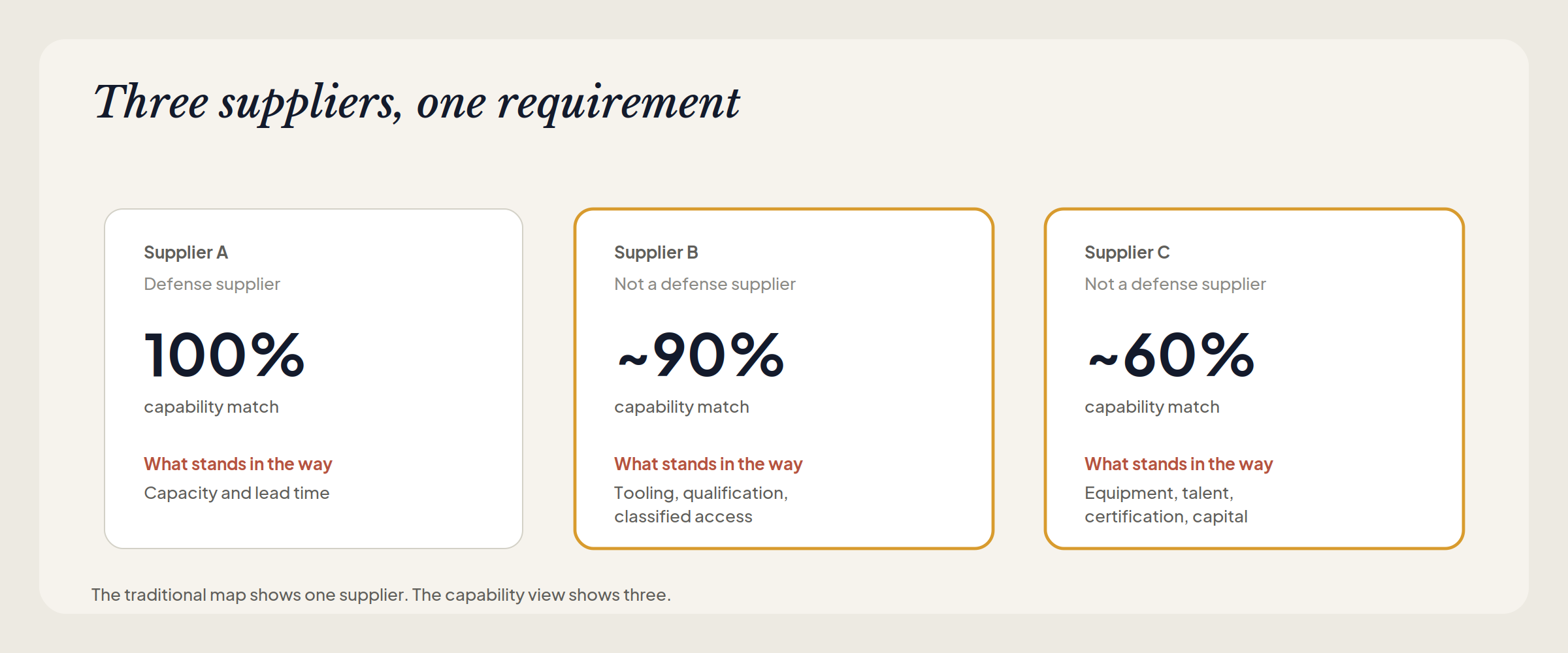 The traditional map shows one supplier. The capability view shows three options with different costs and timelines. The gap between them is what we call Distance to Capability: how much stands between what exists and what the mission needs.
What is Activation Friction?
Activation Friction is everything standing between a capability existing and that capability becoming usable for a mission.
The Department of War just gave us a clear example. On September 3, 2026, it launched the Secure Space Network. The program will deploy about 50 mobile Sensitive Compartmented Information Facilities at military installations, APEX Accelerators, and other sites.
The Department said many companies with technology relevant to national security lack access to accredited facilities. It also said building fixed classified infrastructure is a barrier for emerging and nontraditional suppliers.
Consider what that means. A company can have the technology, the engineers, the equipment, the capacity, and the willingness to help. It can still contribute nothing because it cannot enter the room where the problem is discussed.
There is a second lesson in the fine print. A mobile SCIF does not grant access to classified information. Companies still need a facility security clearance to work on a classified contract. Remove one barrier and the next one becomes visible. That is why friction has to be mapped as a stack, not fixed one item at a time.
Activation Friction usually falls into four groups:
- Security: personnel and facility clearances, SCIF access, cybersecurity requirements
- Qualification: certification, first-article testing, quality system approval
- Commercial: contract vehicles, data rights, capital, government approval
- Physical: tooling, materials, workforce
Once the friction is visible, the decision changes. Consider an illustrative capability gap with two paths:
| Path | Time | Cost |
|---|---|---|
| Build new capacity | 36 months | $120 million |
| Activate adjacent commercial capacity | 8 months | $14 million |
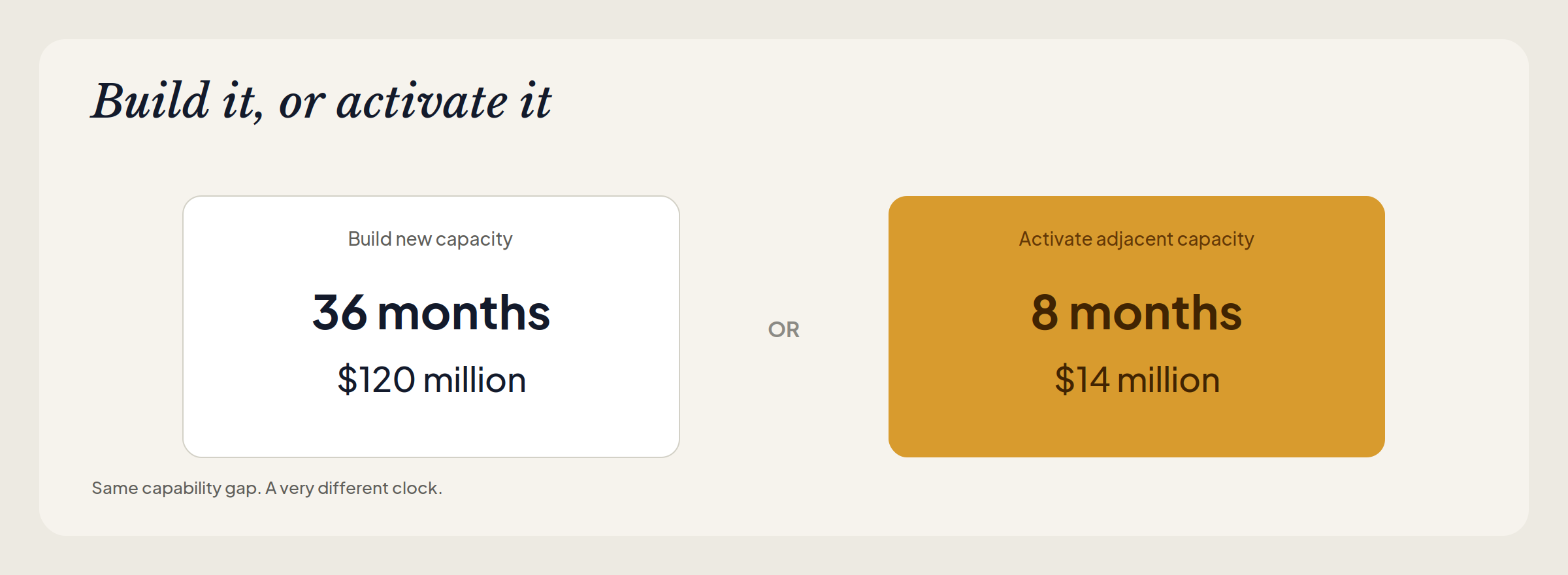 Neither path is automatically right. But now there is a real decision. The question becomes which intervention creates mission ready capability fastest at acceptable cost and risk. That is Decision Intelligence.
Why does the clock matter more now?
This week, Stephen Messer revisited Mark Leslie’s framework with Leslie himself, in The Arc of a Company’s Life Now Fits Inside a CEO’s First Term. Leslie’s original 2015 argument, The Arc of Company Life and How to Prolong It, is that companies move through creation, growth, maturity, and decline. The time to transform is while the company still has money, talent, momentum, and market power. He calls that moment the Sweet Spot of Maximum Optionality.
Messer argues that AI has compressed the clock. By his count, Kodak had roughly ten years between peak and collapse, Nokia five, BlackBerry three.
The two disagree on one point. Messer thinks the Sweet Spot is now a permanent state leaders must run continuously. Leslie thinks it still opens and closes, but on a cycle of 12 to 18 months instead of a decade.
Either way, the time available to recognize change and act on it is shrinking. That is not only a corporate problem. It is an industrial base problem.
A manufacturing capability can move through a whole arc: irrelevant to defense, then adjacent, then strategically valuable, then constrained, then obsolete. That can happen faster than supplier qualification and procurement were designed to handle.
AI accelerates technology, conflicts reshape supply chains, factories gain and lose capacity, and workforces move. A company that was irrelevant to a mission 18 months ago may now hold exactly what the mission needs. A supplier considered indispensable today can fade just as fast.
The industrial base is not a static list. It is a moving system.
The Capability Activation Model
If the industrial base is a moving system, industrial base intelligence has to start with the mission, not the vendor list. We use a six stage model:
- See the capability. Find where the required capability exists today, inside and outside the known supplier base. (Latent Capability)
- Measure the distance. Score how close each candidate sits to the requirement. (Capability Adjacency)
- Map the friction. List every barrier between that company and participation: security, qualification, commercial, physical. (Activation Friction)
- Clock the activation. Estimate how long each barrier takes to clear and what it costs. (Time to Activate)
- Test readiness. Separate could theoretically do it from can do it when we need it, at the scale we need, under the conditions that matter. (Capability Readiness)
- Choose the intervention. Compare build, activate, certify, clear, fund, retool, or contract, then act while there is still time. (Decision Intelligence)
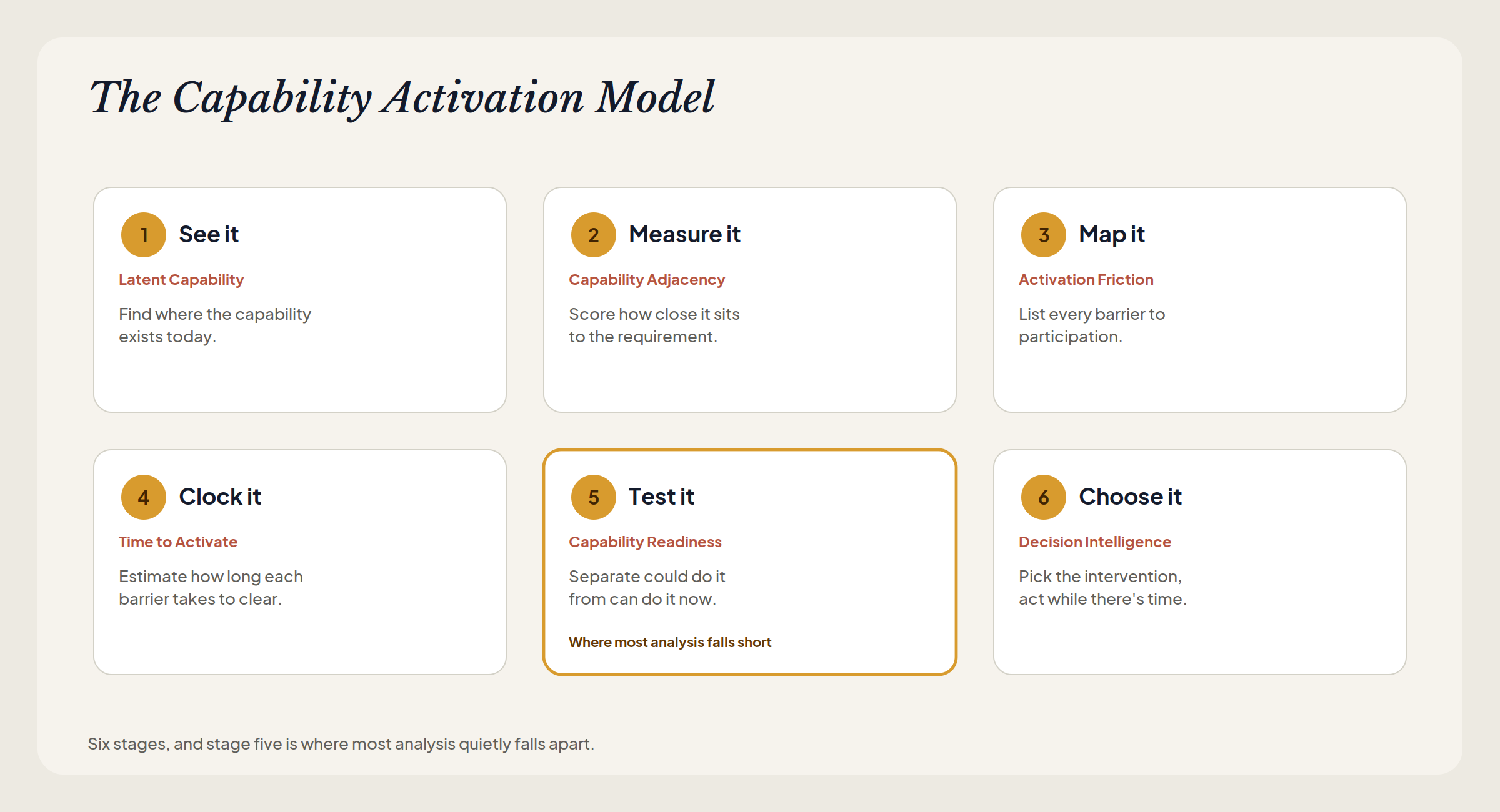 Stage five is where most analysis falls short. Owning a five-axis CNC machine does not mean the capacity is available. Having built something similar five years ago does not mean the workforce is still there.
Readiness depends on technical fit, available capacity, supplier health, dependency exposure, workforce, certification, security, geography, cost, and mission urgency. That is a much harder problem than supplier matching, and a much more valuable one.
Put the model to work on your own requirement. Bring us one component, subsystem, or capability gap. In a 30-minute working session, we will show you how Polaris I/O maps adjacent capability and activation friction for it. Book a capability discovery session.
Hidden dependency and hidden capability are the same map, read in two directions
In Follow the Supply Chain Until the Alternatives Disappear, we traced a mission downward: mission, platform, subsystem, component, supplier, material, processing capability. Keep going until the alternatives disappear, because that is where the real risk sits.
Capability intelligence runs the same exercise outward: mission requirement, required capability, known suppliers, adjacent industries, adjacent companies, existing equipment, available capacity, activation requirements.
One direction finds hidden dependency. The other finds hidden capability. Resilience needs both, because resilience is not only knowing what you depend on. It is knowing what else you could depend on if the world changes. We introduced both ideas in The Capability You Need Already Exists. You Just Cannot See It.
Why is optionality a national security asset?
Leslie’s Sweet Spot is valuable because it gives a company several ways to respond before circumstances force a choice. National capability works the same way.
A mission that depends on one qualified supplier has almost no options. Compare a mission that has all of these:
- Two existing suppliers
- Four adjacent suppliers
- Three commercial manufacturers capable of conversion
- Two technologies that could remove the dependency entirely
You may never activate most of them. The value is knowing they exist and what it would take to activate them before you need to.
Optionality without visibility is theoretical. Visibility without time is useless.
Five questions to ask before funding the next factory
Building new capacity is sometimes the right call. It should not be the automatic one. Before committing three years and nine figures, ask:
- Where does 80 percent of this capability already exist outside our supplier list?
- What single barrier keeps the closest candidate from participating today?
- How long would it take to clear that barrier, and who owns it?
- What dependencies would a new supplier share with the current one?
- What would we learn by activating one adjacent supplier in parallel with the build?
Sometimes the answer will still be build. More often, it is certify, clear, connect, fund, retool, qualify, contract, or simply removing the one barrier in the way.
The Secure Space Network is a physical version of that idea. The government is not building new technology companies. It is removing one obstacle that keeps existing ones out of the room.
How does Polaris I/O help?
Polaris I/O is a decision intelligence platform. It connects what is changing outside your organization with the data you already hold, so your team sees capability, constraints, and options months before they show up in internal reporting.
The difference is easiest to see side by side.
| The job | How it usually works | How it works with Polaris I/O |
|---|---|---|
| Finding candidates | Search the approved supplier list and send surveys | Continuously monitor companies inside and outside the supplier base for signals of relevant capability and capacity |
| Judging readiness | Take a supplier’s yes at face value | Weigh hiring, overtime, capital spending, leadership changes, financial health, and competing programs to separate stated capacity from executable capacity |
| Spotting friction and drift | Find out after a delivery slips | Read your contracts, track the variables that matter, and flag when performance, delivery, pricing, capacity, or compliance starts moving away from plan |
| Choosing a response | Analysts assemble a brief from disconnected sources | Receive a Risk Report with qualified alternatives, ranked mitigation options, and a risk action plan, each linked to its evidence |
What each part of the platform does
Signal Monitoring watches the external environment for developments tied to your priorities: supplier health, regional risk, operational capacity, market movement, leadership, labor, and compliance. Every Signal states what changed, why it matters, who or what is affected, and the evidence and confidence behind it.
Pattern Engine connects related Signals with your own data, shared through APIs, SFTP, or uploads, and tracks how the picture develops over time. One unfilled machinist posting means little. Together, these signals describe a supplier approaching the limit of what it can actually deliver:
- Rising overtime
- Flat capital spending
- A second customer announcing a production ramp
- Longer equipment lead times
Decision Activation turns that picture into action: prioritized situations, Risk Reports, recommended next steps, alerts, and Polaris Assist workflows that draft risk mitigation options. Every recommendation stays connected to the underlying Signals and sources, so your team can check the reasoning before acting on it.
Why this matters now
An Oliver Wyman survey of more than 160 U.S. defense manufacturers, published in July 2026, found that 45 percent could not double production within a year without significant new investment. Specialized long-lead tooling was named a hard constraint by 77 percent, and 71 percent cited shortages of cleared or specialized labor.
Those are exactly the frictions that decide whether an adjacent supplier can be activated in time. They appear in external signals long before they appear in a delivery report. Leo Sayavedra covers the research in The Defense Industrial Base Doesn’t Have a Demand Problem. It Has a Capacity Intelligence Problem.
People stay in control. Polaris I/O does not make the decision. It gives your team the evidence, the priorities, and the options. Customer data is protected with encryption at rest and in transit, private AWS networking, role-based access controls, and governed agent access.
The underlying problem is not unique to defense. A fraud pattern building across thousands of accounts and a supplier’s capability going quiet before a mission needs it are the same kind of problem: scattered signals that mean nothing alone and everything together.
“Polaris I/O has streamlined our access to key industry data, helping us make faster, smarter decisions.”
Leslie Lagan, Senior Director, Fraud Management, T-Mobile
Polaris I/O supports program offices, prime contractors, supplier development teams, and investors. See our defense solutions or request a briefing.
The industrial base is bigger than we think
Ford is still an automaker. So are General Motors and Jaguar Land Rover. Each one holds capabilities that can serve missions far beyond the category we use to describe it.
The next defense supplier may not be in the defense supplier database. The next critical manufacturing capability may be sitting inside a factory built for a different market. The machines, the engineers, the suppliers, and the scale may already be in place. The missing piece may be tooling, a certification, a contract, a clearance, a secure room, or simply someone recognizing that the capability is there.
Seeing that capability early, measuring how far it sits from the mission, and acting before the window closes is the work Polaris I/O was built for.
In a world where the arc of change keeps compressing, the question is no longer only who our defense suppliers are.
It is who could become one fast enough to matter.
Find your next supplier before the window closes. If your program office, prime, or portfolio is deciding whether to build new capacity or activate what already exists, bring us the requirement and we will show you what Polaris I/O sees. Schedule a demo.
Frequently asked questions
What is Latent Capability in the defense industrial base?
Latent Capability is manufacturing, engineering, or technical capacity that already exists in the commercial economy but is not yet connected to a defense mission. GM Defense delivering Patriot interceptor housings 22 days after signing with Lockheed Martin in 2026 is a clear example of Latent Capability being activated.
What is Activation Friction?
Activation Friction is the set of barriers between a capability existing and that capability becoming usable for a mission. Common examples include security clearances, SCIF access, certification, qualification, contract vehicles, data rights, tooling, capital, and workforce. Mapping these barriers shows whether activating an existing supplier is faster than building new capacity.
What is the Department of War Secure Space Network?
The Secure Space Network is a Department of War initiative announced September 3, 2026, to deploy about 50 mobile Sensitive Compartmented Information Facilities across the United States. It aims to help emerging and nontraditional suppliers take part in classified work. Companies still need a facility security clearance to perform on classified contracts.
Why are automakers bidding for defense contracts?
Rising Western defense budgets, slowing car sales, and competition from Chinese automakers have left companies like Ford, GM, and Jaguar Land Rover with spare capacity. They are bidding with modified versions of vehicles they already build and selling idle plants to defense firms. Analysts expect the revenue impact on automakers to stay small.
How did GM deliver Patriot missile parts in 22 days?
GM Defense used General Motors’ existing casting, machining, and high-volume manufacturing capability. The contract was signed August 6, 2026, and the first housing components reached Lockheed Martin on August 28. The companies had announced a broader collaboration in June, so engineering work began before the contract was signed.
What is the difference between capability existence and Capability Readiness?
Capability existence means a company could theoretically do the work. Capability Readiness means it can do the work when the mission needs it, at the required scale, under real security and quality conditions. Readiness depends on available capacity, workforce, certification, supplier health, dependencies, and time to activate.
How does Polaris I/O help find nontraditional defense suppliers?
Polaris I/O monitors supplier health, capacity, hiring, leadership, financial, and compliance signals across companies inside and outside a customer’s supplier base. It connects them with the customer’s own supplier and program data. It then delivers Risk Reports with qualified alternatives, ranked mitigation options, and alerts, each linked to its supporting evidence, so teams can act before the window closes.
Sources and further reading
Reuters, September 28, 2026: From pickups to idle plants: automakers seek lifeline from defence boom
U.S. Department of War, September 3, 2026: Department of War Launches Secure Space Network to Break Down Barriers to Classified Defense Work
Holland & Knight, September 2026: Mobile SCIF Network Will Expand Classified Opportunities for Cleared Contractors
Defense News, September 17, 2026: Lockheed Martin gets first batch of Patriot interceptor parts from General Motors
Stephen Messer and Mark Leslie, September 28, 2026: The Arc of a Company’s Life Now Fits Inside a CEO’s First Term
Mark Leslie, First Round Review, 2015: The Arc of Company Life and How to Prolong It
Oliver Wyman, July 2026: US defense supply chain: 6 reasons it is falling behind
Polaris I/O: The Capability You Need Already Exists. You Just Cannot See It.
Polaris I/O: Follow the Supply Chain Until the Alternatives Disappear
Polaris I/O: The Defense Industrial Base Doesn’t Have a Demand Problem. It Has a Capacity Intelligence Problem.
Polaris I/O: Moving as Fast as the World Outside: Why Supply-Chain Resilience Requires External Foresight