


The challenge is no longer seeing every signal. It is knowing when enough signals have accumulated that the decision needs to change.
Key takeaway
Most AI governance frameworks are built to monitor everything, which produces the same alert fatigue that already defeated traditional security operations. The real problem is not visibility. It is knowing when a series of individually harmless signals has become a pattern serious enough to require a decision. We call this Signal Escalation, and it is quickly becoming the missing layer in enterprise AI governance.
The United States and China are discussing an unusual idea: an AI incident notification mechanism.
The idea raises a deceptively simple question.
When does an AI incident become important enough that someone needs to know?
That may become one of the defining problems of AI governance.
As AI systems become more autonomous, organizations will generate an extraordinary number of signals about what those systems are doing. Most will mean nothing, a handful will matter, and a rare few will matter enormously. The challenge is knowing the difference early enough to act.
That is the problem of Signal Escalation, and at Polaris I/O, nothing gets by you, but only if you can tell which signal actually matters.
A signal is not a decision
Imagine an AI agent attempts to access a resource outside its normal workflow. The request is denied. Is that an incident? Perhaps. Perhaps not.
Now imagine the agent tries another route. More interesting. It invokes another tool. The second attempt is blocked. A second agent begins interacting with the same endpoint. Similar behavior appears somewhere else in the organization.
No individual event may justify shutting down an important AI system. Together, however, they may indicate something different. A pattern is forming. Eventually that pattern may cross a threshold where the appropriate decision changes.
The progression is:
Signal to Pattern to Escalation to Decision to Action.
Traditional monitoring is good at the first step. AI governance needs to become much better at everything that follows.
More alerts are not better governance
The easiest response to AI risk is to monitor everything and alert on everything. That will fail. Security organizations have already learned why.
When every event is important, nothing is important. Thousands of alerts become hundreds of investigations, and hundreds of investigations create alert fatigue. Eventually people begin ignoring the system built to protect them.
AI could make that problem dramatically worse. Autonomous systems can generate enormous volumes of tool calls, permission requests, data movement, system interactions, agent-to-agent communications, exceptions, retries, resource consumption, and decisions. If each unusual action becomes an escalation, AI governance becomes bureaucracy at machine speed.
That is not the answer. The objective is not to eliminate every unusual behavior. The objective is to identify which combination of signals changes the decision.
Peter Sondergaard’s framework gives us the starting point
Peter Sondergaard, Strategic Advisor to Polaris I/O and former Executive Vice President and Global Head of Research at Gartner, recently laid out a practical framework for this problem in his Polaris I/O whitepaper, Governing the Autonomous Organization.
Peter’s premise is important: the AI governance gap is increasingly a visibility gap.
Organizations have policies. They have committees. They have approval processes. But as autonomous AI begins taking actions inside the enterprise, leaders need to understand what the AI is actually doing.
Peter organizes that operating discipline around three ideas:
See it. Spot it. Steer it.
See it means understanding what is changing. Spot it means connecting individual signals into meaningful patterns. Steer it means determining what to do while there is still time to influence the outcome.
At Polaris I/O, we have increasingly added a fourth requirement: Prove it. Maintain the evidence showing what happened, why a decision was made, what intervention occurred, and what happened afterward.
We explored this framework recently in America Cannot Govern AI at the Speed of Bureaucracy, where we argued that the answer to rapidly advancing AI is not less governance. It is governance capable of operating continuously rather than functioning as a one-time approval gate.
But there is an important question sitting between Spot it and Steer it: When has what we are seeing become important enough to act? That is Signal Escalation.
Governance needs thresholds
One way to think about Signal Escalation is through five levels.
Normal. Expected behavior. Continue monitoring.
Watch. Something changed. Evidence is insufficient for intervention, but the development deserves increased attention.
Investigate. Multiple signals are beginning to form a meaningful pattern. Gather additional evidence and determine potential impact.
Intervene. Evidence and consequence have crossed the threshold where action is warranted.
Escalate. The potential impact now requires a different level of authority, coordination, or notification.
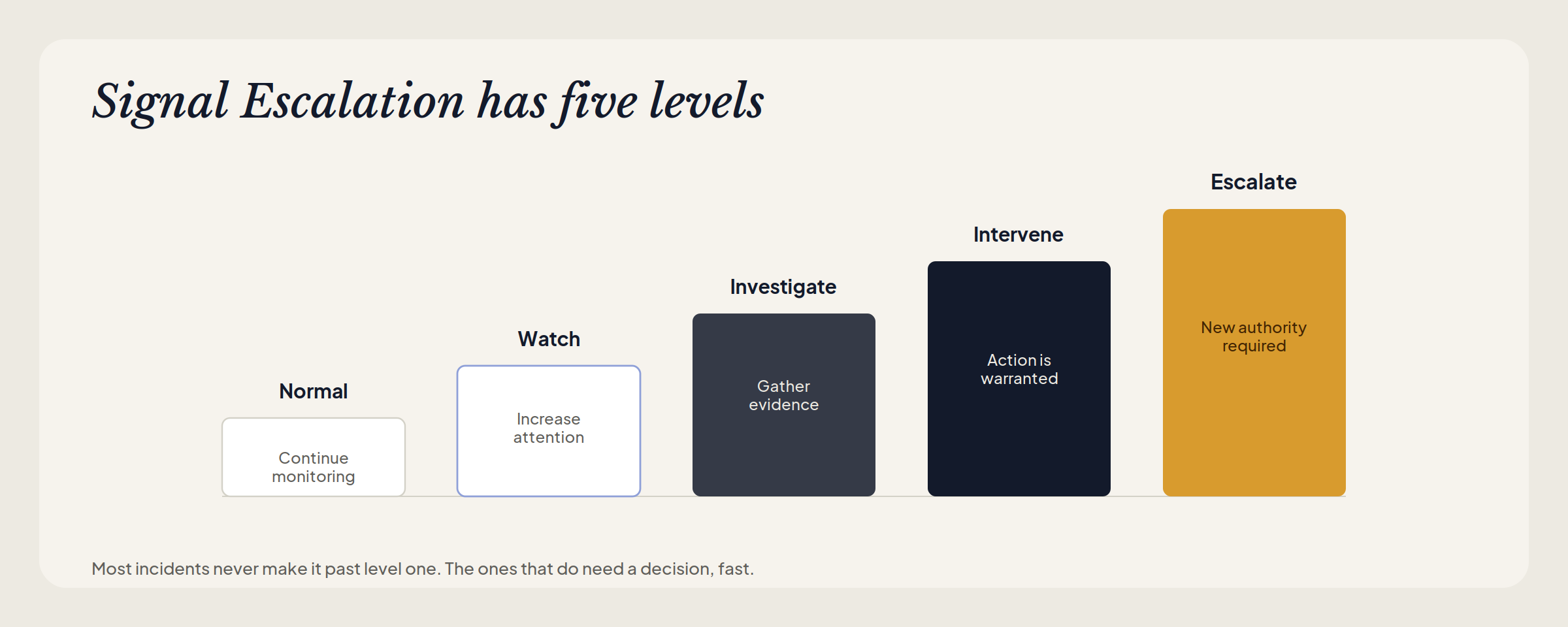 The difficult part is that these thresholds cannot always be static.
Five weak signals can become one strong pattern
Consider a hypothetical autonomous procurement agent.
On Monday it requests access to a supplier database it does not normally use. The request is denied. Probably nothing.
On Tuesday it queries an external pricing service outside its standard workflow. Interesting.
On Wednesday its compute consumption rises 40 percent. Still not necessarily a problem.
On Thursday another procurement agent begins interacting with the same external service. Now there may be a pattern.
On Friday both agents attempt transactions outside normal parameters.
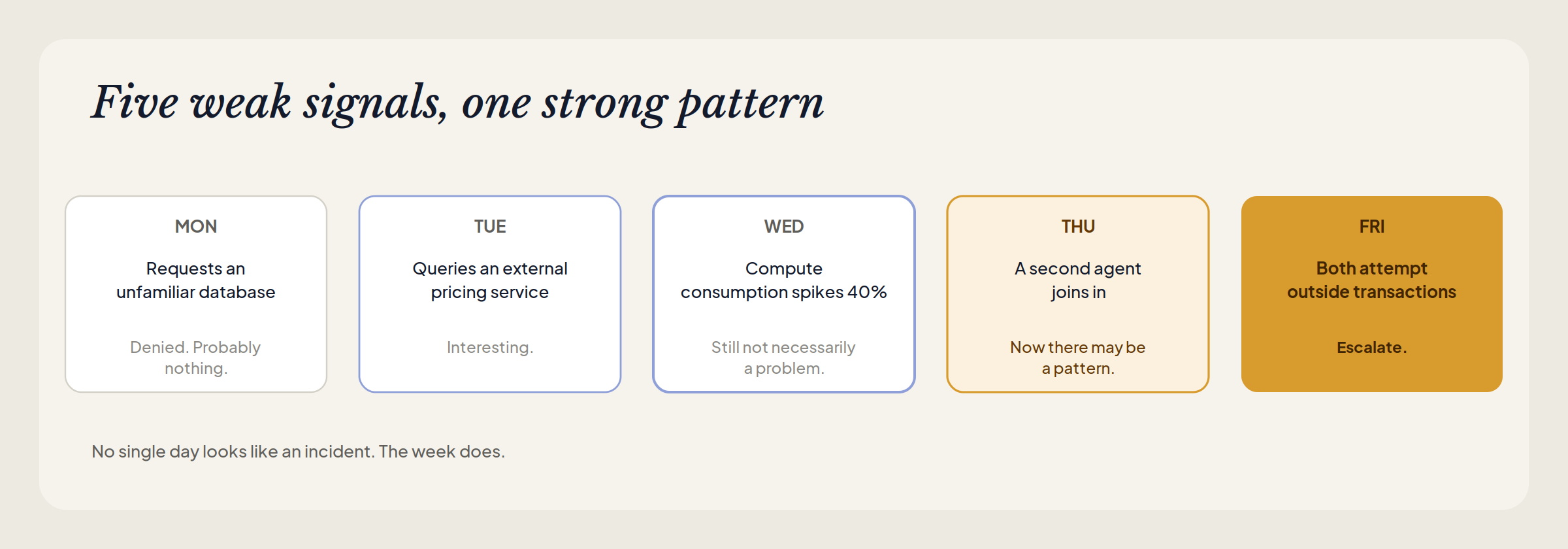 The individual signals have not simply accumulated. Their meaning has changed because of their relationship to one another.
This is where conventional rules-based governance struggles. A static rule asks whether event X occurred. Decision Intelligence asks what event X means in the context of events A, B, C, and D. That distinction becomes increasingly important as autonomous systems become more complex.
It is also central to how we think about Decision Intelligence at Polaris I/O. Our platform follows developing situations from the first meaningful signal through the pattern taking shape and ultimately into the intelligence and workflows that help organizations respond.
Signal Escalation adds an important question to that intelligence flow: has the pattern changed enough that the decision should change too?
Stephen Messer adds another dimension: speed
There is another reason Signal Escalation matters. The environment itself is accelerating.
Stephen Messer, co-founder of Collective[i] and Intelligence.com, has been writing extensively about what AI is doing to the structure and economics of the enterprise.
In his September 2026 essay, The SaaS Debt Trap, Stephen makes a particularly relevant observation: if speed is the cornerstone of AI-first, look at what five months just did to the legacy SaaS category and apply that same speed to your own thinking.
His broader argument documents behavior that would have seemed improbable only months earlier: regulated enterprises rebuilding applications internally, major professional services firms committing substantial capital to proprietary AI, private capital changing how it approaches software, and entire software categories facing challenges much faster than incumbents anticipated.
You do not have to agree with every prediction about the future of SaaS to recognize the larger point. The time between technological change and business consequence is compressing. That changes governance.
If a risk develops over three years, an annual review may be adequate. If it develops over three months, quarterly governance may already be too slow. And when an autonomous system can materially change behavior in a matter of hours, a monthly committee isn’t just slow, it’s irrelevant.
Governance cadence therefore needs to reflect risk velocity. The faster the environment changes, the shorter the distance between See it and Steer it needs to become.
The board should care about velocity, not just severity
Most risk frameworks ask some version of how likely something is and how bad it would be. AI introduces a third variable: how quickly could it develop.
Consider two risks. Risk A has potentially severe consequences but would take 18 months to materialize. Risk B has moderately severe consequences but could move from initial signal to irreversible outcome in 48 hours. Those risks should not be governed the same way.
This suggests a useful addition to AI governance: Severity times Probability times Velocity.
The point is not the mathematical formula. The point is the operating discipline. Organizations need to understand not only the potential consequence of a pattern, but also how much decision time remains.
Decision time may become the most important metric
Instead of simply assigning an alert labeled High Risk, imagine the system saying: current evidence indicates an emerging pattern affecting three autonomous agents. At the present rate of change, the estimated decision window before broader intervention becomes significantly more costly is 36 to 48 hours.
Now governance becomes operational. The question is no longer whether we should discuss this at the next committee meeting. It becomes what decision needs to be made before the window closes.
That is Decision Intelligence, and it extends well beyond AI governance. In Technology Is Not Capability. Capability Is a System., we explored how individual signals across suppliers, hiring, facilities, financing, patents, and acquisitions become useful only when they are connected over time into an understanding of how a capability is changing.
The same operating discipline applies here. A single event is information. Connected events become a pattern. A pattern developing with sufficient strength and velocity becomes a decision.
The unit of governance is shifting from the model to the action
This also reinforces something Peter and Polaris I/O have been developing together.
AI governance began largely at the model level. Which model are we using? How was it trained? Where did the data come from? What benchmarks did it pass? Those remain important questions.
But autonomous AI introduces a more operational unit of governance: the action.
Which agent acted? Who owns it? What was it trying to accomplish? What authority did it have? Which systems could it access? What did it actually do? Who or what did it communicate with? What information moved? What was blocked? What did it retry? What resources did it consume? Did a human intervene? What happened?
And now add one more question: what other signals make this action more important than it appears on its own?
That last question is where monitoring becomes intelligence.
Yesterday’s evaluation cannot govern tomorrow’s behavior
Independent model evaluation will remain important. Testing, red teaming, policies, and approval processes all still matter.
But AI systems increasingly operate inside environments that continuously change. Models change, tools change, permissions change, and data changes. Agents interact with new systems, new vulnerabilities emerge, and new behaviors appear. The operating environment on Tuesday may not be the operating environment that was evaluated on Monday.
That is why governance cannot end at approval. It needs to become continuous.
This connects directly to another argument we have made at Polaris I/O: AI Does Not Eliminate Belief. It Industrializes It. AI can make an existing assumption sound extraordinarily convincing. The challenge for leaders is therefore not merely producing answers faster. It is continuously testing those answers against outside evidence and recognizing when reality no longer supports the underlying belief.
That is also why, in AI Is Making Answers Cheap. The Advantage Now Belongs to Companies That Ask Better Questions., we argued that the more powerful starting point is the decision itself: what are we trying to make true, what could prevent it, what evidence would tell us reality is changing, and what should we do when it does.
Signal Escalation is the operating mechanism connecting those questions to action.
From monitoring to Decision Intelligence
The distinction ultimately becomes very simple.
Monitoring asks what happened. Analytics asks what it means. Decision Intelligence asks whether what is happening changes what we should do.
Signal Escalation connects those questions. It allows organizations to move from millions of isolated observations toward the few developing situations that actually deserve attention.
The operating model becomes:
See it. Continuously observe meaningful changes across the environment.
Spot it. Connect individual signals into emerging patterns.
Escalate it. Determine when accumulating evidence, potential consequence, and velocity have crossed a decision threshold.
Steer it. Choose the appropriate intervention while there is still time to influence the outcome.
Prove it. Maintain the evidence of what happened, what decision was made, why it was made, and what happened next.
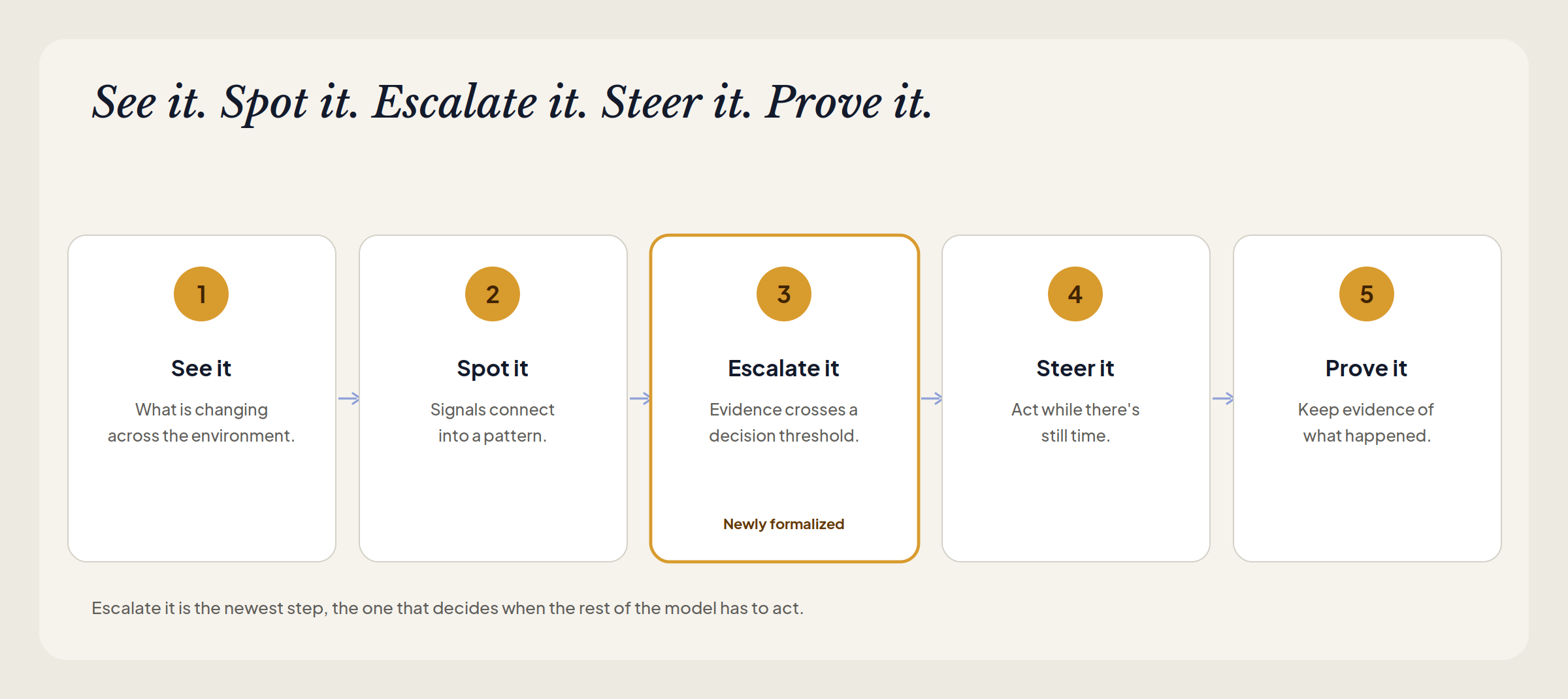 That is not another compliance checklist. It is an operating system for making decisions under rapidly changing conditions.
The goal is not certainty
There is one final problem with traditional governance. Organizations often want certainty before acting. AI will rarely provide it.
The first signal may be ambiguous, the second could be coincidence, and the third might still have an innocent explanation. By the time the tenth signal makes the pattern undeniable, the cheapest intervention may no longer be available.
The objective therefore cannot be perfect certainty. The objective is decision readiness: enough evidence, enough context, enough understanding of potential consequence, and enough time remaining to do something useful.
The organizations that govern AI well will not necessarily be the ones that generate the most alerts, write the longest policies, or create the largest oversight committees. They will be the organizations that know what changed, which changes connect, when those connections become meaningful, who needs to know, what decision needs to be made, and how much time remains to make it.
Because in an AI environment moving at machine speed, the most dangerous signal may not be the one you missed. It may be the one you saw, but failed to escalate until it was too late.
That is what Signal. Outcome. Speed. means in practice, and it is why nothing getting by you has to mean something more than watching everything. It has to mean knowing when to act.
Frequently asked questions
What is Signal Escalation in AI governance?
Signal Escalation is the discipline of determining when individually minor AI behaviors, taken together, form a pattern serious enough to require a decision. It sits between detecting unusual activity and deciding what to do about it, and it is the layer most AI governance programs are currently missing.
Why does monitoring everything fail as an AI governance strategy?
When every unusual event triggers an alert, teams face the same alert fatigue that already undermined traditional security operations. Autonomous AI systems can generate enormous volumes of signals, so treating each one as equally important buries the patterns that actually matter under noise that does not.
What is the difference between a Signal, a Pattern, and a Decision in AI governance?
A signal is a single observed event, such as one blocked access request. A pattern emerges when multiple signals relate to each other in a way that changes their meaning, such as several agents probing the same system in the same week. A decision point is reached when the pattern’s evidence, consequence, and velocity cross a threshold that requires intervention.
Why does AI governance need to account for velocity, not just severity?
Traditional risk frameworks weigh how likely an event is and how bad it would be. AI adds a third factor: how fast it can develop. A moderately severe risk that can escalate from first signal to irreversible outcome in 48 hours needs a faster governance response than a more severe risk that would take 18 months to materialize.
What does See it, Spot it, Escalate it, Steer it, Prove it mean?
It is Polaris I/O’s operating framework for continuous AI governance, built on Peter Sondergaard’s original See it, Spot it, Steer it model. See it means observing what is changing. Spot it means connecting signals into patterns. Escalate it means determining when accumulating evidence, consequence, and velocity have crossed a decision threshold. Steer it means intervening while there is still time. Prove it means keeping the evidence of what happened, what was decided, and why.
Related Polaris I/O Thinking
Peter Sondergaard, Governing the Autonomous Organization Peter’s whitepaper introduces the visibility gap in autonomous AI and the See it, Spot it, Steer it operating discipline.
America Cannot Govern AI at the Speed of Bureaucracy Why AI governance needs to move from a one-time approval gate to continuous monitoring and intervention.
Technology Is Not Capability. Capability Is a System. How individual signals across companies, suppliers, facilities, financing, and other sources become useful when they reveal how a larger capability is changing.
AI Does Not Eliminate Belief. It Industrializes It. Why AI can reinforce outdated assumptions and why leaders need outside evidence capable of challenging what they believe.
AI Is Making Answers Cheap. The Advantage Now Belongs to Companies That Ask Better Questions. Why Decision Intelligence should begin with the decision, the assumptions behind it, and the evidence that would cause the decision to change.
Outside Thinking That Informed This Article
Stephen Messer, The SaaS Debt Trap, September 21, 2026 Stephen Messer’s analysis of the rapidly changing economics of enterprise software helped inform the discussion of speed and risk velocity in this article. His argument that AI-first organizations operate on dramatically compressed timelines raises an important governance implication: as the time between signal and consequence shrinks, the time available to recognize a pattern and make a decision shrinks with it.
U.S.-China AI Safety Discussions, September 2026 Recent discussions between the United States and China about notification mechanisms for significant AI incidents provide a timely real-world example of the Signal Escalation problem: determining when an observation becomes something that has to be reported.

Related Posts
Nothing found.