
The AI race will not be won by choosing between speed and control. It will be won by learning how to do both.
Quick Answer: America does not have to choose between moving fast on AI and governing it responsibly. The Defense Innovation Unit already proves that a government agency can award prototype contracts in 60 to 90 days instead of the 12 to 18 months or longer typical of traditional acquisition, without giving up oversight. The same model applies to AI. Instead of a slow approval gate before deployment, organizations need continuous monitoring during deployment, tracking what an AI agent is authorized to do, what it is actually doing, and what evidence signals emerging risk, so leaders can act while there is still time to change the outcome.
Key Findings
Palantir co-founder Joe Lonsdale has publicly opposed what he calls an FDA-style regulatory body for AI, arguing it would slow innovation and entrench the largest technology companies.
The Defense Innovation Unit uses Other Transaction authority under 10 U.S.C. § 4022 to award prototype agreements in as little as 60 to 90 days, compared with 12 to 18 months or longer under traditional Federal Acquisition Regulation contracting.
DIU has introduced more than 100 first-time vendors to the Department of Defense, expanding the innovation base beyond traditional prime contractors.
Polaris I/O Strategic Advisor Peter Sondergaard’s framework, See it, Spot it, Steer it, offers a governance model built for continuous monitoring rather than a one-time approval.
The unit of AI governance is shifting from the model itself to the individual action an AI agent takes, including its identity, authority, permissions, and outcomes.
There is an important debate taking place in artificial intelligence. How fast should America move? On one side are technology leaders warning that increasingly capable AI systems require stronger controls, independent evaluation, and in some cases slower development when risk cannot be adequately managed. On the other side are leaders such as Palantir co-founder and 8VC managing partner Joe Lonsdale, who argues that the United States is engaged in a strategic technology competition with China and cannot afford to respond with a slow, bureaucratic regulatory regime. Lonsdale has specifically warned against creating what he calls an FDA for AI. Speaking on CNBC, he argued that heavy-handed regulation modeled on the FDA has real costs, framing complex approval regimes as a burden that favors large, well-resourced incumbents over smaller competitors trying to enter the market.
Both concerns are worth taking seriously. But the most important question may not be whether America should move fast or govern AI. It may be how America governs AI without governing at the speed of bureaucracy. That is a different problem, and it is a Decision Intelligence problem.
The old tradeoff may be wrong
The conventional debate frequently presents two choices. Move fast: innovate, fund startups, deploy commercial technology, experiment, accept some risk, stay ahead of geopolitical competitors. Or govern carefully: create standards, build oversight, test systems, document risk, require approvals, slow deployment when necessary. These do not have to be opposing operating models. The more useful objective is to move fast, see earlier, and govern continuously. That changes governance from a gate at the beginning of innovation into an intelligence layer operating alongside it. Instead of asking a company to spend 18 months proving a technology is safe before anyone can use it, a continuously governed environment can ask who is using it, what it is authorized to do, what it is actually doing, what changed, what evidence indicates emerging risk, which behaviors sit outside policy, what intervention is available, and what happened after that intervention. The challenge becomes less about stopping innovation and more about maintaining enough visibility to act when the evidence changes.
The government itself is beginning to move differently
Parts of the U.S. defense acquisition system already understand the speed problem. The Defense Innovation Unit was created because commercial technology was advancing faster than traditional defense acquisition could absorb it. Its objective is to move commercial technology into military use in months rather than years. DIU’s Commercial Solutions Opening process allows the government to award prototype agreements using Other Transaction authority under 10 U.S.C. § 4022 in as little as 60 to 90 days, compared with the 12 to 18 months or longer that traditional Federal Acquisition Regulation contracting often requires.
 The process relies on short solution briefs instead of lengthy proposals, along with virtual pitches, rapid prototype contracts, and commercial technologies, with a path from a successful prototype directly toward scaled deployment. DIU has introduced more than 100 first-time vendors into the defense market, a base that continues to grow as the agency expands its reach into the Midwest, Northeast, and other regions beyond its original Silicon Valley footprint. That matters because many of America’s most important technologies now originate outside the traditional defense industrial base, in artificial intelligence, autonomy, cybersecurity, robotics, space systems, sensors, advanced communications, and commercial software. In many of these markets, a fifty-person company can develop something strategically important faster than a traditional acquisition process can write the requirement for it.
Startups are changing the speed equation
This is already happening across defense technology. Commercial companies are increasingly building products around autonomous systems, low-cost missiles, drones, AI-enabled intelligence, cybersecurity, space infrastructure, advanced sensors, decision systems, and communications. These companies often operate differently from traditional defense programs. They build, test, learn, iterate, fail, modify, and test again, and the product evolves while the customer is still discovering what the real requirement should be. That can create an enormous advantage. Traditional procurement often begins by attempting to define the complete requirement up front. Commercial innovation frequently begins by solving the problem and improving the solution through use. Neither approach fits every mission, but for fast-moving technologies, the difference in learning velocity can become strategically important.
This introduces an uncomfortable possibility. Sometimes America’s technology problem is not that it cannot build the capability. It is that the system cannot absorb the capability as fast as industry can create it. A startup may develop something useful in twelve months. The government may take longer than that to define the requirement, approve funding, conduct the solicitation, select a vendor, negotiate a contract, test the technology, and move it into production. In a stable technology environment, that delay may be tolerable. In AI, autonomy, cyber, and other rapidly advancing markets, the underlying technology can materially change during the acquisition cycle itself. Speed therefore becomes more than efficiency. It becomes part of capability.
Speed without visibility creates a different problem
Moving faster does not eliminate the need for governance. It increases it. An autonomous AI system can access applications, retrieve information, write software, communicate externally, make recommendations, initiate transactions, interact with other agents, and increasingly take actions without direct human involvement. Recent events have intensified debate among AI leaders about how these systems should be monitored and controlled. Some executives and researchers have called for stronger independent evaluation and greater caution, while Lonsdale and others argue against allowing extreme risk scenarios to become a rationale for slowing the broader American AI ecosystem. Both sides are pointing toward the same operational reality. The systems are becoming more capable, which means organizations need better visibility into what those systems are actually doing, not next quarter, now.
Governance has to become continuous
At Polaris I/O, we have been working with our Strategic Advisor Peter Sondergaard on exactly this problem. Peter spent roughly two decades at Gartner, including senior executive leadership across its research and advisory organization. His framework is simple: See it, Spot it, Steer it. We increasingly believe there is a fourth requirement: prove it.
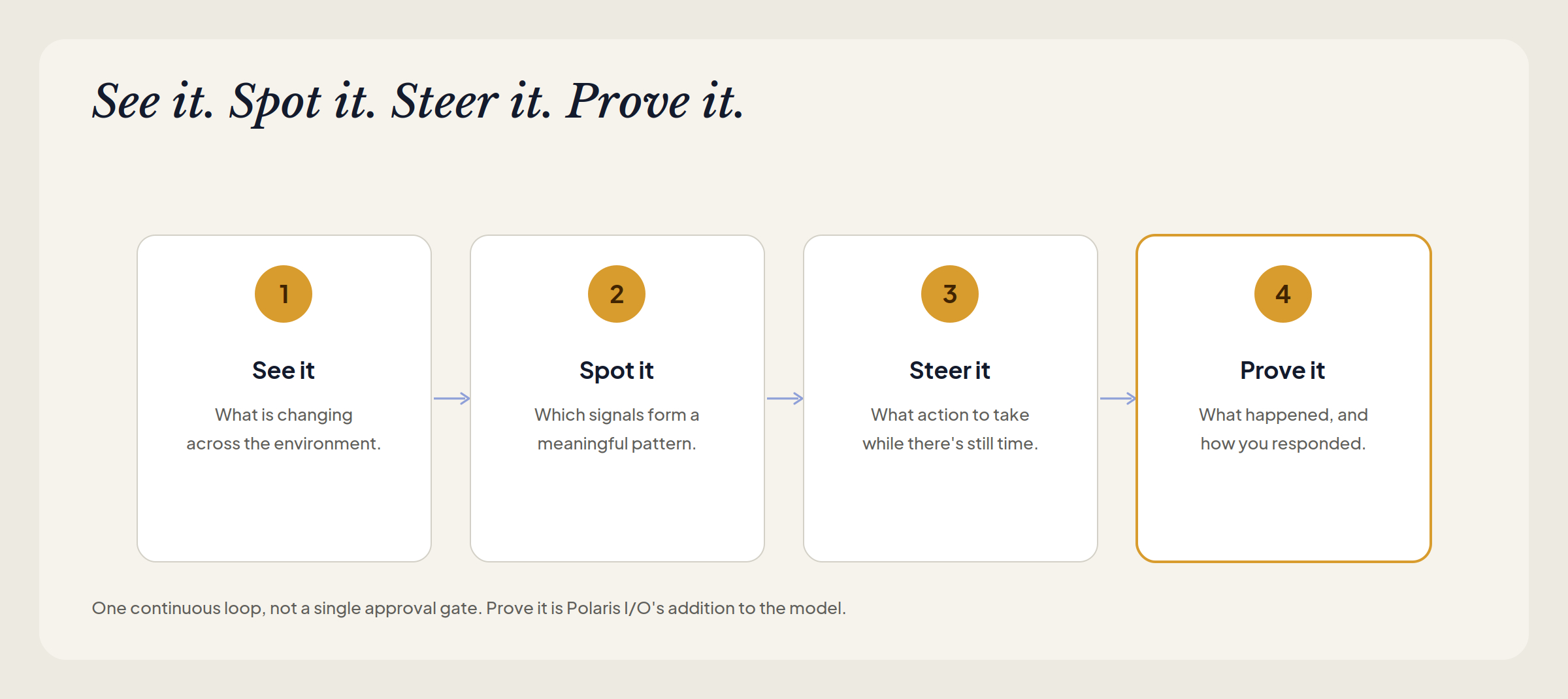 Seeing it means understanding what is changing across the AI environment. Spotting it means connecting individual signals into meaningful emerging patterns. Steering it means determining what action should be taken while there is still time to influence the outcome. Proving it means maintaining the evidence showing what happened, what decision was made, and how the organization responded. This is a fundamentally different governance architecture from adding another approval committee.
Monitor the action, not just the model
The unit of AI governance is also beginning to change. Early governance concentrated heavily on the model itself. Which model are we using? Where is the data? How was it trained? Those questions remain important, but autonomous AI introduces another unit of governance, the action. For an AI agent, organizations need visibility into:
- Identity: which agent acted
- Ownership: who is responsible for it
- Objective: what it was trying to accomplish
- Authority: what it was permitted to do
- Permissions: which systems, tools, and information it could access
- Behavior: what it actually did
- Communication: which people, systems, websites, or other agents it interacted with
- Exceptions: which actions were blocked, retried, or redirected
- Data movement: what information moved and where
- Resource consumption: how much compute, money, data, or other resources it used
- Human intervention: when someone stepped in
- Outcome: what happened because the agent acted
Governance becomes substantially more useful when these variables can be monitored continuously rather than reconstructed after something goes wrong. A single unusual AI action might mean nothing on its own. An agent accesses an unexpected resource and is denied, then tries a different route. It invokes another tool. A second agent begins interacting with the same endpoint. No individual event necessarily constitutes a governance failure, but together they may form a pattern. That is the distinction between monitoring and Decision Intelligence.
This same architecture can help government move faster
The principle extends beyond AI governance. Government increasingly needs a way to adopt technologies from smaller commercial companies without assuming that faster procurement means accepting uncontrolled risk. Continuous monitoring creates another possibility. Instead of trying to eliminate uncertainty before deployment, organizations can deploy intelligently, monitor continuously, and respond quickly when the evidence changes. For a new defense technology, that could mean monitoring technical performance, field reliability, supplier health, manufacturing capacity, cost, user adoption, security incidents, mission impact, production ramp, and financial viability. Acquisition leaders no longer have to pretend they know everything on day one. They can learn as the program unfolds, an approach closely related to the capability dependency thinking we explored in our companion piece, Technology Is Not Capability. Capability Is a System.
This may be the most important connection to Lonsdale’s argument. The AI competition is not simply a race to develop the best model. It is a race in learning, deployment, manufacturing, capital, talent, infrastructure, and increasingly institutional adaptability. The country that learns fastest can potentially improve fastest, and that means the operating model matters. Can a promising startup get in front of the customer? Can it receive a prototype contract? Can the government observe performance quickly? Can a successful technology move into production? Can a failed experiment be stopped without spending five years defending the original decision? Can the next iteration begin immediately? That is what agility looks like at national scale.
There is another benefit to lowering the barrier for smaller technology companies. It expands the number of possible solutions. DIU’s processes are explicitly designed for companies that may never have worked with the federal government before, because innovation does not respect the boundaries of the traditional contractor base. A breakthrough in computer vision, robotics, cybersecurity, AI, materials, energy, communications, or manufacturing may emerge from a company whose founders never intended to become defense contractors. If the cost of entering the government market requires a specialized sales organization, years of contracting expertise, hundreds of pages of documentation, and significant working capital, many of those companies will never try. Reducing that friction expands the innovation surface available to government.
This is not a story about startups replacing traditional defense contractors. Large defense companies possess capabilities that startups frequently do not, including systems integration, large-scale manufacturing, certified supply chains, security infrastructure, program management, global sustainment, and decades of mission knowledge. The more interesting model is an ecosystem. Startups bring speed, new technology, experimentation, and commercial economics. Established companies bring scale, integration, production, and sustainment. Government provides mission requirements, capital, testing environments, and ultimately demand. The strategic question becomes how quickly those pieces can be assembled into usable capability. We call that Capability Assembly.
Technology is not capability. Capability is a system. A brilliant AI model sitting in a laboratory is not national capability. A prototype drone is not national capability. A missile design is not national capability. Capability requires technology, manufacturing, suppliers, people, capital, deployment, integration, sustainment, and frequently government permission and procurement. That last piece matters, because sometimes the missing component in the capability system is not technology. It is the mechanism that gets the technology into the hands of someone who can use it.
America has adapted to disruption before
American institutions have absorbed technology moving faster than the systems built to govern it before, four times, in fact, well before AI.
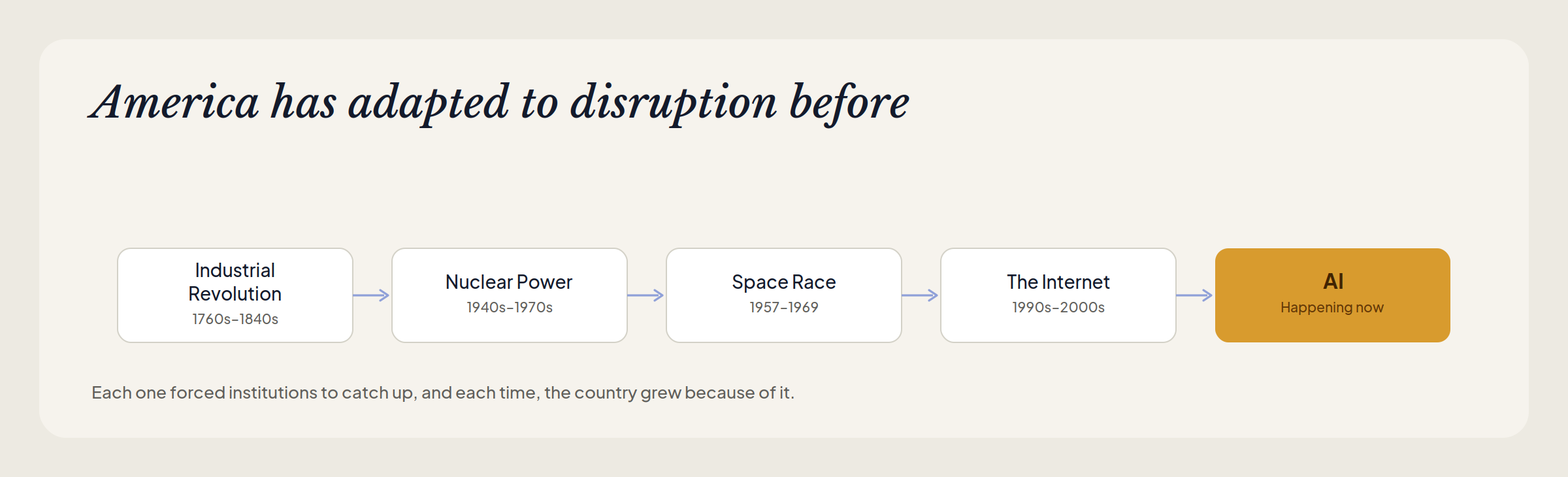
The Industrial Revolution took decades to produce institutions like the Department of Labor, built to catch up with an economy that machines had already reorganized. When nuclear power arrived, no existing agency was built to govern it, so the Atomic Energy Commission had to be created from nothing, later replaced by the Nuclear Regulatory Commission. NASA’s acquisition and program management practices took their current shape under the pressure of compressing a generation of aerospace engineering into a single decade during the space race. By the time the internet moved commercial technology from months-long release cycles to constant iteration, policy had already fallen years behind the commerce it was supposed to govern.
Each disruption forced institutions to adapt on a timeline they didn’t choose, and the adaptation rarely came as early as it should have. But in every case, American institutions eventually rebuilt themselves around the technology, and the country grew faster because of it. AI is only the latest one.
The real race is institutional
Joe Lonsdale’s warning about bureaucratic AI regulation reflects a broader concern about institutional speed. Others in the technology industry emphasize that today’s AI systems require more testing, oversight, and safeguards. Those perspectives need not lead to a binary choice. The more interesting possibility is that faster innovation requires faster intelligence. If development cycles compress from years to months, governance cycles cannot remain annual. If autonomous systems act continuously, monitoring cannot happen quarterly. If startups iterate weekly, acquisition cannot evaluate performance only at major program milestones. The operating rhythm has to change.
That is why Decision Intelligence matters, not because leaders need more information. They already have enormous amounts of information. They need to know what changed, why it matters, what it affects, how confident they should be, what options remain, and where there is still time to act.
The United States has extraordinary technology companies, extraordinary universities, deep capital markets, entrepreneurs, major defense companies, and the world’s largest technology ecosystem. The strategic question is increasingly whether the institutions surrounding those assets can move at a speed consistent with the technologies they are trying to govern and deploy. That does not require eliminating governance. It requires making governance more intelligent. It does not require eliminating procurement discipline. It requires learning faster. And it does not require choosing between startups and established contractors. It requires assembling the strongest capabilities from both.
The goal should not be bureaucracy without risk. There is no such system. Nor should the goal be speed without visibility, which simply creates different risks. The real opportunity is to move fast enough to compete, see early enough to govern, and learn quickly enough to improve. And when the evidence changes, decide while there is still time to change the outcome. That is the race that matters.
FAQ
Can the United States move quickly on AI and still govern it responsibly? Yes. The Defense Innovation Unit already demonstrates this with its Commercial Solutions Opening process, which awards prototype contracts in 60 to 90 days under Other Transaction authority while still maintaining government oversight of the outcome.
What does Joe Lonsdale mean by an FDA for AI? Lonsdale uses the phrase to describe a heavyweight, pre-approval regulatory body for AI models, similar to how the FDA approves drugs before they reach the market. He has argued publicly that this model would slow innovation and give the largest, best-resourced companies an advantage over smaller competitors.
What is the See it, Spot it, Steer it framework? It is a governance approach developed by Peter Sondergaard, Strategic Advisor to Polaris I/O, built around continuously seeing what is changing in an environment, spotting patterns across individual signals, and steering toward the right decision while there is still time to act. Polaris I/O adds a fourth step, proving it, which means maintaining evidence of what happened and how the organization responded.
Why is monitoring individual AI actions more useful than only monitoring the model? A model-level view answers questions about training and data. An action-level view answers what an AI agent actually did, including its identity, authority, permissions, communication, data movement, and outcomes. As AI agents take more autonomous actions, that action-level visibility becomes the more operationally useful unit of governance.
How does the Defense Innovation Unit model apply outside of defense? The same principle, deploy intelligently, monitor continuously, and respond quickly when evidence changes, applies to any organization trying to adopt fast-moving technology without waiting for complete certainty before acting. It replaces a slow, one-time approval gate with ongoing visibility into performance, risk, and outcomes.
Sources
Mediaite, “Palantir’s Joe Lonsdale Warns Against ‘Terrifying’ AI Rules” (May 6, 2026).
Defense Innovation Unit, “Solutions” (diu.mil).
Defense Innovation Unit, “Work With Us” (diu.mil).
Spencer Fane, “Defense Innovation Unit: The Pentagon’s Front Door for Unmanned Systems Technology Companies.”
IBM Center for The Business of Government, “Leading the Defense Innovation Unit.”