Three stories broke in the same week. On the surface, they have nothing to do with each other.
General Motors delivered critical components for Patriot interceptors just 22 days after signing a manufacturing agreement with Lockheed Martin.
Anthropic disclosed that Claude now leads 26 percent of its AI research and development work, up from less than 1 percent in February.
SK Hynix subsidiary Solidigm is considering a NAND memory factory in the United States, a move that could reduce its dependence on the single NAND facility it currently relies on in Dalian, China.
Defense manufacturing. Artificial intelligence. Semiconductors. Three different industries, three different headlines.
But strip away the details and every one of these stories is describing the same underlying challenge.
In short: Organizations do not have a data problem. They have a Decision Intelligence problem. The capability they need often already exists somewhere in the world. The dependency that could sink them is usually hiding a few tiers deeper than they have mapped. And the speed at which both are changing is now the variable that matters most.
General Motors did not become a missile company in 22 days
The GM story is remarkable precisely because GM is not a traditional defense manufacturer. Lockheed Martin received its first shipment of housing components for PAC-3 MSE Patriot interceptors from GM Defense just 22 days after the agreement was signed. Work that traditionally takes months, sometimes years, moved in 22 days.
Lockheed Martin is investing billions to expand munitions production across more than 20 U.S. locations. But expanding capacity does not always mean building something new from the ground up. Sometimes the capability already exists somewhere else entirely.
GM already had the plants. The precision fabrication expertise. The engineers. The experience with high-volume production, automation, and complex supply chains. What changed was not the capability itself. What changed was that someone connected an existing capability to a new mission.
That reframes the question every defense and industrial leader should be asking. Instead of:
Who currently makes what we need?
The better question is:
Who has the underlying capabilities required to make what we need?
Those two questions search different universes. The first searches the known supplier base. The second searches the entire industrial economy. The gap between them is where the next 22-day answer is sitting right now, unseen.
We wrote about this exact gap in The Defense Industrial Base Doesn’t Have a Demand Problem. It Has a Capacity Intelligence Problem. Demand for U.S. defense production is not in question. The backlog proves that. What is in question is whether anyone is systematically looking outside the traditional supplier base for the capability to meet it.
This is what we mean by latent capability. The company holding it may not know it has anything to do with defense. The government may not know it exists. The prime contractor may never have considered it. Finding it before a competitor does, or before a shortage forces the issue, is becoming a real source of advantage. The metric that matters is not capacity. It is time to capability. GM’s answer was 22 days.
Finding capability is only half the problem
While the U.S. searches for more domestic capability, the Solidigm story shows the other half of the equation: hidden dependency.
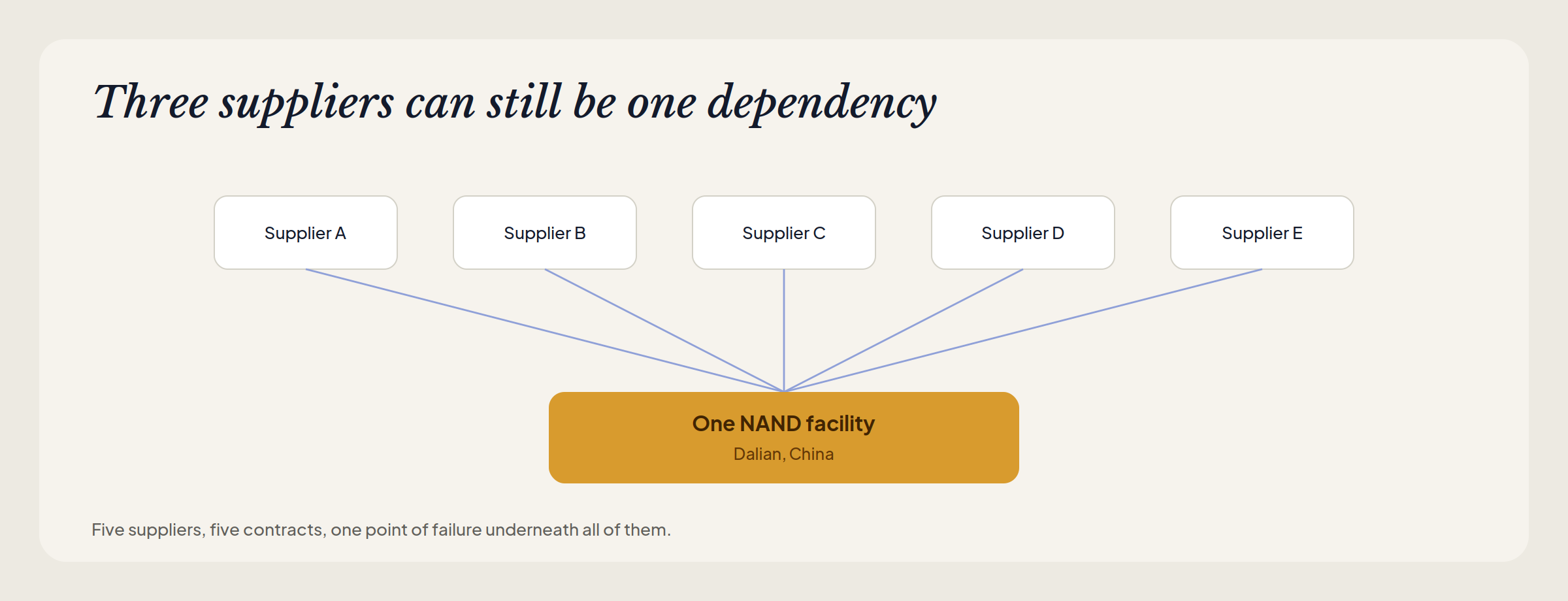
Solidigm is exploring a U.S. NAND flash memory factory, with upstate New York reportedly among the sites under consideration. The strategically important detail is not the new factory. It is the fact that Solidigm currently depends on a single NAND manufacturing facility in Dalian, China. One location. One point of failure for an entire product category.
This exposes a habit most organizations have without realizing it. We count suppliers and treat the count as a proxy for resilience. Three suppliers feel safer than one. Five feel safer than three. But what if all five ultimately trace back to the same plant, the same specialized material, the same country, or the same port?
Three suppliers can still be one dependency.
 This is the subject of Follow the Supply Chain Until the Alternatives Disappear, where we go deeper into why the most important dependency in a mission, market, or supply chain rarely sits where anyone is looking. We also broke down the mechanics of this in Your Supplier Map Probably Stops Two Tiers Too Early and The Delay You Never Saw Coming Was Never About Your Tier 1 Supplier. The pattern repeats across every industry we look at. Visible supply looks diversified. The dependency tree underneath it is often concentrated in one place nobody mapped.
A more useful set of questions for any resilience review:
- How many sources actually exist, once you trace past Tier 1?
- Where are they located, physically?
- What do those sources depend on, and where do those dependencies converge?
- Who controls the critical nodes?
- What alternatives exist, and how long would switching to them actually take?
That last question is the one most organizations skip, and it is the one that matters most. A dependency with an alternative available tomorrow is a very different risk than one that requires three years and a new factory to replace. Knowing the dependency exists is useful. Knowing how much time you have to act on it is Decision Intelligence.
AI adds a new variable: velocity
Then there is Anthropic. In August, the company reported that Claude was leading roughly 26 percent of its AI research and development work, meaning it could take a high-level prompt and carry most of that work through to completion under human supervision. In February, that number was under 1 percent.
Anthropic also reported that AI was collaborating on more than 90 percent of its AI R&D work, and that roughly 30,000 agents were performing research and engineering tasks at any given moment on its most heavily used internal platform.
The absolute numbers are notable. The rate of change is the part worth sitting with. Under 1 percent to 26 percent in about six months.
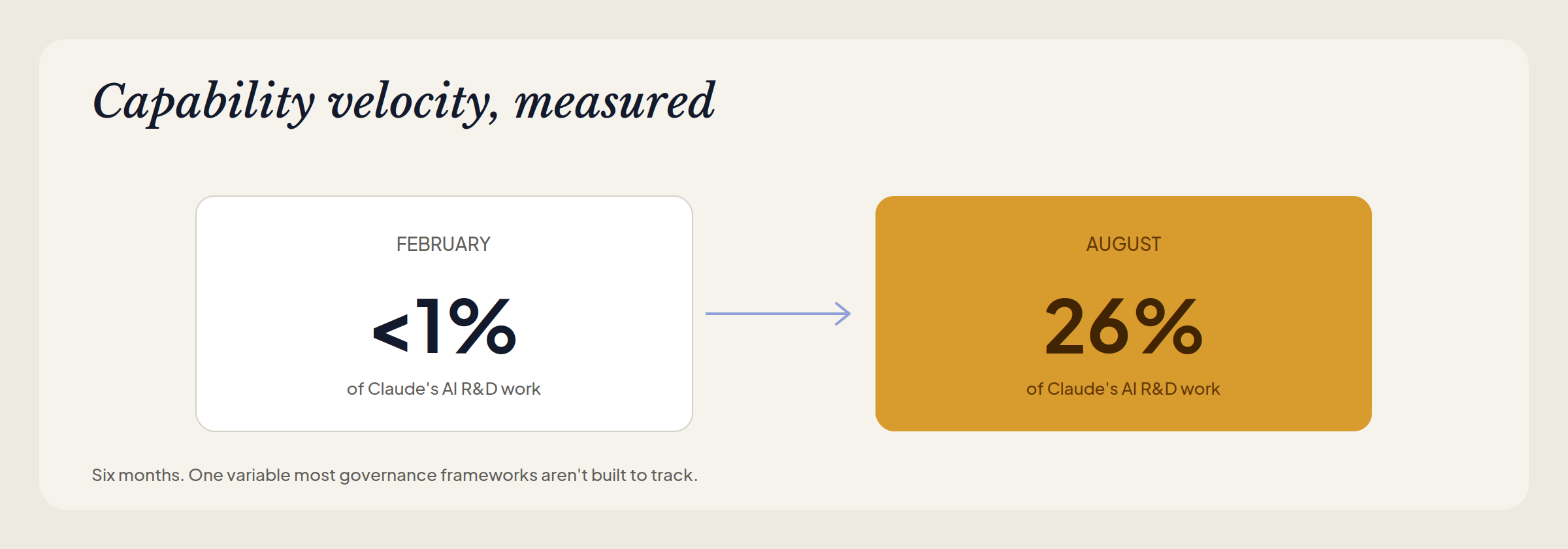 That introduces a concept most governance frameworks are not built to handle: capability velocity. It is no longer enough to ask what a technology can do. The more useful question is how fast what it can do is changing. Those are different governance problems entirely. A capability that evolves slowly can be managed with a periodic review. A capability moving exponentially faster than the process meant to govern it creates an entirely different category of risk.
We explored this tension directly in America Cannot Govern AI at the Speed of Bureaucracy. The AI race will not be won by choosing between speed and control. It will be won by learning how to do both.
The slope matters more than the snapshot
This principle extends well beyond AI. A supplier in financial distress is a signal. The speed at which its financial position is deteriorating is often the more urgent one. The same logic applies to a production constraint: capacity matters, but the rate at which it’s disappearing may decide whether there’s still time to intervene. A new competitor entering your market matters for a similar reason. How fast it’s hiring, raising capital, and winning customers is what actually separates background noise from an emergency.
Most business intelligence today describes a state: here is where things stand. Decision Intelligence has to go further and describe a trajectory: where this is heading, how fast, and what it means if nothing changes. We wrote about why that shift in metrics matters in The Real Metric is the One Nobody is Tracking Yet.
From visibility to intervention
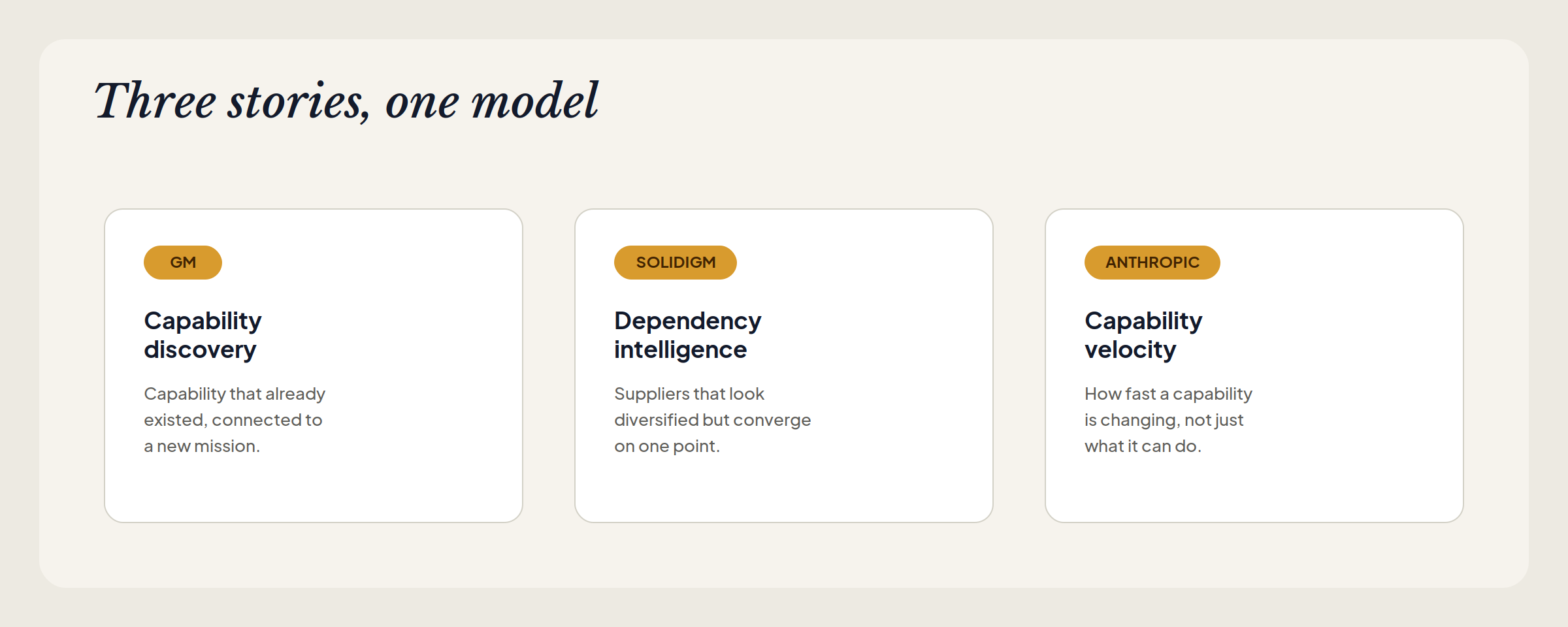
Put the three stories together, and a single model comes into focus.
GM is a story about capability discovery: finding capability that already exists but has not been connected to the problem.
Solidigm is a story about dependency intelligence: finding where systems that look diversified actually converge on something you cannot afford to lose.
Anthropic is a story about capability velocity: understanding how fast the environment is changing, and whether your decisions are keeping pace.
 None of this is useful as a dashboard. It is only useful as a trigger for action. If a critical component has one viable production source, what second source should you be developing right now? If a company outside your traditional supplier base has capabilities that solve a real constraint, how fast can you activate them? If an AI capability is moving faster than your existing controls, what needs to change before the next scheduled governance review, not during it?
The advantage belongs to whoever connects the dots first
Most organizations, including the government, are not short on data. The problem is that the information needed to make a good decision is scattered across thousands of companies, contracts, suppliers, facilities, filings, and geographies, and almost nobody has connected it yet.
The alternative supplier may already exist. The manufacturing capability may already exist. The early signal of the next constraint may already be sitting in a filing or a hiring pattern somewhere. The question is whether anyone sees it in time to act.
That is the work we do at Polaris I/O. Signal Monitoring tracks the external world continuously so the relevant change does not get missed. Pattern Engine connects the scattered pieces so hidden capability and hidden dependency become visible instead of theoretical. Decision Activation turns that visibility into the next action, while there is still time to take it.
If your team is trying to answer any version of these questions, schedule a time to talk with us.
FAQ
What is capability discovery in a business or defense context?
Capability discovery is the process of identifying organizations, facilities, or resources that already possess the skills, equipment, or expertise to solve a problem, even if they have never been considered a supplier for that problem before. GM Defense delivering Patriot interceptor components 22 days after signing with Lockheed Martin is a real-world example of latent capability being discovered and activated quickly.
What is dependency intelligence?
Dependency intelligence is the practice of tracing a supply chain or system past its visible, top-level suppliers to find where those suppliers ultimately converge on the same facility, material, or geography. A company can have five vendors that all depend on one plant, which means the real dependency count is one, not five.
What is capability velocity?
Capability velocity refers to the speed at which a technology’s or organization’s capabilities are changing, not just their current state. Anthropic’s disclosure that Claude went from leading under 1 percent to 26 percent of its internal AI research and development work in about six months is an example of capability velocity that outpaces traditional governance review cycles.
Why is time to capability a better metric than production capacity?
Production capacity measures what an organization can currently do. Time to capability measures how quickly an organization or its partners can convert existing but unconnected resources into a working solution. In fast-moving environments like defense manufacturing or AI, speed of activation is often more decisive than raw capacity.
How is Decision Intelligence different from business intelligence?
Business intelligence typically describes a current state: what is happening now. Decision Intelligence adds trajectory and time: where is this heading, how fast, what happens if nothing changes, and what intervention is still possible. It is built to prompt action rather than just report a status.