
The Thirty-Year Deal
A Fortune 500 client of Collective[i] had a prospect they’d chased for thirty years and never closed. The seller on the account had a practiced explanation for why it would never happen: switching costs too high, the incumbent too entrenched, the buying cycle too long. Every data point he had access to agreed with him.
Then Collective[i]’s network picked up something the seller couldn’t see: leadership transitions, internal project shifts, budget cycle changes at the buyer. None of it had any line of sight from inside the seller’s CRM. The deal’s win probability score climbed steadily until it attracted leadership attention, and resources, toward an account everyone had written off.
Six months later, it became the largest deal in that company’s history.
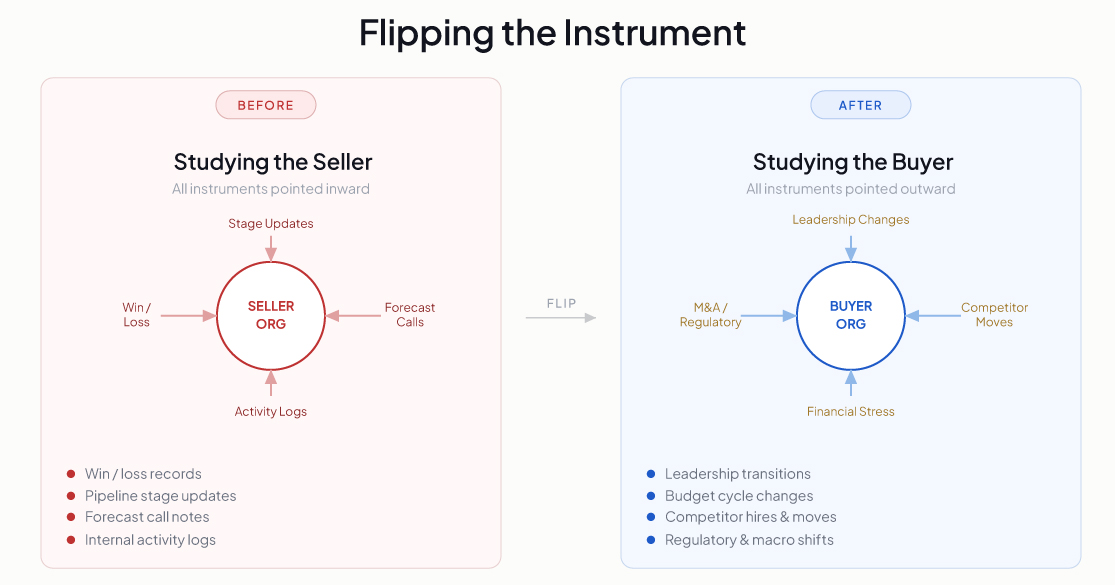
Stephen’s point isn’t that AI replaced the seller’s judgment. The seller still had to work the deal. What changed was what the organization was looking at. For thirty years, the company had built instruments to study itself: CRM fields, forecast calls, pipeline stages. None of it pointed at the buyer. He compares it to what Bezos understood about Amazon early on: the breakthrough wasn’t a faster checkout; it was treating the product as a listening instrument aimed at the customer, not a reporting tool aimed at the company. B2B sales spent three decades studying the one party who doesn’t make the final call, instead of the one who does. The seller with thirty years of “this never happens” wasn’t wrong based on what he could see. He was just looking at the wrong thing. That’s the difference between a war story and the odds.
He calls it flipping the instrument. At Polaris I/O, we’d put it more bluntly: the future doesn’t belong to whoever has the most data. It belongs to whoever can see what’s actually changing before it shows up anywhere official.
Same Instinct, Different Aperture
Collective[i] flips the instrument inward, toward the buyer’s organization. Who’s gaining influence. What’s shifting in their budget cycle. What the network has observed right before a stalled deal suddenly moves. That’s buyer intelligence, built from millions of commercial relationships.
Polaris I/O is a signal intelligence platform that monitors the external environment surrounding your buyers, suppliers, and competitors, the kind of change that rarely surfaces inside any internal system until it’s too late. We flip the instrument outward, toward everything surrounding the buyer. Leadership moves. Supplier exposure. Competitor hires. Regulatory shifts. M&A activity. Media coverage. Economic indicators. That’s signal intelligence, built from the broader economy’s signal layer that most internal systems never monitor.
Different data. Same conviction. The decisions that matter most are rarely driven by what’s happening inside your four walls. They’re driven by what’s changing outside them, and almost nobody has built a system pointed in that direction.
What This Looks Like If You Run Supply Chain
This isn’t theoretical for procurement and supply chain leaders right now. The pattern researchers keep flagging as we move into the second half of the year is the same one Stephen described: supplier failures rarely start with a missed delivery. They begin with subtle signs of financial distress, shifts in payment behavior, rising short-term debt, unexplained revenue fluctuations, all of it surfacing months before the supplier acknowledges any distress.
The problem isn’t that this data doesn’t exist. It’s that early instability rarely shows up in the systems supply chains monitor most closely, so when data is scattered or out of date, the weak signals stay buried even when the surrounding process is sound. That’s the supply chain equivalent of thirty years of CRM fields pointed at the wrong party. You can have a mature S&OP process and still be looking at your own inventory dashboards while the actual risk is building three tiers upstream, in a supplier’s balance sheet, in a regulatory filing, in a leadership change at a vendor you’ve never even audited.
What This Looks Like If You Run Revenue
For CROs, the parallel is even more direct. Stephen’s thirty-year deal didn’t close because someone got better at selling. It closed because the organization finally had visibility into a shift at the buyer that had nothing to do with what the seller said or did. The equivalent miss on the Polaris side looks like this: a competitor quietly hires a new VP of partnerships three months before they announce a channel program that guts your pipeline, or a target account’s parent company undergoes a leadership change that reopens a budget conversation you assumed was closed for the year. None of that shows up in a forecast call. All of it shows up in the signal layer, if anyone’s built one.
The Part That Should Worry You
The uncomfortable truth underneath both pieces is that the volume of signal has already exceeded what any human can track manually. Not because people got worse at their jobs. Because the world generates more consequential change in a single day than any analyst, seller, or supply chain leader can process in a week. A CEO resigns. A supplier shows early financial stress. A competitor poaches a key leader. A regulator quietly shifts priorities. Individually, each one looks like noise. Together, they’re often the sharpest signal available, and they show up well before anything reaches a CRM field or a quarterly business review.
This is where both pieces land on the same idea from opposite directions: trust the odds, not the war story. A thirty-year track record of “this never happens” is still just a story about the past. The pattern in the data is a story about right now. That doesn’t make experience worthless. It means experience without current signal is a coin flip wearing a suit.
The question isn’t whether the signals exist. They do, constantly, in your suppliers, your competitors, your buyers’ organizations. The question is whether you’ve built anything capable of hearing them before the disruption, the deal, or the competitor gets there first. That’s what Polaris I/O is built for.
The series by Stephen is worth your time.