
What Stephen Messer’s “Artificial CommonSense” Gets Right and What It Means for How You Sell Into It
Stephen Messer published a piece this week that every revenue leader selling into enterprise accounts should read twice.
His argument, stated plainly: SaaS incumbents like Salesforce, ServiceNow, and Workday are about to report record AI-driven revenue. Analysts will call it a recovery. They will be wrong about what it means. The revenue is real. The moat it implies is not. The structural displacement is already happening and the financials just have not reflected it yet.
He calls it the Last Great Head Fake in Software History.
He is right. And for go-to-market teams, the implications run deeper than the capital markets framing suggests.
The Revenue Is Being Extracted From a Captive Base
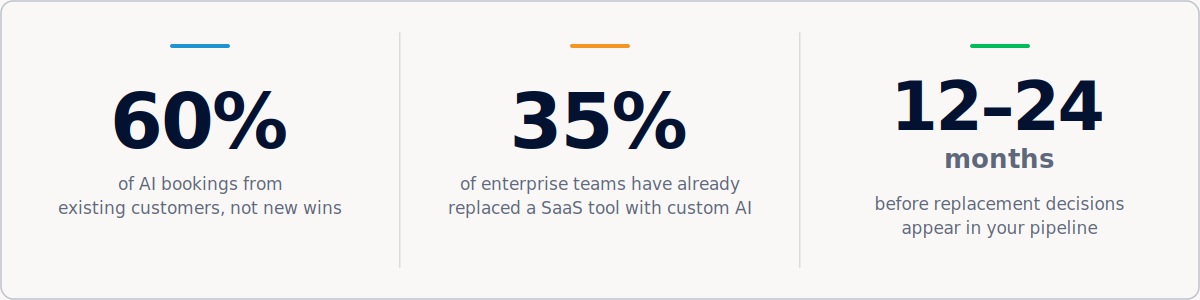
Messer’s forensic read of the filings is worth sitting with. More than 60% of Agentforce bookings in Salesforce’s most recent quarter came from existing customers, not competitive wins — customers already locked into multi-year master service agreements (MSAs), buying an AI add-on because the path of least resistance is the vendor already in the building.
ServiceNow’s CEO described a customer who had quantified exactly $682 million in savings from the platform and still refused outcome-based pricing because they preferred seat-based predictability. The customer knew the arbitrage. They chose convenience.
That calculus changes at renewal. Not always. But increasingly.
The signal Messer is watching is not the ARR headline. It is whether the customers of these platforms are showing AI-like productivity gains in their own filings. Revenue per employee improving. Margin expanding. Headcount flat or down while output grows. If yes, the AI add-ons are working. If no, companies are paying for the AI story on the vendor’s invoice without getting AI results on their own P&L. That gap closes at renewal, or before.
Why This Matters for How You Engage Enterprise Accounts Right Now
The installed base is not as stable as it looks. A customer running Salesforce, ServiceNow, or Workday today is not necessarily a locked account. They are a customer whose renewal math is quietly changing. 35% of enterprise teams have already replaced at least one SaaS tool with a custom AI build. 78% plan to build more in 2026. The replacement cycle has started. It is visible in procurement conversations if you know to listen for it.
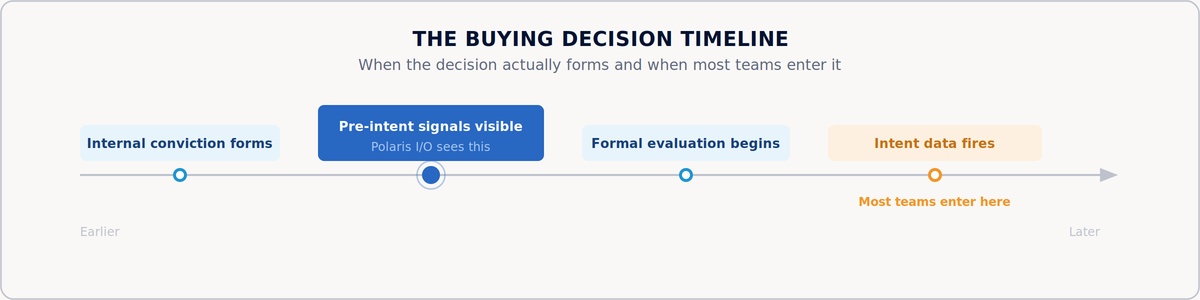
The buying window is moving earlier than ever. Messer’s point about the stock-to-revenue lag is a capital markets observation with a commercial parallel. BlackBerry’s stock peaked three years before revenue peaked. The enterprise accounts making structural platform decisions right now will show up in your CRM pipeline 12 to 24 months from now. By the time intent data lights up on these accounts, the shortlist is already built and you are not on it.
This is the pattern Polaris I/O is built to break. The accounts reorganizing their technology architecture around AI — standing up new data infrastructure, posting ML engineering roles, shifting vendor relationships, restructuring their GTM — are generating signals today. Not intent signals. Pre-intent signals. The kind that precede the formal buying motion by quarters, not weeks.
The SaaS bump creates a specific window. If your primary account intelligence is intent data and inbound activity, you are reading the same signals everyone else is reading, months after the real decisions started forming. The accounts currently expanding their Salesforce or ServiceNow footprint are exactly the ones most likely to be running a quiet parallel evaluation of what replaces it.
The Data Moat Argument Is Weaker Than It Sounds
One element of Messer’s analysis maps directly onto what we see in account intelligence work. He argues that the SaaS incumbents’ supposed data moat — the “proprietary data and context” Goldman Sachs credits them with owning — is largely illusory.
The data does not belong to the vendors. Most of it has already migrated to Snowflake, Databricks, and cloud data warehouses. What remains in the CRM is workflow architecture: mandatory fields, prescribed processes, standardized objects. That is not an AI asset. It is an AI constraint. The system was built to standardize human behavior for reporting purposes. AI needs variation to find patterns. The architecture eliminates variation by design.
The same structural problem shows up in how most enterprises use their internal data for commercial intelligence. Your CRM contains your company’s behavior. Your customers exist in a market of millions of interactions you cannot see. A model trained only on internal signals is studying yourself to predict someone else.
This is why pre-intent intelligence has to operate at network scale — monitoring signals across markets, industries, and competitive landscapes, not just inside a single account’s activity log. The accounts you need to reach before everyone else are not signaling in your CRM. They are signaling in hiring patterns, earnings call language, regulatory filings, supplier relationship shifts, and leadership transitions. That is where the real picture forms.
Three Questions Worth Asking About Every Enterprise Account You Are Working
Messer closes with a framework for capital markets. The commercial version is just as useful.
Is the account showing AI results in their own operations? If your customer is using an AI-enhanced SaaS platform and cannot point to measurable productivity improvement, margin expansion, or revenue per employee gains, the renewal conversation is already in motion whether or not procurement has opened a new evaluation.
Is the account’s expansion coming from real adoption or from locked contracts? When a customer expands a license, it is worth understanding whether that expansion reflects genuine workflow adoption or a vendor upsell into existing obligations. The former is a stable account. The latter is a renewal risk.
Are there pre-intent signals pointing to architectural change? Platform replacement decisions are not spontaneous. They follow months of adjacent signals — technology infrastructure hiring, vendor consolidation language in earnings calls, internal reorganizations that change who owns the technology budget, procurement behavior that suggests a broader vendor reassessment is underway.
If you are waiting for those accounts to show up in intent data, you are already late. The accounts making the most consequential technology decisions right now are not searching review sites. They are building internal business cases, running internal pilots, and having conversations that will not reach your pipeline for another two or three quarters.
What This Looks Like in Practice
The companies Messer highlights as AI-native disruptors did not start with an RFP. Rocket Companies closed loans 2.5x faster after gutting the legacy application layer. Klarna replaced Salesforce and Workday and publicly credited the removal. JPMorgan built $2 billion in annual AI value on proprietary infrastructure. Each of them started with an internal conviction that the current architecture was the constraint. That conviction was visible months before any vendor got a call.
The revenue leaders who will win the next cycle are not waiting for those accounts to issue an intent signal. They are already in the room, having built a relationship before the formal evaluation started, because they saw the signals early enough to show up with context instead of a pitch.
That is what pre-intent intelligence makes possible. Not faster follow-up on the same signals everyone else is watching. Earlier presence, in the right accounts, before the shortlist exists.
Nothing gets by you when you are already there.
Polaris I/O tracks thousands of pre-intent signals — leadership transitions, hiring surges, strategic announcements, budget indicators — and delivers them as actionable intelligence to revenue teams that need to move first. See how it works.