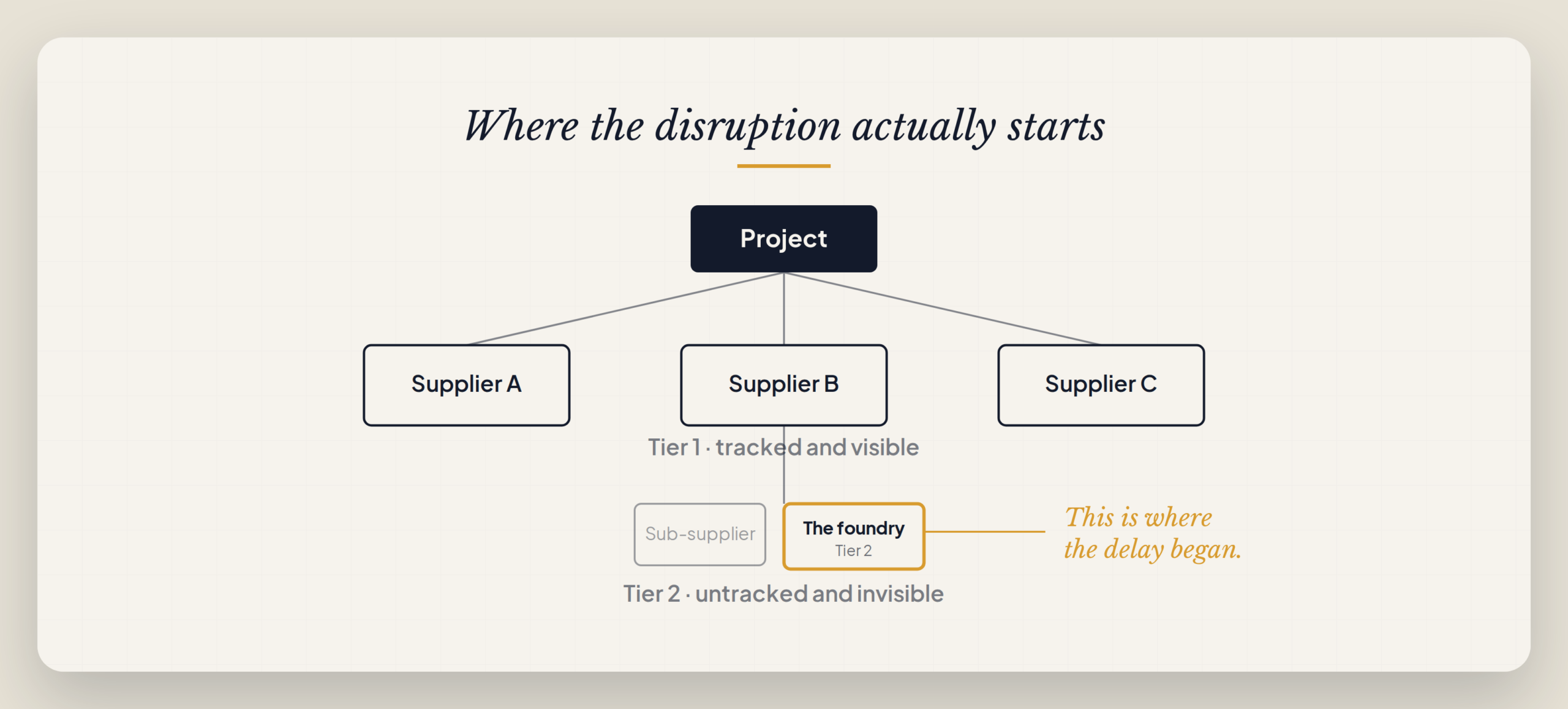
A project falls two weeks behind. The postmortem finds the cause fast: a specialty valve manufacturer couldn’t get a casting out of a foundry that was running behind on a completely unrelated contract.
Nobody on the project team had ever heard of that foundry. It wasn’t in any supplier database, wasn’t on any dashboard, wasn’t a name anyone would have thought to ask about. It sat two levels below the Tier 1 supplier everyone was watching closely.
This happens more often than most engineering, procurement, and construction (EPC) organizations would like to admit. Tier 1 suppliers are tracked, managed, reported on. That part of the supply chain gets attention. But the disruptions that actually derail a schedule tend to start further out: at a sub-supplier, a logistics provider, a customs process, a commodity source, or some specialized resource the EPC has no direct relationship with and no visibility into. By the time the problem surfaces through the Tier 1 supplier, fabrication is already behind.
We built Polaris I/O to close that gap.
Start with the project, not the supplier list
Most supplier monitoring works from a list. You track your suppliers, you flag the ones showing signs of trouble, you hope the list is complete enough to matter.
 We do something different. We start with the project itself and work outward. Break it into work packages. Map the Tier 1 suppliers tied to each one. Then identify the Tier 2 suppliers most likely to actually matter, using a weighted model that pulls in commercial history, product alignment, market position, geography, and relevance to that specific project. What comes out the other end is what we call an Execution Ecosystem, a map of everything a project actually depends on, not just the vendors with a signed contract.
From there we look for the places where that ecosystem gets fragile: geopolitical events, commodity pressure, port congestion, customs bottlenecks, a supplier that shows up more often than it should. And when a project team is willing to share their own procurement and execution data, the model gets better fast. Real project evidence has a way of sharpening probability into fact.
A supplier problem and a project problem aren’t the same thing
Here’s the distinction that matters most. It’s useful to know a supplier is struggling. It’s a different thing entirely to know that the struggle is going to delay fabrication at a specific yard, hold up a specific logistics move, tie up a vessel you’re counting on, or put a milestone at risk that has real dollars attached to it. The first tells you where to look. The second tells you what to do, and how fast you need to do it.
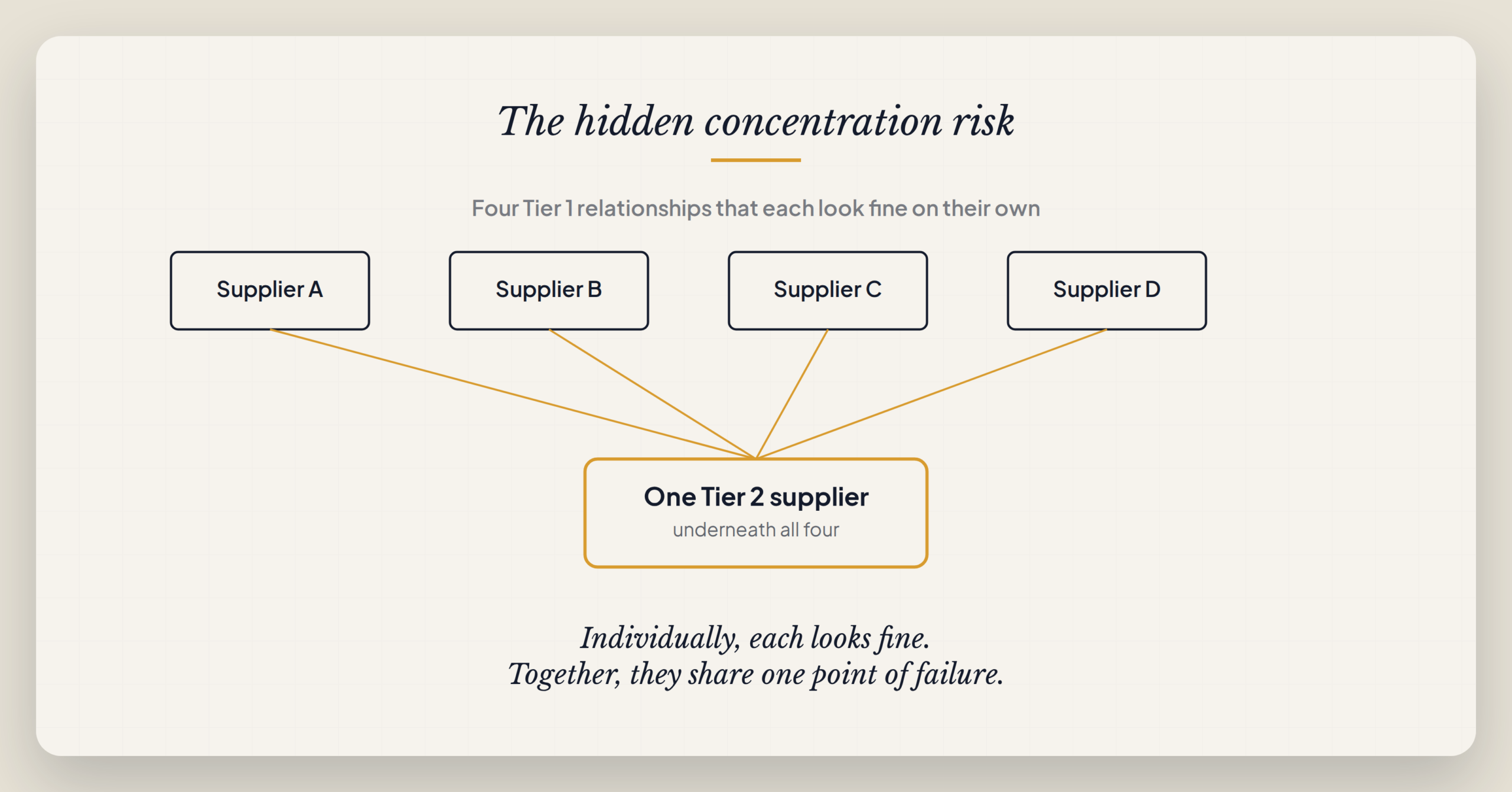
There’s a risk hiding in here that most supplier monitoring misses completely: concentration. One Tier 2 supplier can sit underneath three or four of your Tier 1 relationships without anyone realizing it. Individually, each of those Tier 1 suppliers looks fine. Together, they’re all exposed to the same single point of failure. You only catch that by mapping the ecosystem. You’ll never catch it by watching suppliers one at a time.
 Time is the actual product
None of this is really about seeing more of the supply chain. Plenty of platforms can show you more. What matters is whether that visibility arrives early enough to do something with it.
So the question we want project teams asking isn’t “which suppliers are at risk.” It’s “where is this project actually exposed, what will it hit if it goes wrong, and what can we do about it today, while there’s still time to do something.” That’s the conversation Polaris I/O exists to make possible.