


Why the next real advantage isn’t a faster answer. It’s an AI that never looks away.
Picture this: you run a global supply chain. In the last 48 hours, a storm system shifted course, a key supplier started missing production targets, a port started backing up, commodity prices moved, early reports of a labor dispute surfaced, and satellite activity near one of your facilities looked different than it did last week.
On its own, none of that tells you anything. Together, it might tell you everything.
The old playbook is to wait. Wait for the report, wait for the supplier to call, wait for someone to connect the dots, wait until the problem is big enough that everyone can see it without help. Then react.
AI finally gives us a way out of that loop.
From answering questions to staying with the problem
Patrick Dennis said something recently that has stuck with me. He argued that how we measure AI is changing: snapshot benchmarks and the speed of a single answer matter less as models evolve into long-running agents that can stay focused on a problem for hours, days, or longer. Patrick calls this shift a move from instant Q&A to continuous cognitive labor.
That framing changes a lot.
Most of us still experience AI as a simple exchange: ask a question, get an answer, ask another, get another. But the problems that actually matter in business rarely show up as a single prompt. A supply chain disruption doesn’t happen in one message. A competitor doesn’t become dangerous overnight. A customer doesn’t wake up one morning already in market for what you sell.
The world moves gradually. Signals build on each other, relationships form quietly in the background, and then one day something that looked minor turns out to be the whole story.
The world doesn’t arrive as a prompt
Here’s the real problem most companies face: the information executives need is scattered everywhere. News. Financial filings. Company activity. Executive moves. Weather. Satellite data. Supply chain feeds. Government filings. Consumer behavior. Industry-specific sources. Internal enterprise data nobody has time to dig through.
Most organizations already have more data than they know what to do with. Their real problem isn’t finding more of it. It’s understanding what all of it means when you look at it together.
One signal is interesting. A handful of independent signals reinforcing each other is intelligence, and real intelligence should lead somewhere: to a point of view.
That’s the direction we think decision intelligence is heading. Observe, connect, form a point of view, act, watch what happens, learn, reassess. Then do it again, continuously.
The Hero User
There’s a second idea worth pulling into this conversation. Tidemark recently published its System of Action framework, and in it they introduce the idea of the Hero User: a practitioner with enough authority to buy and adopt software and actually change how work gets done. Tidemark’s argument is that AI-native challengers are moving past tools that simply help people do their jobs, toward systems that start participating in the work itself.
It’s a strong idea, and it lines up with something we believe deeply at Polaris I/O.
The hero was never the AI. The hero is the person still responsible for the decision.
Think about who actually sits in these seats: the supply chain leader deciding whether to move inventory before a disruption hits, the salesperson deciding which account deserves attention today instead of next quarter, the investor trying to spot an inflection point before the rest of the market catches on, the analyst trying to figure out whether five unrelated events are actually one story, the executive trying to decide if a new competitor is real or just noise.
None of them need another dashboard. They definitely don’t need a thousand more alerts. What they need is help understanding what deserves their attention right now, and why.
From signals to opinions
Here’s the distinction that matters most: AI is getting remarkably good at finding information, but finding a signal isn’t the same thing as understanding it.
Say Polaris I/O picks up five separate developments tied to one company: a new executive joins, hiring picks up in a specific function, construction starts near one of its facilities, a supplier relationship shifts, and local spending patterns start to move.
Five alerts, taken individually, aren’t worth much. But if those same five signals have historically shown up together right before a major facility expansion, that’s a different story entirely. That’s context. Add one more independent signal and confidence goes up again. Add proprietary data from inside the enterprise and the picture gets sharper still.
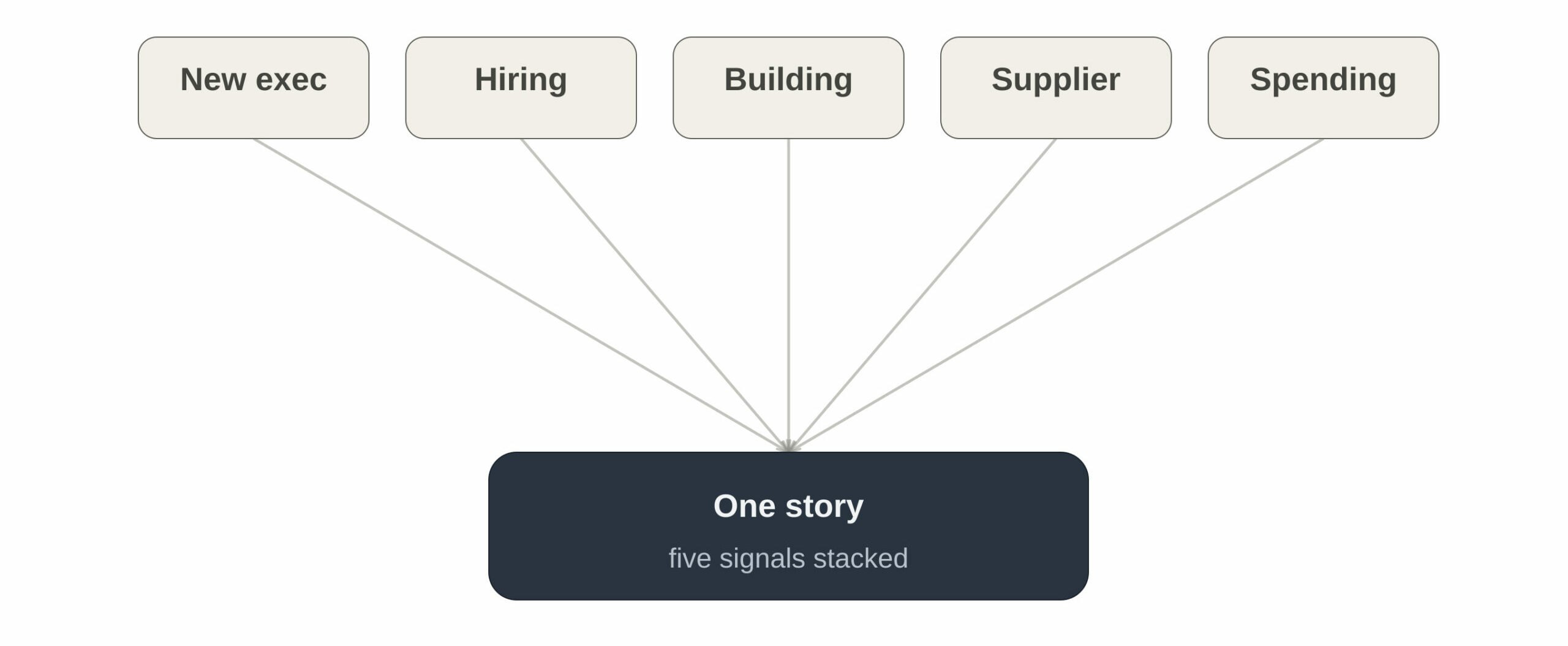 The goal was never to produce more information. It’s to form a real opinion about what’s actually happening, show the evidence behind that opinion, and keep testing it as the world keeps moving.
We call this stacking signals. No single signal has to be the smoking gun. The intelligence comes from the pattern underneath all of them.
The first answer isn’t necessarily the right one
This is where Patrick’s idea of continuous cognitive labor gets really interesting.
Traditional software waits for you. You log in, you search, you ask, you analyze, you leave. But the world doesn’t pause just because you closed the tab, and a system built to reason continuously doesn’t have to pause either.
Say this morning the evidence points to a 30 percent chance of a supply disruption. Nothing happens yet. Then weather conditions get worse, a local government issues an evacuation notice, shipping patterns shift, and a supplier misses a delivery.
The probability moves.
A good system doesn’t protect yesterday’s answer out of habit. It changes its mind.
That might be the single most important trait an intelligent system can have: not just the ability to form an opinion, but the ability to know when the evidence says that opinion needs to change.
Giving the hero time
Which brings us back to the person actually making the call. What does better intelligence really give them? Time.
Time to see a disruption coming before it becomes a crisis. Time to reach a customer before they’ve started a formal buying process. Time to spot a competitor before the market notices them. Time to reposition inventory, to look into a threat while it’s still small, to realize that five unrelated developments are actually the same story told five different ways.
In most businesses, the value of knowing something isn’t just about being right. It’s about how early you knew it. Three months ahead of the market can change the outcome entirely. Three days behind it can make the answer irrelevant.
So what
There’s a lot of noise right now about agents and what tasks they can perform. We think the more important question for enterprises is different: what problems can intelligence stay with, continuously, without getting tired or distracted?
That reframes how we think about AI at the enterprise level. Instead of asking what AI can answer, ask what it should never stop watching. Instead of asking what tasks we can automate, ask which decisions get dramatically better if we understand, in real time, how the environment around them is shifting. And instead of judging AI purely on the quality of a single response, start judging it on the quality of the decisions it actually helps people make.
Now what
For business leaders, we’d start in three places.
First, find the decisions where being early actually matters. Which ones get significantly more valuable if you know something days, weeks, or months sooner than everyone else?
Second, identify the signals that tend to show up before those decisions. Don’t stop at the obvious ones. Look for the weak signals, across internal, external, and specialized data, that only become meaningful once you connect them.
Third, build a learning loop. Don’t stop the moment the system spits out an answer. Keep watching what actually happens, compare the prediction to reality, feed in new evidence, adjust your confidence, and keep learning.
That’s the point where AI stops being a tool that answers questions and starts becoming something far more valuable: continuous decision intelligence.
Patrick Dennis’s thinking on long-running agents and continuous cognitive labor gives us a clear view of where the underlying technology is headed. Tidemark’s work on Systems of Action and the Hero User is an equally important reminder of who all of it is actually for.
We think the real opportunity sits right at the intersection of the two: AI that doesn’t just answer, but observes, connects, reasons, learns, and stays with the problem.
Not to replace the hero. To give the hero an unfair advantage.
Related Articles




Related Posts
Nothing found.