
That number should stop you cold.
It means the demos, the pricing conversations, the competitive bake-offs your team spends so much energy on are largely a process being run by buyers who have already decided which vendors are plausible candidates. Everything after that is confirmation, not deliberation.
Bain calls the shortlist buyers carry into every evaluation the Day 1 list. If you are not on it when a prospect starts shopping, you are almost certainly not going to close the deal. Not because your product is worse. Not because your seller underperformed. Because you were never really in the running. Polaris I/O exists for exactly this reason. Getting on the Day 1 list requires showing up before it forms, and that means knowing which accounts are moving toward a purchase decision before they announce it.
The Question Most Teams Are Not Asking
Most B2B organizations track why they lose deals. Very few track whether they are being considered in the first place.
Those are two completely different problems, and Bain’s research makes that distinction impossible to ignore.
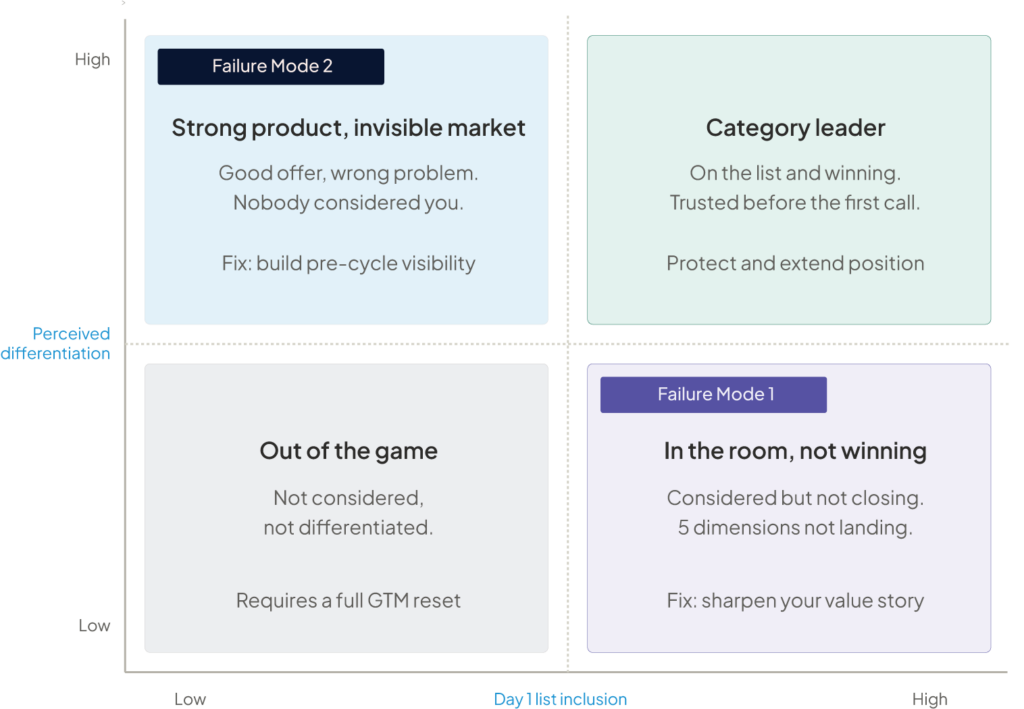
Failure mode one: you are on the Day 1 list but not winning. You are in the conversation, but something about how you are perceived is not sticking. That is a positioning problem you can work on.
Failure mode two: you are not making the Day 1 list at all. You are not losing deals late. You are absent from them before they ever show up in your pipeline. No amount of sales coaching or late-stage effort touches that problem.
This is where Polaris I/O changes the equation. If shortlists form before buying cycles officially begin, the only way to get on them is to show up before they do. Polaris tracks the external signals that tell you an account is moving toward a purchase decision weeks before they announce it. Leadership changes. Hiring surges. Organizational shifts. Budget cycle indicators. The signals that precede a buying process, not the ones that follow it.
Bain tells you the window exists. Polaris I/O helps you get through it before it closes.
The People Your Seller Never Meets
Bain also identifies what they call hidden buyers: the procurement leads, finance reviewers, IT gatekeepers, and legal stakeholders who never use the product but carry real weight in whether the purchase gets approved.
Hidden buyers do not evaluate vendors the way end users do. They are not comparing features. They are asking whether the vendor is safe, whether choosing this company will create problems for them later, whether they can justify it if something goes wrong. They answer those questions based almost entirely on what they already thought about your company before the sales process started.
So the buying committee your seller is working to win contains people whose minds were largely made up before the first meeting. And the shortlist they are working from was formed before the first meeting too.
This is why waiting for a buying cycle to begin is already too late. Hidden buyers are forming opinions and narrowing options in the weeks and months before your seller gets a call on the calendar. Polaris I/O surfaces the organizational signals that tell you when that process is starting: new procurement hires, executive changes, budget shifts, and partnership moves that show up before any formal evaluation gets underway. By the time the hidden buyers are in the room, the goal is to already be a known and trusted name on the list they are working from.
The Metric That Points at the Right Problem
Bain introduces a measure called Likelihood to Buy. It captures two things: whether a vendor makes the Day 1 list at all, and how well it performs across five dimensions buyers use to make final decisions. Those five are meeting current and future needs, value relative to total cost, being a choice that can be defended internally, confidence in implementation, and ease of working together.
Notice what is not on that list. Product specs. Feature lists. Technical benchmarks. Several of the five are about trust and perception. “A choice I can defend internally” means the buyer is asking whether your brand gives them cover when their CFO asks why they picked you. That is not a product evaluation. That is a reputation question, and the answer was mostly formed before your seller ever got on a call.
Improving your Likelihood to Buy score starts long before the sales process begins. It starts with showing up in the right accounts at the right moment, when leadership is shifting, when budgets are moving, when organizational changes signal that a purchase decision is forming. That is the intelligence Polaris I/O is built to deliver, so that by the time a buyer is measuring you against those five dimensions, you are already a familiar name with a head start.
From Diagnosis to Action
Bain’s Likelihood to Buy framework is one of the most useful diagnostics the B2B world has seen in a while. It tells you where you stand relative to competitors in a buyer’s mind, which dimensions are working for you, and which are not. Every go-to-market team should be paying attention to it.
The natural next step is turning that diagnosis into action at the account level, in the weeks before a buying cycle officially begins. Which target accounts are quietly shifting in ways that signal a coming purchase? Which competitor hires or partnerships are about to change your standing on a shortlist you did not know was forming? What changed at a key account last month that makes a conversation you assumed was dead worth reopening?
Bain’s research gives you the framework to understand the problem. Polaris I/O gives you the visibility to act on it before the window closes.
The companies that close the Day 1 list gap are not the ones running better discovery calls. They are the ones who show up before the shortlist is set.
You can read the full Bain and LinkedIn research on Likelihood to Buy here.