


The Coinbase, Block, and Klarna headlines have triggered the usual cycle. AI is replacing people. Org charts are collapsing. Managers are disappearing. Software stacks are getting ripped out.
Most of that commentary misses the point.
Stephen Messer recently wrote a sharp piece outlining how AI is restructuring organizations. His core argument is that the modern corporate hierarchy was never designed from first principles. It was designed around the communication and information technology available at the time. Letters created tall hierarchies. The telephone created functional departments. Computers created the data analyst layer. SaaS created the software stack and the information broker profession. And now AI is eliminating the reason all of those layers existed in the first place.
He is directionally right, and his historical framing is excellent. The management layer that existed to relay status, reconcile systems, and assemble context for leadership is becoming structurally unnecessary when intelligence systems can do that work continuously. Armstrong at Coinbase is not describing cost cuts. He is describing a company where intelligence is the operating system and humans are the directors of it. Dorsey at Block said most companies will reach the same conclusion within a year. Klarna cut headcount in half while growing revenue 108% and raising average pay 60%.
Stephen frames this as the shift from the Software Era to the Intelligence Era. I agree with that framing. But I think the deeper story underneath it deserves more attention, because it changes what leaders should actually prioritize.
The deeper story is not organizational flattening. It is decision asymmetry.
Stephen talks about replacing the software stack. I think we also need to talk about replacing delayed awareness.
Stephen’s org chart argument matters most at the portfolio level.
Stephen makes a compelling case that the traditional SaaS stack created what he calls the “Jenga stack” problem. Every function got its own tool. Pipeline management for sales. Conversational analytics for recording calls. A forecasting tool for predicting revenue. A sequencing tool for outbound. Each one creates its own data structure, its own definitions, its own reporting. A deal in stage 3 means something different in your pipeline tool than in your forecasting tool. Activity means something different in your engagement platform than in your BI dashboard.
He is right that this created an entire profession of information brokers: BI analysts, RevOps teams, FP&A analysts, and Chiefs of Staff. People whose job was not to create value but to translate between systems, correct bad data, reconcile conflicting definitions, and produce reports that leadership could actually use.
But here is where I think the conversation needs to go further.
The Jenga stack did not just create translation problems. It created a timing problem. And the timing problem is the one that actually determines who wins.
Every system in that stack is recording what already happened. CRM captured historical activity. ERP tracked completed transactions. Marketing platforms measured engagement after the fact. BI summarized lagging indicators. Even when you collapse those systems into a single intelligence layer, as Stephen advocates, the question remains: what is that intelligence layer actually observing?
If it is observing the same internal data those systems were capturing, you have solved the translation problem and the coordination problem. That is genuinely valuable. But you have not solved the awareness problem.
The companies that will pull ahead over the next decade are not just those that flatten their org charts and eliminate information brokers. They are the ones that detect change in their markets, accounts, and competitive landscape earlier than anyone else and act before consensus forms. That is a fundamentally different operating model.
The LLM problem Stephen identifies is real. The answer is signal quality, not just reasoning quality.
Stephen makes an important point that I want to build on. He argues that layering a large language model on top of fragmented enterprise systems does not work, because the LLM cannot compensate for information that was never captured, never entered, or captured in incompatible formats across disconnected systems.
He is right. But I would extend the argument further.
Even if you solve the data capture problem internally, you are still missing the most important signals—the ones that exist outside your four walls.
Most enterprise intelligence strategies are still inward-looking. They are trying to get better visibility into what is happening inside the company: pipeline health, forecast accuracy, rep activity, customer engagement scores. That is necessary work. But it is not sufficient.
The signals that actually predict what is going to happen next are largely external: hiring changes at target accounts, budget movement, supplier instability, leadership transitions, technology adoption patterns, regulatory pressure, capital allocation shifts, competitive positioning changes, and behavioral anomalies across ecosystems.
Individually, most of these signals look like noise. But when multiple signals converge around a single account or market condition, they create what we call decision-grade insight: the kind of visibility that lets teams act before the buying process even begins.
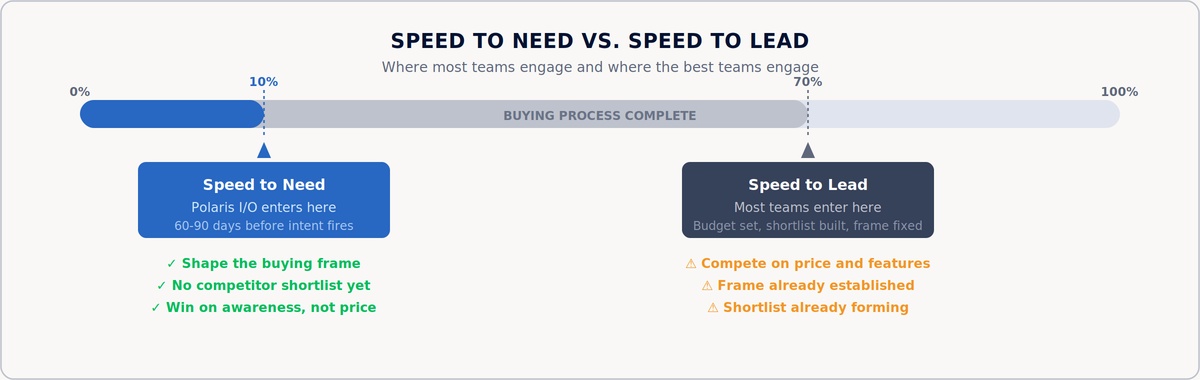
This is why we talk about “speed to need” rather than “speed to lead” at Polaris I/O. Most traditional go-to-market systems detect intent after buyers enter the market. By that point, budgets are allocated, shortlists are built, and competitors are already engaged. Research consistently shows that roughly 70% of the B2B buying process is complete before a prospect enters formal vendor evaluation. If your revenue teams are engaging at that 70% mark, they are competing on price and features against an already established frame.
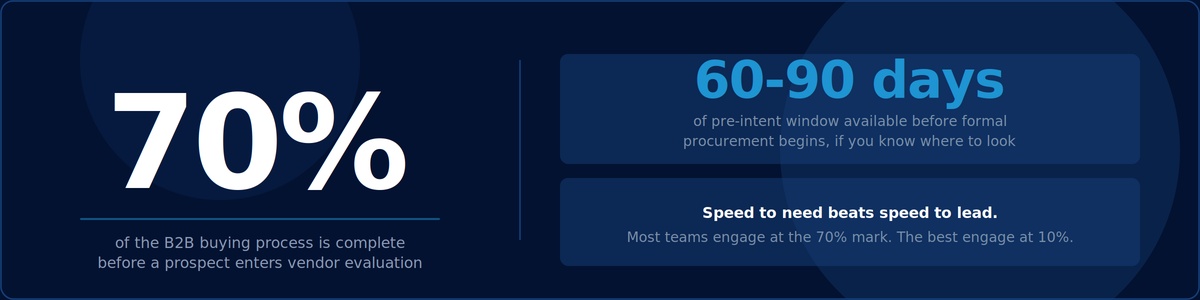
The real advantage comes from identifying the conditions that precede intent, 60–90 days before formal procurement begins.
Stephen’s org chart argument matters most at the portfolio level.
I want to speak directly to the operating partner audience for a moment, because Stephen’s argument about organizational restructuring has implications that go beyond any single company.
If Stephen is right that the hierarchy built around information scarcity is collapsing, then the way operating partners evaluate and govern portfolio companies needs to change too. The hardest part of portfolio oversight has always been the information problem. Quarterly business reviews arrive too late for meaningful intervention. CRM pipeline reports show lagging indicators. Board presentations are backward-looking by design. By the time revenue problems surface in a quarterly board presentation, the best window to intervene has already closed.
Stephen describes how Armstrong at Coinbase is building a company where a single person supported by agents can do the work previously requiring separate engineers, designers, and product managers. That is interesting from an org design perspective. But from an operating partner perspective, the more important question is this: across your portfolio, how many of your companies can tell you what is changing in their key accounts and target markets this week—not what changed last quarter?
If the answer is few or none, that is not a sales execution problem. That is an intelligence architecture problem. And it directly impacts value creation timelines and exit multiples.
I am seeing more sponsors centralize RevOps, standardize tech stacks, and deploy AI tooling at the fund level rather than letting every portfolio company make independent bets. Those moving fastest are not just standardizing processes. They are building portfolio-wide early warning systems that give them visibility into growth and risk signals before those signals show up in board decks.
Where the conversation should go next.
Stephen ends his piece by saying the next article in his series will cover how to start—what the first step actually looks like in practice. I think that is the right question.
But I would frame the starting point differently than most people expect.
The first step is not choosing an AI tool. It is not flattening your org chart. It is not eliminating managers.
The first step is asking a more honest question about your current operating model: are we detecting reality as it changes, or are we still assembling stale information through layers of human interpretation and hoping it is close enough?
Stephen’s point about Armstrong is instructive here. Armstrong said Coinbase is “rebuilding as an intelligence, with humans around the edge aligning it.” That is a powerful framing. But an intelligence is only as good as what it can observe. If it is only observing internal data, you have a faster mirror. If it is observing the full landscape of signals that predict what is going to happen in your markets, your accounts, and your competitive environment, you have something qualitatively different.
That is what we built Polaris I/O to do. We monitor thousands of external signals across accounts, markets, suppliers, and ecosystems and convert them into the operational context that revenue and leadership teams need to act—not dashboards to manage, not alerts to triage, but decision-grade insight with clear direction on what to do, who to engage, and when.
For PE operating partners, we provide portfolio-wide visibility into the signals that matter before they surface in the reporting chain. For CROs and revenue leaders, we get teams into accounts before the shortlist is built. For CEOs, we provide the kind of continuous awareness that Stephen describes as the end state—built from the outside in rather than just the inside out.
Stephen is right that the race has started. But the race is not just about who has AI or who flattens their org chart first.
The race is about who sees what is changing earliest and who is structured to act on it.
That gap is already widening. And for the companies and portfolios that move early, it is becoming very difficult to close.
If you are an operating partner, CRO, or CEO thinking about how this applies to your business or portfolio, I would welcome the conversation.
Related Articles




Related Posts
Nothing found.