


A note on this post: the core argument here is about supply chain provenance and the risk that hides below Tier 1. To show what that looks like on the ground, we asked two colleagues who work inside very different supply chains to weigh in. Carol Attak, Senior Account Executive, covers food, beverage, and QSR. Howie Mandell, VP of Federal Solution and Deployment, covers energy. You’ll find their perspectives in the highlighted panels at three points in the post, wherever the problem looks different depending on your industry.
Key takeaways
- Knowing who you bought from does not tell you where something came from. Tier 1 compliance checks the entity, not the network behind it.
- Reuters linked three Vietnamese factories exporting cotton apparel to the U.S. back to Esquel Group, a Chinese textile company listed under the Uyghur Forced Labor Prevention Act.
- The U.S. recently made the largest-ever expansion of the UFLPA Entity List. Every expansion changes the risk profile of suppliers you already approved.
- Three suppliers are not diversification if all three converge on one processor, port, material or country.
- A supplier assessment is a snapshot. Provenance has to be monitored continuously, because ownership, sourcing, and regulation keep changing.
What is the difference between supplier compliance and supply chain compliance?
Supplier compliance asks whether the company you contract with meets your requirements: is it sanctioned, approved, or certified? Supply chain compliance asks whether everything behind that company does too: its owners, affiliates, sub-tier manufacturers, raw material sources and processors. A Tier 1 supplier can pass every check while the exposure sits three or four layers underneath it.
What did Reuters find about Vietnamese cotton imports?
In July, a ton of cotton shirts was unloaded at the Port of Los Angeles after a trip from southern Vietnam. Shipment records show they came from a garment maker closely linked to Chinese textile giant Esquel Group.
Esquel has effectively been banned from selling to U.S. customers since November 2024, when Washington sanctioned it over alleged links to forced labor programs in Xinjiang. Esquel denies the allegations. Its listing under the UFLPA lets customs presume its goods are made with forced labor unless importers prove otherwise.
Reuters found that three Vietnamese manufacturers (An Loi Apparel, Tessellation Binh Duong and Tessellation Hoa Binh) have exported at least $5 million in cotton goods to the U.S. since the sanction.
The paperwork said Vietnam. The network told a different story:
| What the Tier 1 record showed | What the network showed |
| Vietnamese manufacturer | All three factories used variations of the name Esquel Garment Manufacturing Vietnam until a rebrand in October 2022 |
| New company names | The same three offshore companies owned the factories before and after the name changes, and a former Esquel CEO is listed as the owners’ representative |
| Independent supplier | Workers at one plant said management and working practices did not change after the rebrand |
| Diversified sourcing | Esquel sent about 70% of the $34 million in cotton it exported from China between November 2024 and June 2026 to these three factories |
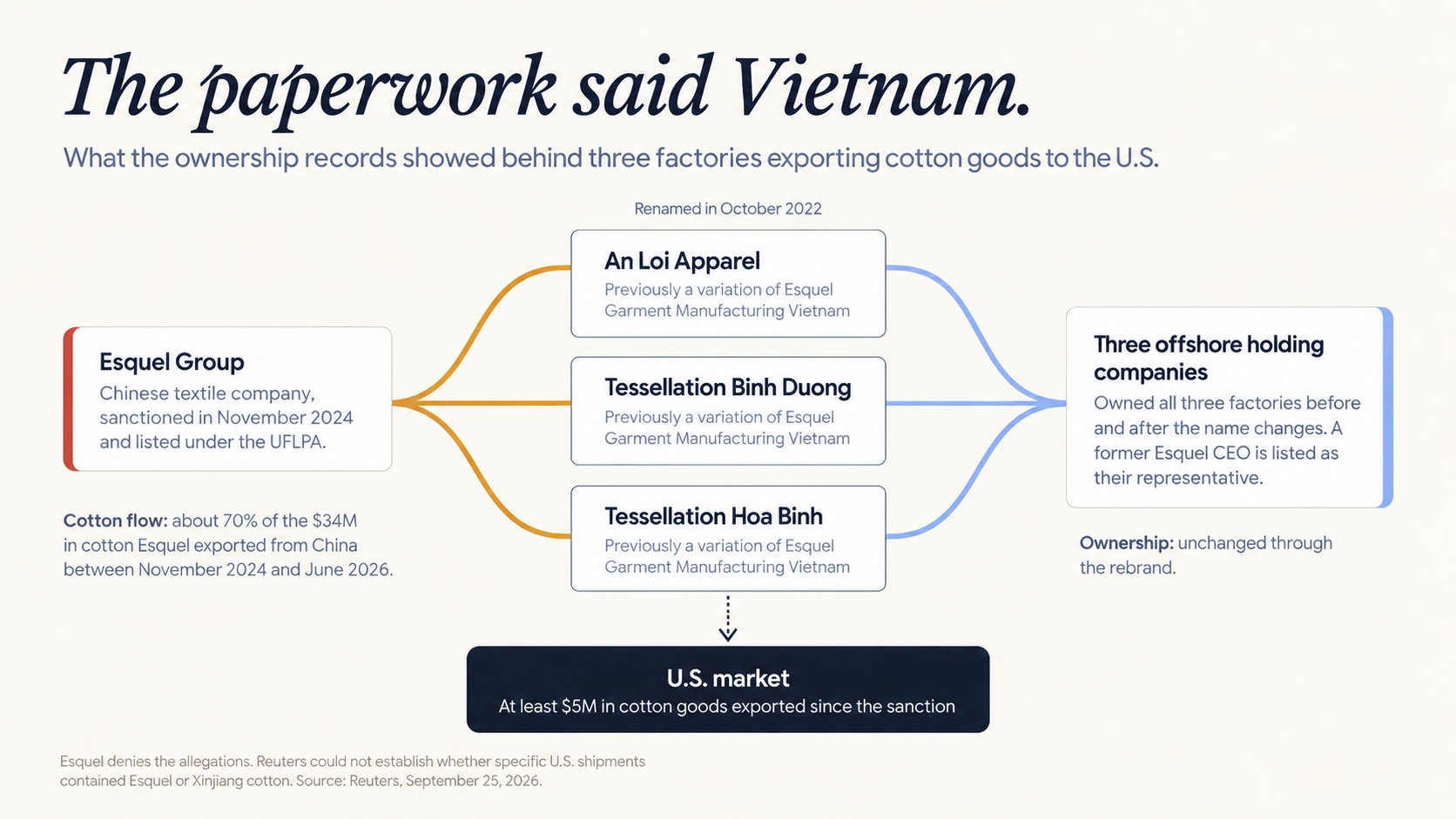 To be fair to the facts: Reuters could not establish whether the specific products shipped to the U.S. contained Esquel or Xinjiang cotton, and the factories also source elsewhere. But industry practice is to blend cotton from different sources. That is precisely the problem. Once materials blend, you cannot prove origin after the fact. You either had provenance before the shipment moved, or you didn’t.
A former assistant U.S. trade representative told Reuters the connections are likely enough for customs authorities to conclude the companies operate within Esquel’s ecosystem.
Knowing who you bought something from does not necessarily tell you where it came from.
Why is supply chain provenance getting harder, not easier?
Because the lists keep moving. Effective August 3, 2026, DHS added 43 companies to the UFLPA Entity List, bringing it to 187 entities, a 30% increase and the largest expansion ever. Under the law, shipments containing inputs or components from any listed company are deemed made with forced labor and barred from entry.
Enforcement is also crossing borders. CBP has detained significant numbers of shipments originating in Malaysia, Vietnam, Thailand, India, Mexico, and elsewhere, not just China.
And the stakes for importers are specific. The list includes alternate and former company names, and one traceable input from any listed entity can detain an entire shipment. Since the law took effect, CBP has denied entry to more than 24,300 shipments valued at nearly $1 billion.
Every time a list expands, suppliers you approved last year can become exposure this year. Nothing about your Tier 1 record changed. The world around it did.
Your Tier 1 supplier is only the beginning
Most organizations know their direct suppliers well. They know who they contracted with, what they bought, how much they spent, where the supplier sits, and whether it passed compliance checks.
We wrote about this in Follow the Supply Chain Until the Alternatives Disappear:
The most important dependency in your supply chain may be a company you have never heard of.
The Reuters investigation shows the other side of that problem. The most important origin in your supply chain may also be somewhere you never thought to look.
| Below Tier 1: two industry views | |
| Food, beverage and QSR: Carol Attak
In food and beverage supply chains, a Tier 1 supplier can perform well while exposure builds several layers down: in an ingredient source, processor, packaging input, production region, logistics route or capacity constraint. Those dependencies can surface as availability, cost, quality or service issues. Deeper visibility pays off when it gives the customer and supplier a shared view of emerging exposure, early enough to act together. |
Energy: Howie Mandell
Most energy organizations can name their Tier 1 vendors instantly; far fewer can say who those vendors depend on for long-lead inputs. A pressure-control equipment supplier can post strong delivery performance for years while its schedule rests on a limited pool of forge shops qualified for high-pressure, sour-service work. When that pool tightens, the supplier’s record still looks clean right up until lead times stretch well past plan. By then it is too late to fix, because qualifying a new shop takes longer than the schedule can absorb. |
What is Provenance Intelligence?
Provenance Intelligence is the continuous understanding of where a product, component or material actually came from, who touched and owned it along the way, what it depends on, and whether any of that has changed. It extends supplier management from “who supplied this?” to “what network sits behind it, and what exposure does that network carry?”
A modern product may be assembled in Country A, from components made in Country B, containing materials processed in Country C, by a company headquartered in Country D, with a sub-tier relationship to an entity in Country E.
So what is the origin? The answer depends on why you are asking:
| If you are asking for… | The origin that matters |
| Customs and tariffs | Country of origin under trade rules |
| Sanctions and forced labor | Any listed entity or region anywhere in the chain |
| Domestic content requirements | Where value and critical components were produced |
| National security | Ownership, control and influence at every tier |
| Supply continuity | The single point where alternatives disappear |
One product can have five different answers. Your supplier database usually holds one.
The five power questions of Provenance Intelligence
For any critical product, component, or material, these five questions separate a supplier list from a provenance map.
1. Where did this actually come from?
Not the shipping country or the invoicing entity. The origin of the materials, the processing, and the components inside it. If materials are blended or pooled, where did the inputs to the blend come from?
2. Who touched it along the way?
Every manufacturer, processor, distributor, logistics provider, and port between the raw material and your receiving dock. Each touchpoint is a place where origin can be obscured, or exposure can enter.
3. Who owns those companies?
Parent companies, offshore holding entities, joint ventures, affiliates, and key executives. The Reuters case turned on ownership that stayed constant while names changed. A new name on an old ownership structure is a signal, not a clean slate.
4. What depends on it?
Which products, programs, contracts, missions, and customers rely on this node? Exposure only becomes risk when it connects to something you care about.
5. Has any of that changed?
New owners, new names, new sources, new list designations, new shipping patterns, new export controls. This is the question most organizations never ask after onboarding, and it is the one that matters most.
A supplier map is not a provenance map
Consider a hypothetical component bought from a U.S. supplier. The Tier 1 relationship looks clean. Follow it deeper.
| Tier | What you find |
| Tier 1 | One U.S. supplier, fully compliant |
| Tier 2 | The component contains a specialized alloy from a second supplier |
| Tier 3 | That supplier buys processed material through a distributor sourcing from two companies |
| Tier 4 | Both companies rely on the same processor in another country |
| Ownership | One supplier was recently acquired, another has a new joint venture, and the processor has a relationship with an entity under new export controls |
One U.S. supplier became four companies behind it, became two apparent sources, became one underlying dependency.
The Tier 1 record never changed. The risk did.
Why Dependency Depth matters for compliance, not just continuity
In Follow the Supply Chain Until the Alternatives Disappear, we introduced Dependency Depth: start with the mission, then follow the chain through capability, platform, subsystem, component, Tier 1 supplier, Tier 2 supplier, specialized material and processing capability. Keep going until credible alternatives disappear. That is where Dependency Power concentrates.
Provenance Intelligence follows the same chain for a second reason.
| Dependency Depth asks | Provenance Intelligence asks |
| What stops working if this node disappears? | What exposure enters the system because this node exists? |
| Continuity risk | Sanctions, forced labor, geopolitical, domestic content, cyber, ownership and reputational risk |
Same chain. Two different questions. You need both, and the deeper the chain goes, the easier both are to miss.
Can three suppliers still be one dependency?
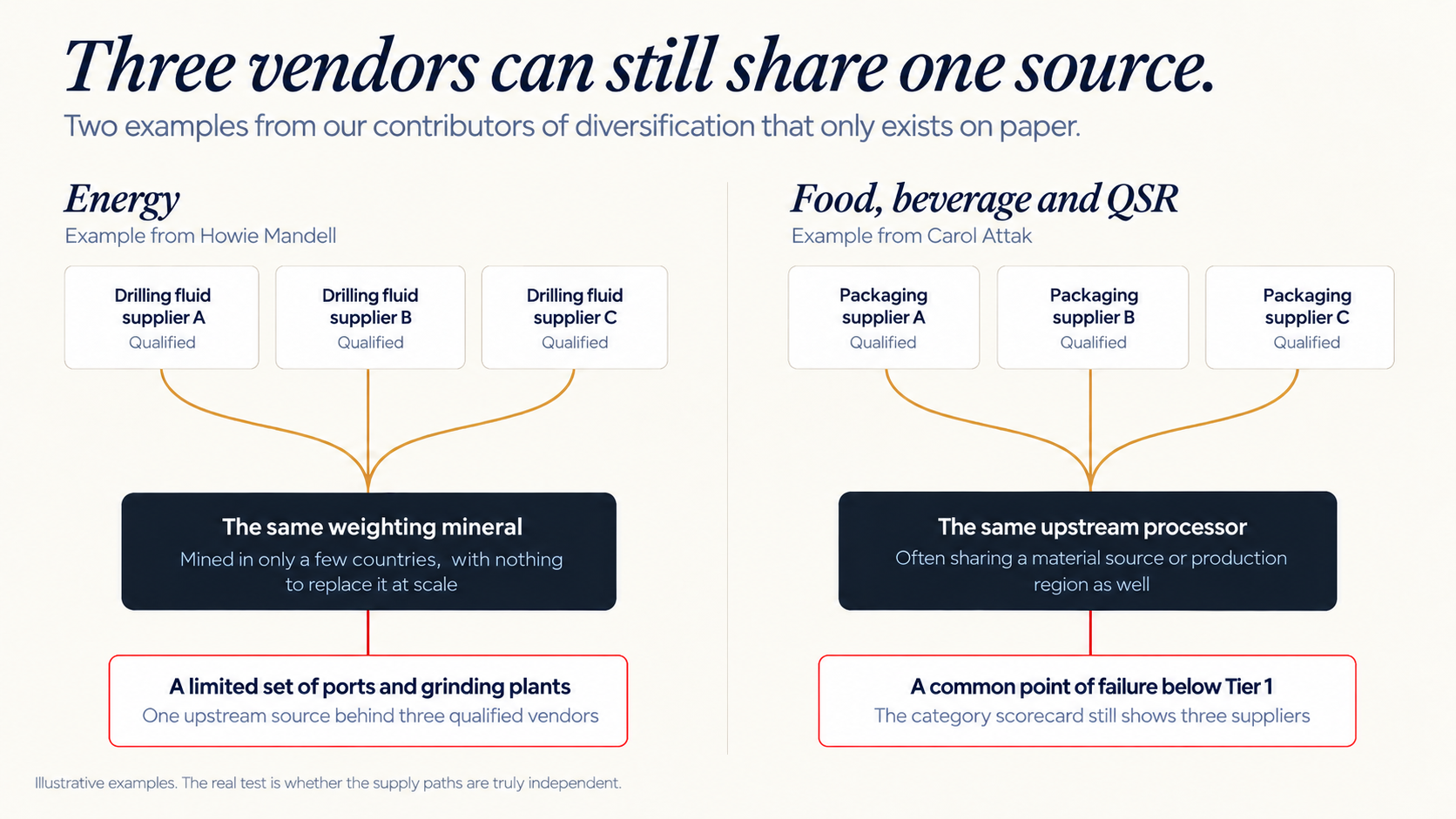
Yes. Three suppliers are only diversification if they are independent. If all three rely on the same foundry, port, processor, raw material, country, energy source, or specialized equipment, you do not have three supply chains. You have three paths into one dependency.
This is about to matter a lot more. The EU is reportedly preparing rules that would require companies in critical industries to source components from at least three suppliers, with limits on how much can come from a single supplier or country. On September 25, Germany’s main industry association, BDI, called for a more determined effort to diversify supply chains and reduce economic risk linked to China.
But diversification cannot be measured by counting supplier names. If five suppliers converge on the same material, processor or geography, the diversification exists on paper, not in reality. A supplier count satisfies a checkbox. A provenance map tells you whether the checkbox means anything.
| Where diversification breaks down | |
| Food, beverage and QSR: Carol Attak
A food or QSR company may qualify multiple suppliers for a critical packaging or ingredient category and still find that those suppliers depend on the same upstream processor, material source, production region or logistics route. On the category scorecard, the business looks diversified; below Tier 1, it may still hinge on a common point of failure. That shifts the sourcing question from “How many suppliers do we have?” to “Are those supply paths truly independent?” |
Energy: Howie Mandell
An operator may qualify several drilling fluid suppliers and consider the category diversified. Yet nearly all of those suppliers’ fluids depend on the same weighting mineral. It is mined in a small number of countries, has no large-scale substitute and moves through a limited set of ports and grinding plants. Three qualified vendors can still share a single upstream source. |
 Compliance is becoming a network problem
Traditional compliance evaluates entities. Is this company sanctioned? Is this supplier approved? Did the vendor certify?
Those questions still matter. Complex global supply chains now require another:
What network sits behind this entity?
Risk enters through ownership, sub-tier sourcing, material origin, processing, transportation, affiliates, and relationships that changed after the supplier was approved.
That last point matters enormously. A supplier assessment is a snapshot. A supply chain changes continuously. Companies are acquired. Factories open and close. Suppliers change sources. Governments impose restrictions. Shipping routes shift. New joint ventures appear. Relationships that were harmless six months ago can be material today.
Provenance cannot be established once. It has to be monitored.
What early signals show supply chain exposure is building?
By the time a shipment is detained, a sanction is announced, or a supplier misses delivery, the underlying conditions have usually been building for months. Earlier signals often include:
- Ownership changes or new holding entities
- Company name changes with no change in management
- Unusual shipping patterns or new routing through third countries
- New supplier relationships or shifts in sourcing geography
- Changes in import and export volumes
- Regulatory filings and government actions
- Production declines or capacity expansion somewhere unexpected
Individually, most of these look insignificant. On its own, the 2022 Esquel rebrand was just a name change. Connected to constant ownership, a former CEO listed as the owners’ representative and 70% of a sanctioned supplier’s cotton exports from China, it becomes a Pattern.
We have written before that the real metric is the one nobody is tracking yet. Supply chains work the same way. The signal is visible long before the metric everyone watches starts to move.
From Signal to Decision: how Provenance Intelligence works
At Polaris I/O, we think the architecture should look like this:
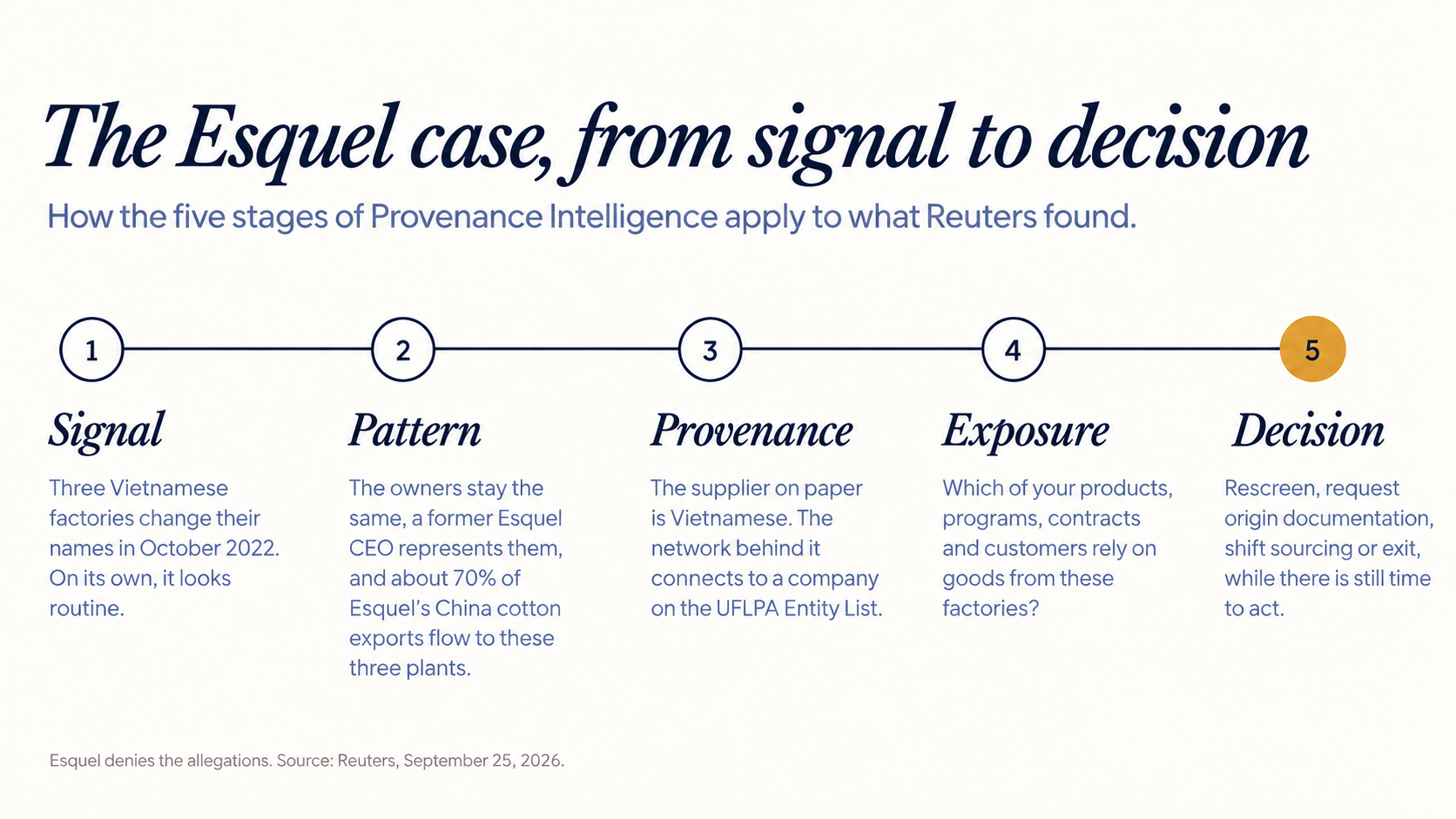 The final step is the point. The goal is not to build the world’s largest supply chain graph. It is to make a better decision, sooner.
Finding the exposure is only half the job
Earlier this week we explored Dependency Elimination. When a critical input is constrained, the reflex is to find another supplier. Sometimes the better answer is to use another material, redesign the component, recycle the input, repurpose another capability, or remove the dependency entirely.
Provenance Intelligence should lead to the same place. Once you find an exposure, the question becomes: what can we do about it?
| Intervention | When it fits |
| Qualify another supplier | A truly independent alternative exists |
| Change sourcing or reroute material | Exposure sits in a specific origin or path |
| Increase inventory | You need time to execute a longer fix |
| Change contract terms | You need traceability rights, audit rights or origin warranties |
| Investigate ownership | Signals point to a hidden relationship |
| Substitute or redesign | The dependency itself is the problem |
| Eliminate the dependency | The exposure cannot be managed at an acceptable cost |
Then compare each option on time, cost, risk reduction, performance and mission impact. Now you have moved from understanding the supply chain to changing the outcome.
| Acting while there’s still time | |
| Food, beverage and QSR: Carol Attak
In a collaborative supplier ecosystem, earlier visibility creates time for both sides to determine what can still change before service is affected. The customer may see broader category or enterprise exposure, while the supplier may see sub-tier capacity, alternate sources, or production options. Bringing those views together early can preserve sourcing, inventory, capacity, routing or substitution options that disappear once disruption is acute. The conversation shifts from “tell us when you have a problem” to “what are we seeing together, and what can we do now?” |
Energy: Howie Mandell
In energy operations, the calendar is set long before the work starts: a planned turnaround or shutdown is built around specific equipment, crews, and replacement parts. Seen early, a sub-tier constraint can still be absorbed by reserving capacity in a constrained queue, qualifying an alternate supplier, or resequencing the work scope. Seen late, those options are gone, because every buyer is competing for the same capacity and qualification takes longer than the window that remains. |
What this means for supply chain, procurement and compliance leaders
| Role | The question to take into your next review |
| Chief Procurement Officer | How many of our diversified categories actually converge on a common sub-tier source, geography or capacity constraint? |
| Trade Compliance | When the UFLPA Entity List expanded in August, which of our approved suppliers did we rescreen, including former and alternate names? |
| Supply Chain Risk | Which emerging changes in our supplier network require supplier engagement now to protect continuity, cost, quality or service? |
| Operations and Asset Integrity | Which critical spares and long-lead equipment depend on a source we have never mapped below Tier 1, and how long would an asset sit idle waiting for it? |
| Executive Leadership | If a sanction or detention hit tomorrow, how many days would it take to know our exposure? |
The world outside your company keeps changing
We recently wrote about the need for the world inside an enterprise to move as fast as the world outside it. That is especially true in supply chains.
Your ERP understands the suppliers you know. Your procurement system understands the contracts you signed. Your supplier database understands the entities you entered.
The world outside those systems holds the supplier’s suppliers, ownership networks, material flows, ports, government actions, sanctions, geopolitical shifts, capacity changes, and relationships nobody entered into your system. That world does not wait for the next supplier review. Decision intelligence cannot wait either.
Your supplier may be compliant. Your network may not be.
The Reuters investigation is about cotton. The underlying issue applies to semiconductors, critical minerals, defense components, pharmaceuticals, energy infrastructure, food, automotive, and virtually every complex global supply chain.
“Who is our supplier?” is still the first question. It can no longer be the last. You also need to know:
- Where did this really come from?
- What sits underneath it?
- What do those dependencies connect to?
- What changed?
- Where are we exposed?
- Do we still have time to act?
Your Tier 1 supplier may be compliant. Your paperwork may be correct. Your supplier database may be current. And you may still not know your supply chain.
That is the opportunity for Provenance Intelligence. Not another supplier list. Not another compliance checkbox. A continuously updated understanding of where something really came from, what it connects to, what is changing around it, and whether any of those changes should alter the decision.
Increasingly, the risk isn’t hiding in the company you know.
It is hiding in the network behind it.
See what sits behind your suppliers before it reaches your dock. Polaris I/O turns pre-intent signals across ownership, sourcing, and regulatory change into decisions you can act on while there is still time. Talk to our team. Nothing gets by you.
Frequently asked questions
What is sub-tier supplier risk?
Sub-tier supplier risk is exposure that sits below your direct (Tier 1) suppliers, in their suppliers, processors, raw material sources, owners, and affiliates. It includes sanctions, forced labor, geopolitical, cyber, and continuity risk that your supplier onboarding process never sees.
What is supply chain provenance?
Supply chain provenance is the verified history of where a product, component, or material came from, including every company that produced, processed, owned, or moved it. It answers where something actually originated, not just who sold it to you.
What is the UFLPA Entity List?
The UFLPA Entity List is a U.S. government list of companies found to be linked to forced labor in Xinjiang. Goods containing inputs from listed entities are presumed to be made with forced labor and barred from U.S. entry unless the importer proves otherwise. As of August 3, 2026, it includes 187 entities.
Does having multiple suppliers mean my supply chain is diversified?
Not necessarily. If multiple suppliers rely on the same processor, raw material, port, country or equipment, they share a single underlying dependency. Real diversification requires independence below Tier 1, which only a multi-tier map can confirm.
How often should supplier compliance be rechecked?
Continuously for critical suppliers. Sanctions and entity lists expand, companies change owners and names, and suppliers shift sources. Annual reviews miss changes that happen between them, and the list expansions themselves create new exposure overnight.
Why do company name changes matter in supply chain risk?
A new name can hide a continuing relationship. The UFLPA Entity List includes alternate and former company names for this reason. When a name changes but ownership, management, and sourcing stay the same, the exposure usually stays the same too.
What is the difference between Dependency Depth and Provenance Intelligence?
Dependency Depth asks what stops working if a node in the supply chain disappears. Provenance Intelligence asks what exposure enters because that node exists. The first identifies continuity risk. The second identifies compliance, ownership, and geopolitical risk.
Sources and further reading
Reuters via Investing.com, September 25, 2026: Exclusive: How firms linked to sanctioned Chinese cotton giant sell clothes to U.S.
The Jerusalem Post (Reuters): Firms linked to Chinese cotton giant shirk sanctions to sell clothes to US
U.S. Department of Homeland Security, July 31, 2026: DHS Announces the Addition of 43 Companies to the UFLPA Entity List
Kelley Drye & Warren: Largest Expansion of the UFLPA Entity List in History
Gateway Lines: UFLPA Entity List Adds 43: Importer Compliance Alert
Covington & Burling: DHS Expands UFLPA Entity List Amid Intensifying Enforcement Landscape
Free Malaysia Today (Reuters), September 25, 2026: German industry association pushes for Europe to diversify away from China
Modern Diplomacy: EU Moves to Reduce China Dependency with New Supply Chain Diversification Rules
Polaris I/O: Follow the Supply Chain Until the Alternatives Disappear
Polaris I/O: The Delay You Never Saw Coming Was Never About Your Tier 1 Supplier
Polaris I/O: The Real Metric Is the One Nobody Is Tracking Yet
Polaris I/O: Moving as Fast as the World Outside

Related Posts
Nothing found.