


From suspected cyber incidents on military bases to a new Section 232 proclamation and a $9 billion grid acquisition, this week shows why the biggest business risk is often the consequence nobody connected.
The short answer
Most business risk does not arrive as one big headline. It arrives as several small, public signals spread across different sources and different weeks. The freezer failures at U.S. military commissaries are a clear example. Public research on refrigeration controller weaknesses, failures at multiple bases, a confirmed attack on hundreds of French supermarkets and a Pentagon cyber investigation all appeared over about 80 days. Each piece was visible. The value was in connecting them early enough to act. That discipline is called continuous reasoning, and it is what Polaris I/O is built to do.
Key takeaways
- The first headline rarely tells the whole story. An equipment failure can become a cybersecurity investigation. A trade decision can change a sourcing plan before any tariff exists. An acquisition can reshape a supplier ecosystem.
- The consequence depends on your business. The same development can be a threat to one company, an opportunity for another and irrelevant to a third.
- The signals that matter are usually spread across sources. News, regulatory actions, security research, corporate activity and supplier relationships tell a different story when they are read together.
- A good decision can go stale. Conditions keep moving after a purchase order is issued, a contract is signed or an investment is approved.
- Continuous reasoning is the difference. The goal is not another stream of alerts. It is intelligence that keeps connecting evidence, reassessing consequences and telling people when it is time to act.
The question for every executive: what changed in the last 72 hours that could invalidate a decision your organization made last month?
How did a freezer failure become a national security question?
A freezer failure became a question of national security when enough separate, public signals lined up to change its explanation. No single report proved anything. Together, they moved the story from maintenance to possible cyber interference.
It started with something mundane. In late August, the commissary at Fort Huachuca in Arizona posted that an overnight equipment failure had sent every freezer into defrost mode and spoiled all its frozen food (Military Times). Fort Irwin, Naval Station Newport, Travis Air Force Base and F.E. Warren Air Force Base reported refrigeration problems in the same window (My Military Benefits). On their own, those look like bad luck with aging equipment.
Then the surrounding information changed. On October 29, Reuters reported that Pentagon investigators were treating malfunctions at at least six U.S. bases as suspected cyber incidents and were coordinating with French authorities, who were investigating an attack on supermarket refrigeration earlier in the month (Reuters). The investigation has not established that the base incidents were cyberattacks, that they are linked to France or who might be responsible. That distinction matters, and it is the point.
The original event never changed. The evidence around it did.
The signals were public, and they arrived over 80 days
Here is what an organization watching the right sources could have seen, in order. The escalation column is illustrative. It shows how a company running refrigeration controllers of this class might have rated each development using the five Signal Escalation levels Polaris uses: Normal, Watch, Investigate, Intervene and Escalate.
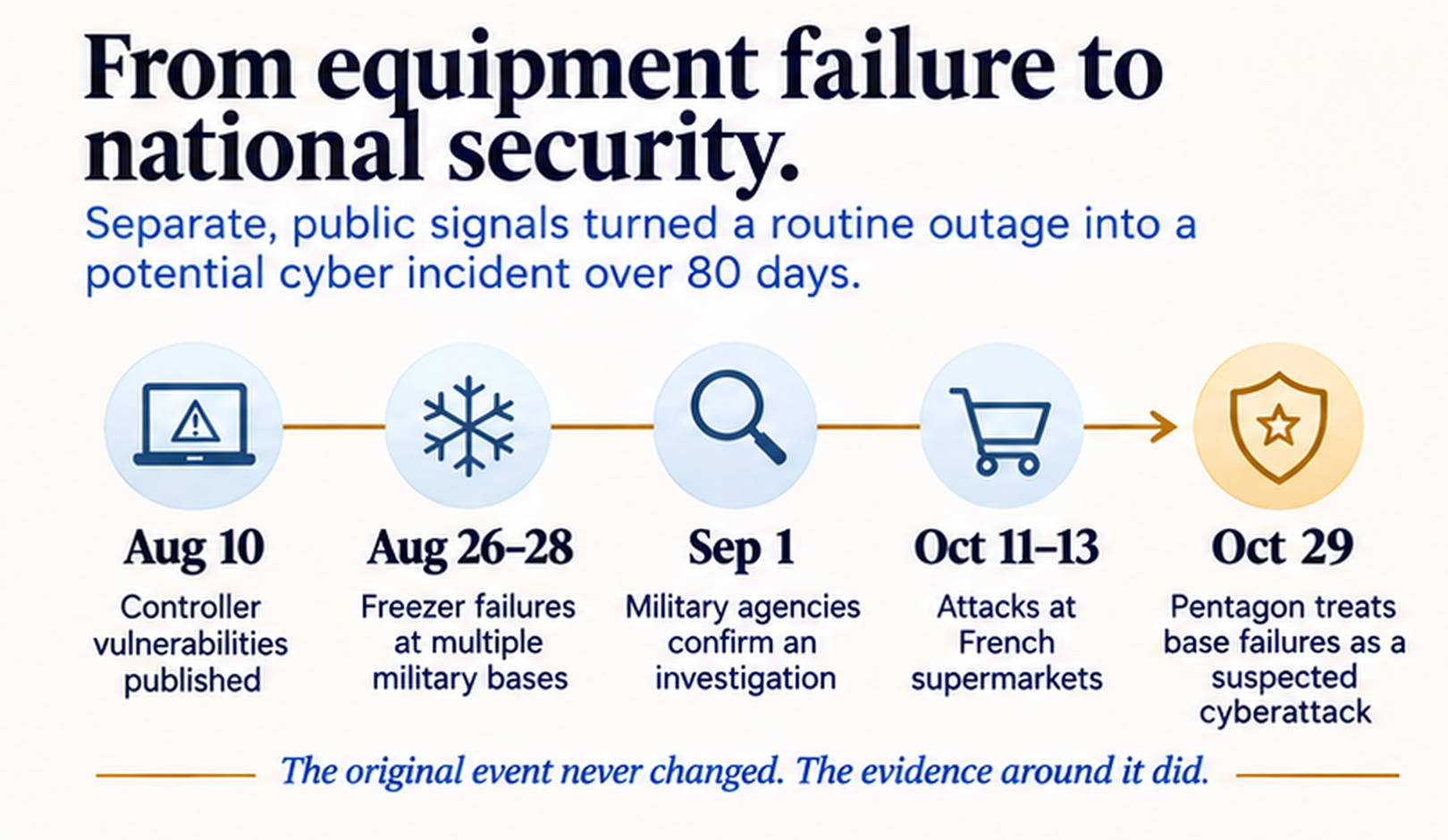 None of these items prove the others. Equipment can fail in clusters for ordinary reasons, and the military incidents may yet turn out to have a mundane cause. But a refrigeration operator who saw the August research, then the August failures, then the October attack in France had a strong reason to patch, segment and verify controllers weeks before the Pentagon story ran.
The window is also getting shorter. Claroty researchers later showed that an AI coding model, given public vulnerability details and freely downloadable firmware, could reproduce working exploits for known controller flaws in under 30 minutes for about $6 (Cybernews). When the gap between disclosure and exploitation shrinks to minutes, waiting for the quarterly risk review is not a plan.
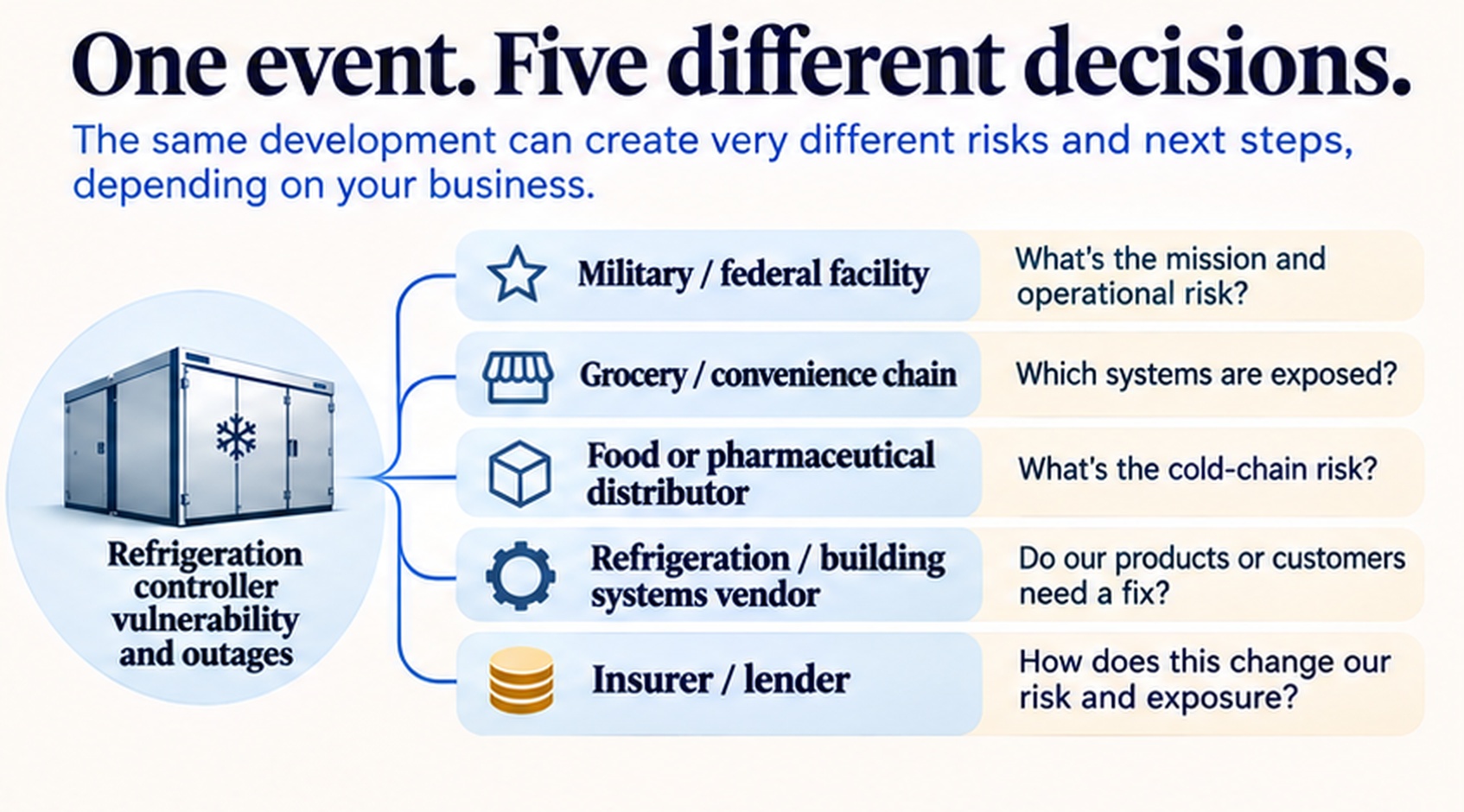
One event, five different decisions
What a leader should do with this news depends entirely on what that leader runs. Knowing what happened is universal. Knowing what it means is specific to your assets, dependencies and commitments.
| If you run | The question this event raises | A reasonable first move |
| A military installation or federal facility | Which building and refrigeration controls are reachable from outside, and who maintains them remotely? | Inventory operational technology on the installation and confirm firmware and remote access paths. |
| A grocery or convenience chain | Do our stores run the same controller families named in the research and the French incident? | Map controllers by store, version and service provider, then patch and restrict internet exposure. |
| A food or pharmaceutical distributor | Which cold storage sites carry our most critical customer commitments? | Rank facilities by revenue and contractual exposure, and confirm backup capacity. |
| A refrigeration or building systems vendor | Are older controller versions still deployed across our installed base? | Contact customers on affected versions and publish clear remediation guidance. |
| An insurer or lender | Is a run of “isolated” spoilage claims actually one correlated exposure? | Review claims and covenants for concentration in the same equipment or service provider. |
One event. Five sets of consequences. Five different decisions. That is the difference between knowing what happened and understanding what it means to you.
Missed connection one: when an equipment failure becomes an operational exposure
The first missed connection happens when a development crosses the boundary between the systems built to watch it. Equipment management watches equipment. Cybersecurity watches the network. Procurement watches suppliers. Risk management watches insurance. Each does its job, and none is designed to notice when one story moves across all four.
Consider a hypothetical national food distributor with 40 refrigerated facilities. A refrigeration controller at one site behaves strangely, and maintenance investigates. A week later, reports surface of similar failures elsewhere. A security advisory names an older class of controllers. The distributor finds that several other sites run related equipment, maintained by the same outside service firm.
The question is no longer whether one freezer needs repair. It is whether a shared technology dependency warrants an enterprise review, and the follow-on questions arrive fast:
- Which facilities run the affected controller families and versions?
- Which customer commitments depend on those facilities this month?
- How much inventory is exposed, and for how many hours can it survive a failure?
- How much backup cold storage capacity exists elsewhere in the network?
- When does protective action cost less than waiting for a confirmed failure?
No single headline answers any of these. They require connecting outside developments with the organization’s own facilities, vendors and obligations. That is a decision intelligence problem, not a monitoring problem.
Missed connection two: nothing happened, yet the decision changed
A policy announcement with no immediate cost can still change the economics of a decision you have already made. The October 28 Section 232 proclamation on robotics and industrial machinery is a good example.
On October 28, the President signed a proclamation agreeing with a Commerce Department finding that imports of robotics, industrial machinery and their parts threaten to impair U.S. national security (White House fact sheet). It did not impose tariffs. Instead, it directed the Commerce Secretary and the U.S. Trade Representative to negotiate with trading partners, with a progress update due within 180 days. If no agreement is reached in that window, or an agreement proves ineffective, the President may take other actions, including tariffs or quotas (Unite.AI).
The scope is broad. The underlying investigation, opened in September 2025, covers programmable, computer-controlled systems such as CNC machining centers, turning and milling machines, grinding equipment and industrial stamping (Husch Blackwell). And the administration has moved quickly before: the 2025 copper action reached tariffs 144 days after its investigation began (White & Case).
A manufacturer reading the headline might conclude that nothing changed. No new tariff, no higher invoice, no reason to revisit the procurement plan. Now consider a company in the middle of a $100 million plant expansion. Some imported robotics and machinery are already on order. More purchases are scheduled over the next six months. The 180 day clock runs to about April 26, 2027, which lands inside that buying window.
Today’s invoice did not change. The assumptions behind next quarter’s purchases did. Leadership now has real questions to work through:
- Should certain orders move forward, ahead of a possible change in duties?
- Which equipment categories and source countries fall inside the scope?
- Which contracts protect the company if new duties arrive mid delivery?
- What happens to the project’s return if equipment costs rise 10% or 25%?
- What evidence from the negotiations would justify waiting, and what would justify acting?
Waiting for a final tariff decision can mean waiting until the most valuable options are gone. That does not mean every manufacturer should switch suppliers or pull orders forward. It means this development deserves a deliberate review of each company’s specific commitments, exposures and decision windows. Continuous reasoning does not turn uncertainty into certainty. It shows which assumptions just got less secure, and what evidence would justify a different response.
Missed connection three: a $9 billion acquisition changes more than ownership
When a critical supplier changes hands, every customer, competitor and supplier in its network inherits a new set of questions. GE Vernova’s agreement to buy Trench Group shows how far one transaction can reach.
On October 28, GE Vernova agreed to acquire Trench Group from private equity firm Triton Partners for $9 billion, with closing expected in late 2027 after regulatory approvals (GE Vernova). Trench makes high and medium voltage bushings, instrument transformers and coils for more than 800 utilities and hyperscalers, with over 3,000 employees across 11 manufacturing sites in Europe, North America and Asia (Offshore Engineer). Its components sit in most high voltage direct current lines built worldwide. It brings about $5 billion in backlog and framework agreements, some running into the next decade, and a new Charlotte, North Carolina plant expected to start 765 kV production in late 2027 (T&D World).
GE Vernova describes the deal as vertically integrating an existing supplier. That phrase alone should prompt questions across the grid supply chain. The same announcement reads very differently depending on where you sit:
| Who you are | What the deal could mean | What to investigate |
| Utility or transmission developer | A key component maker now sits inside a major equipment OEM | Framework agreement terms, allocation of production slots, delivery dates on open orders |
| Hyperscaler or data center developer | Grid interconnection hardware is increasingly scarce and consolidating | Lead times for substation and interconnect equipment tied to commissioning dates |
| Competing grid equipment OEM | A rival now controls a component you may also buy | Supply continuity, pricing and alternative sources for bushings and instrument transformers |
| Supplier to Trench | A new owner with different procurement standards and volume | Contract changes, qualification requirements and new volume opportunity |
| Private equity sponsor | Triton’s exit shows the value strategic buyers place on scarce grid capacity | Portfolio companies with similar bottleneck positions and their exit timing |
The deal does not establish that any product will become unavailable, that prices will change or that customer contracts will be affected. Those are questions to investigate, not conclusions to assume. In grid hardware, the scarce resource is often factory capacity rather than demand, so ownership of that capacity matters (Finimize). A news alert tells you the transaction happened. Decision intelligence tells you why it matters to the suppliers, customers and investments you care about, and keeps tracking it through close.
Why business conditions never change one at a time
These three developments are unrelated events, but they expose the same decision problem: a traditional alert reports the event, while the real exposure sits in your own dependencies.
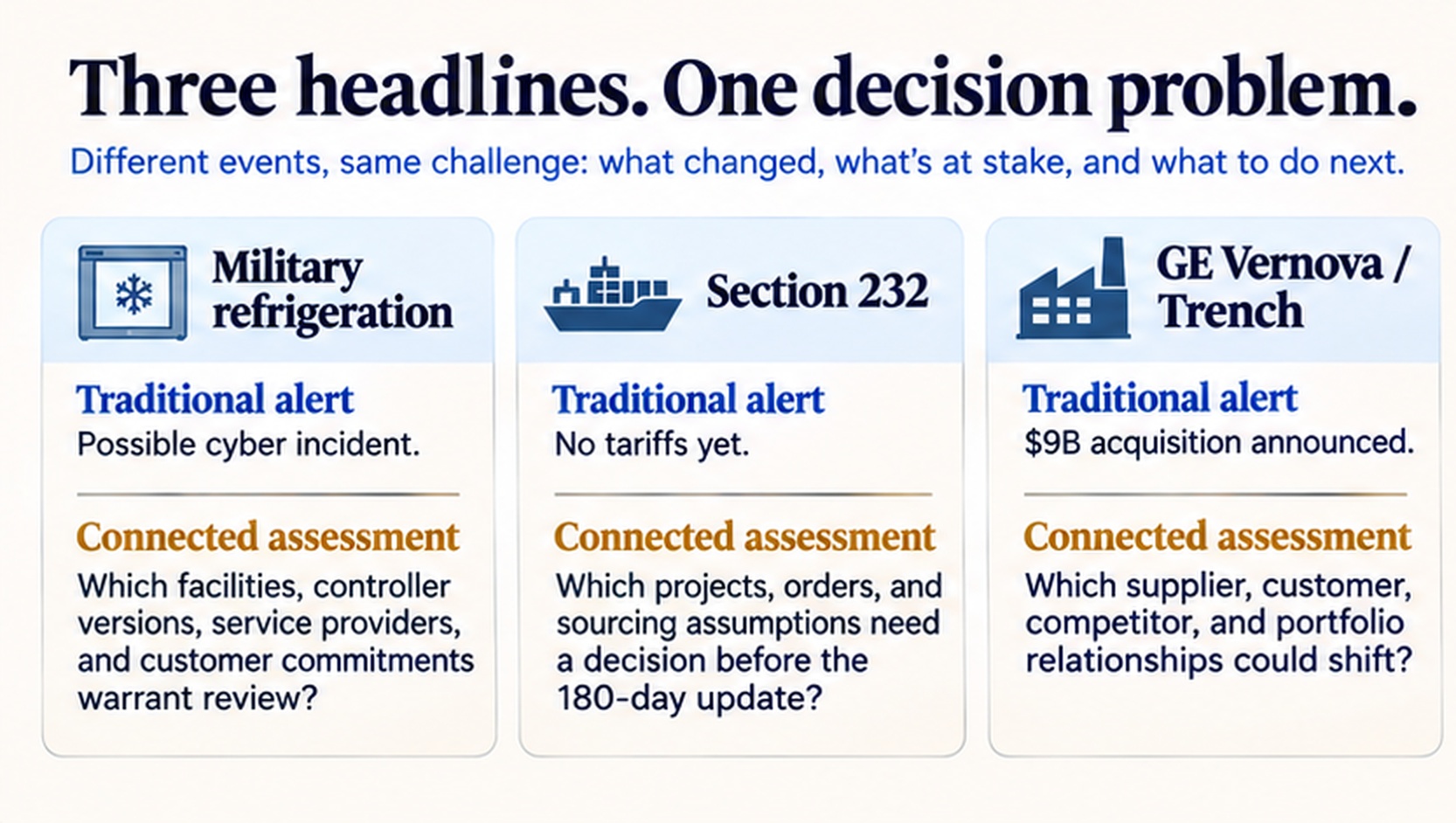 A leadership team cannot give every event equal attention. It needs to know what is relevant, which evidence is credible, where consequences may surface and when action becomes appropriate. That takes more than collecting information. It takes keeping the context around consequential decisions current, every day.
Why does traditional intelligence leave executives looking backward?
Most organizations are built to explain what happened, not to notice what is forming. A supplier misses a commitment. A project slips. A key account moves to a competitor. A portfolio company underperforms. The organization investigates, management gets a report, a new process appears and everyone asks why nobody saw it sooner.
The answer is usually that the early evidence existed, but in different places. The supplier’s financial position had weakened. A factory had cut a shift. A competitor had added capacity. A regulation had entered consultation. Several people had left the same team. A minor technical incident had hit another company using the same system. None of those facts proves a problem is coming. Together, they change the assessment.
In our earlier article, We Don’t Have a Data Problem. We Have a Signal Problem, we argued that more information is not the same as better intelligence. Information becomes useful when it is cleaned, connected, weighed for confidence and read in context. And as we wrote in AI Does Not Eliminate Belief. It Industrializes It., the bigger danger is rarely a lack of answers. It is holding onto yesterday’s answer after the evidence has moved.
The real question is not how many things you can monitor. It is whether you recognize the few developments that change what someone should do.
What is continuous reasoning?
Continuous reasoning is the ongoing evaluation of new evidence against the assumptions behind decisions you have already made. A traditional alert has a beginning and an end: something happens, a notice goes out, someone reads it. Continuous reasoning stays with the situation as it develops, because the original concern can become more serious, less serious or irrelevant as new facts arrive.
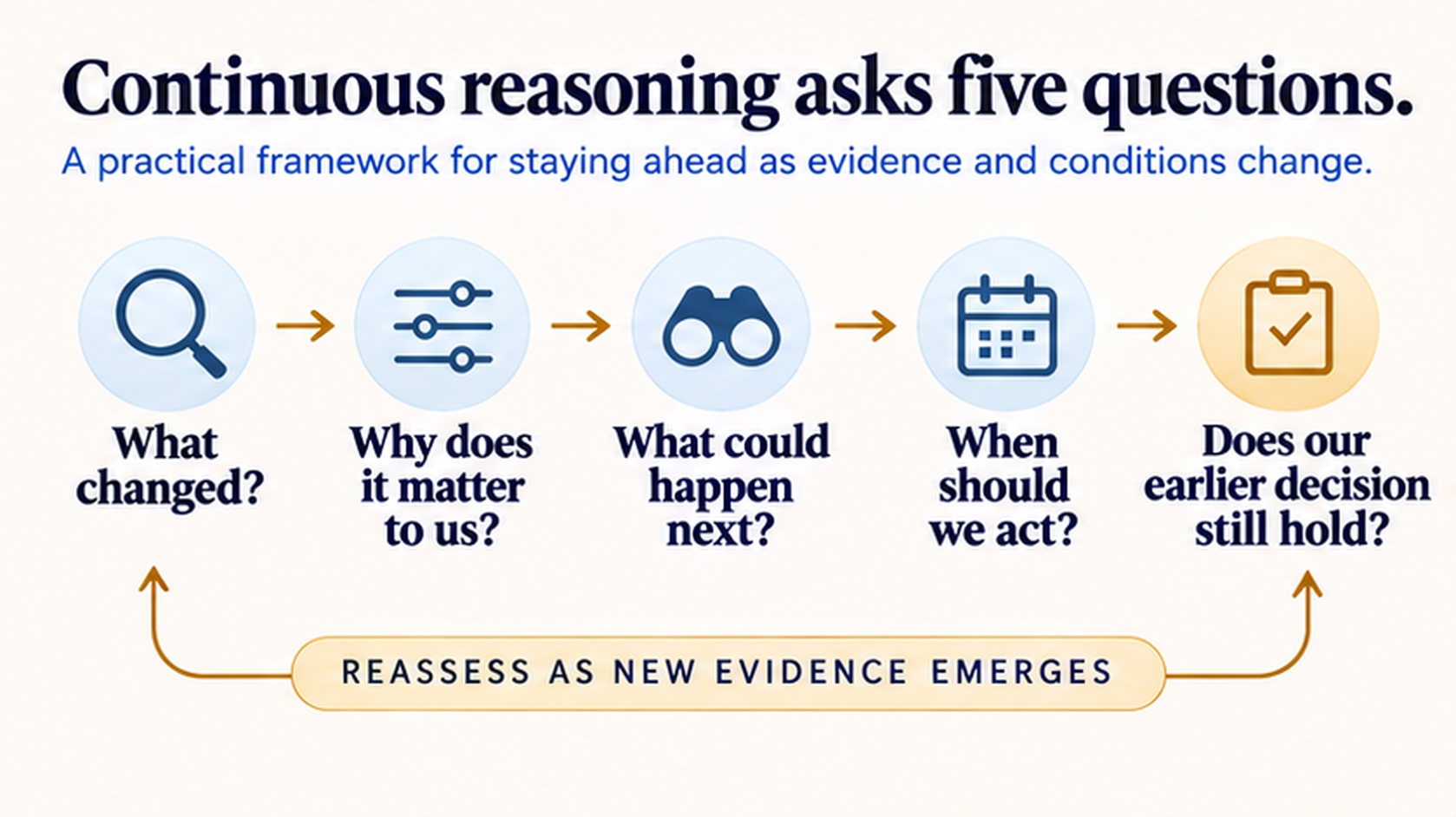 It asks five questions, over and over:
- What changed? The latest development, its source, its timing and how much confidence the evidence supports.
- Why does it matter to us? The link to our accounts, suppliers, facilities, investments, customers, programs or mission.
- What could happen next? The plausible consequences, the relationships that could carry an impact to us, and the evidence that would strengthen or weaken each view.
- When should we act? Whether a development calls for observation, investigation, intervention or escalation. Timing matters because today’s options may be gone next month.
- Does our earlier decision still hold? A fresh check of the original assumptions. If the facts change, the assessment should change.
Signal Escalation: matching the response to the evidence
Not every signal deserves the same response. Polaris uses five Signal Escalation levels, introduced in AI Governance Has a Threshold Problem, so teams act in proportion to what the evidence supports. The freezer timeline above shows how one situation can climb the ladder over weeks.
| Level | What it means | Typical response |
| Normal | No relevant change | Keep monitoring |
| Watch | A credible signal touches something you depend on | Flag it, name an owner, track related developments |
| Investigate | Related signals are accumulating | Confirm your exposure, gather internal facts |
| Intervene | Evidence supports protective action | Patch, reroute, renegotiate or hedge |
| Escalate | Material impact is likely or underway | Leadership decision, communications and contingency plans |
An alert tells you something happened. Continuous reasoning tells you when what happened changes the decision.
How Polaris I/O turns signals into decisions
Polaris I/O connects outside developments to the specific decisions, dependencies and commitments of each customer, and keeps reassessing them as evidence changes. The work runs through three connected capabilities.
- Signal Monitoring tracks developments tied to the organizations, markets, regulations and environments a customer cares about, drawing on open sources and specialized databases such as NIST.
- The Pattern Engine connects related signals over time to show what is forming, how conditions are shifting and what could be affected.
- Decision Activation turns that intelligence into recommendations, reports, alerts and workflows that help teams choose a response.
The advantage is not a bigger feed. It is intelligence shaped to the decision. Most customers start with external signals and later connect internal sources such as CRM records, contracts and supplier lists, which is when the reasoning becomes specific to their exposures. Deployments have gone live in a single day.
The same discipline serves very different roles:
- Commercial leaders see an emerging buying moment at a target account before it shows up as intent.
- Supply chain executives see a risk to a critical commitment while there is still time to reroute.
- Private equity sponsors see a challenge to an investment thesis, or an expansion opportunity, between board meetings. We call this continuous diligence.
- Public sector mission owners see a dependency that could affect operational readiness.
See what is changing. Understand what it means. Know how to respond. Then keep reassessing as the evidence evolves.
Polaris combines external developments with customer provided information through supported integrations. The completeness of any exposure assessment depends on the quality and availability of the relevant data. Polaris is not a substitute for operational cybersecurity tools, regulatory counsel or human decision authority.
The executive test: what changed in the last 72 hours?
Pick one consequential decision your organization has already made and test whether anyone is watching the evidence that could undo it. It might be a major supplier selection, a market entry, an acquisition, a capital project, a critical technology deployment or a new customer relationship. Then ask five questions at your next leadership meeting:
- What assumptions made this decision reasonable when we approved it?
- Which outside developments could make those assumptions less reliable?
- Who is monitoring those developments every day, not every quarter?
- How would we know that enough had changed to reopen the decision?
- Who owns the response, and how much time would we have to act?
If the answers depend on someone remembering to check the news, a quarterly report or a supplier picking up the phone, there is a gap between the information available to your organization and the intelligence it needs to decide in time. We go deeper on this in Five Questions Every Leadership Team Should Be Able to Answer Before It Becomes Obvious.
The goal is not to eliminate uncertainty. It is to recognize meaningful change while you still have choices.
The next thing is already happening
A freezer malfunction is now a suspected cyber incident. A national security finding has changed the outlook for industrial equipment without changing a single invoice. A $9 billion deal has put a critical grid supplier under new ownership. None of these headlines tells any executive what to do, and that is the point. Information is universal. Its consequences are specific to your business.
The advantage goes to organizations that connect new evidence to the decisions they have already made, notice when assumptions start to shift and respond before the consequences become obvious. That is what continuous reasoning makes possible, and it is why we built Polaris I/O.
What did your business miss this week?
Tell us the accounts, suppliers, facilities, investments or initiatives you cannot afford to be surprised by. We will show you which signals are moving around them right now, and how Polaris I/O connects them into patterns that tell you when to act.
Start with one important decision. We will show you the signals that could change it.
Book a conversation at polarisio.com
Polaris I/O. Nothing gets by you.
Frequently asked questions
Were the military commissary freezer failures a cyberattack?
Not confirmed. As of October 29, 2026, Reuters reported that Pentagon investigators were treating refrigeration failures at at least six U.S. bases as suspected cyber incidents but had not established a cause or a perpetrator. Military criminal investigative agencies have been investigating since early September.
What happened in the French supermarket refrigeration cyberattack?
On the night of October 11 to 12, 2026, attackers remotely changed temperature and defrost settings at hundreds of French supermarkets, including Intermarché, Coopérative U, Carrefour and E.Leclerc. Units reached 50°C (122°F), food was destroyed and some stores reported fires. Officials linked the compromises to Danfoss, Copeland and Dixell controllers.
How can refrigeration operators reduce controller risk?
Update supervisory controllers to patched firmware (Danfoss AK-SM 800A R4.3.1 or later, Copeland XWEB Pro 1.13 or later), remove management interfaces from direct internet exposure, restrict remote access to trusted networks or VPNs, segment controllers from other systems and review which service providers hold remote access. Confirm the steps with your vendor and security team.
What is Section 232 proclamation on robotics and industrial machinery?
Signed October 28, 2026, it agrees with a Commerce Department finding that imports of robotics, industrial machinery and their parts threaten to impair U.S. national security. It has no tariffs yet. It directs negotiations with trading partners, with an update due within 180 days, and allows further action such as tariffs or quotas if talks fail.
Why is GE Vernova acquiring Trench Group?
GE Vernova agreed to buy Trench Group from Triton Partners for $9 billion to expand its grid electrification business. Trench supplies high voltage bushings, instrument transformers and coils to more than 800 utilities and hyperscalers and carries about $5 billion in backlog and framework agreements. Closing is expected in late 2027.
What is continuous reasoning in business intelligence?
Continuous reasoning is the ongoing evaluation of new evidence against existing business context, assumptions and decisions. Instead of treating each alert as a separate event, it connects developments over time and flags when an earlier assessment or response should change.
How is decision intelligence different from monitoring?
Monitoring identifies events. Decision intelligence connects relevant events to business context, likely consequences, priorities and possible actions. The goal is not awareness for its own sake, but better and earlier decisions.
What are second order consequences?
Second order consequences are the effects that follow from an event’s immediate impact. A refrigeration control failure first spoils inventory. It can then disrupt deliveries, force a switch to backup storage, strain supplier commitments and create financial or regulatory exposure.
Why do weak signals matter?
A weak signal rarely justifies action on its own. Several related signals can strengthen or change an assessment. Their value depends on credibility, relevance, connection to other evidence and the time left to respond.
How can organizations spot changing supplier risks earlier?
Monitor supplier financial health, operating changes, ownership changes, production capacity, geographic exposure, security incidents and relevant regulation. Connecting those developments to validated supplier and customer relationships shows which exposures warrant review.
How does Polaris I/O help organizations respond to changing conditions?
Polaris I/O uses Signal Monitoring, its Pattern Engine and Decision Activation to identify relevant developments, connect evidence into emerging patterns and support next steps. Customer specific assessments depend on the data available, the configured monitoring priorities and integrations.
How quickly can Polaris I/O be deployed?
Most customers start with external signals focused on the accounts, suppliers or investments that matter most, and deployments have gone live in a single day. Internal data such as CRM records and contracts can be connected later to make assessments specific to the customer’s exposures.
Can continuous reasoning predict every disruption?
No. Continuous reasoning does not guarantee prediction or remove uncertainty. Its value is better timing, context and evidence for decision makers as conditions change.
Related Polaris I/O reading
- We Don’t Have a Data Problem. We Have a Signal Problem. Why more information is not better intelligence.
- Five Questions Every Leadership Team Should Be Able to Answer Before It Becomes Obvious. The leadership version of the 72 hour test.
- AI Governance Has a Threshold Problem. The five Signal Escalation levels and the operating model behind them.
- AI Does Not Eliminate Belief. It Industrializes It. Why outside evidence has to keep testing yesterday’s answer.
- Signing Is the Easy Part. The gap between declared authority and observed authority.
- Continuous Diligence. How private equity sponsors keep an investment thesis current after close.
Sources
- Reuters: Pentagon treating military base freezer malfunctions as suspected cyberattack, October 29, 2026
- Military Times: DoD confirms refrigeration disruption at military commissaries, August 28, 2026
- Stars and Stripes: Army CID investigates commissary refrigerator outages, September 1, 2026
- My Military Benefits: U.S. commissaries hit by widespread refrigeration disruption
- Digital Today: U.S. military base freezers fail simultaneously, cyberattack probe
- BleepingComputer: Cyberattack shuts down refrigerators at French supermarkets, October 12, 2026
- Al Jazeera: Hundreds of supermarkets in France hit by unprecedented cyberattack, October 13, 2026
- INCIBE CERT: Cyberattack on supermarket refrigeration systems in France
- Food and Drink Business: Refrigeration controller flaws risk silent spoilage
- ThreatCluster: Copeland XWEB Pro vulnerabilities, DEF CON 34 timeline
- Refindustry: Danfoss, Copeland and Trane address controller security vulnerabilities
- Cybernews: Claroty researchers recreate refrigeration controller attack with AI
- White House: Fact sheet on Section 232 action for robotics and industrial machinery, October 28, 2026
- AI: Section 232 proclamation on robotics and industrial machinery
- Husch Blackwell: Section 232 investigations on industrial machinery
- White & Case: Section 232 investigation on robotics and industrial machinery
- GE Vernova: Third quarter 2026 results and agreement to acquire Trench Group, October 28, 2026
- T&D World: GE Vernova to acquire Trench Group for $9 billion
- Offshore Engineer: Trench Group to be acquired by GE Vernova

Related Posts
Nothing found.