


Why Transactional AI needs more than powerful models, and why continuously updated signals are becoming the foundation for intelligent decisions and autonomous agents.
On November 13, Reuters reported that Amazon has drafted a plan to collect data on nearly every product sold on Earth, whether Amazon stocks it or not.
The project is called World Product Graph. According to the internal document Reuters reviewed, brands including Coca-Cola and Bayer already contribute product data, Amazon would gather the rest by learning how brands organize products on their own websites, and the aspirational launch date is October 1, 2027. Amazon calls the memo an outdated brainstorm that may not reflect its current plans.
The scale is not the most revealing part. The document also acknowledges that Amazon’s own AI shopping assistant was giving inaccurate answers. (Amazon told Reuters the figures are outdated and puts the assistant’s accuracy at about 97%.)
Sit with that for a second. One of the most capable AI companies in the world sits on the largest product catalog in retail, and its own document argues that its AI needed more complete, more current, and more connected information to answer a shopping question correctly.
If that is true for a pair of running shoes, it is true for a supplier decision, a credit decision, an acquisition thesis, or a national security assessment.
That is the problem Polaris I/O was built to solve.
Key Takeaways
- Transactional AI is AI that supports or executes consequential business decisions: what to buy, sell, lend, source, monitor, defend, or respond to.
- Models supply the reasoning. The quality of the decision depends on how current and connected the information is.
- Gartner predicts that through 2026, organizations will abandon 60% of AI projects unsupported by AI-ready data.
- Polaris I/O provides the signal layer: continuously monitored, connected, evidence-backed intelligence that powers its own applications and feeds other companies’ models and agents.
- In an SBI Growth Advisory study of 46 enterprise accounts, teams acting on signals generated four times as many qualified opportunities and closed deals in roughly half the time.
What Is Transactional AI?
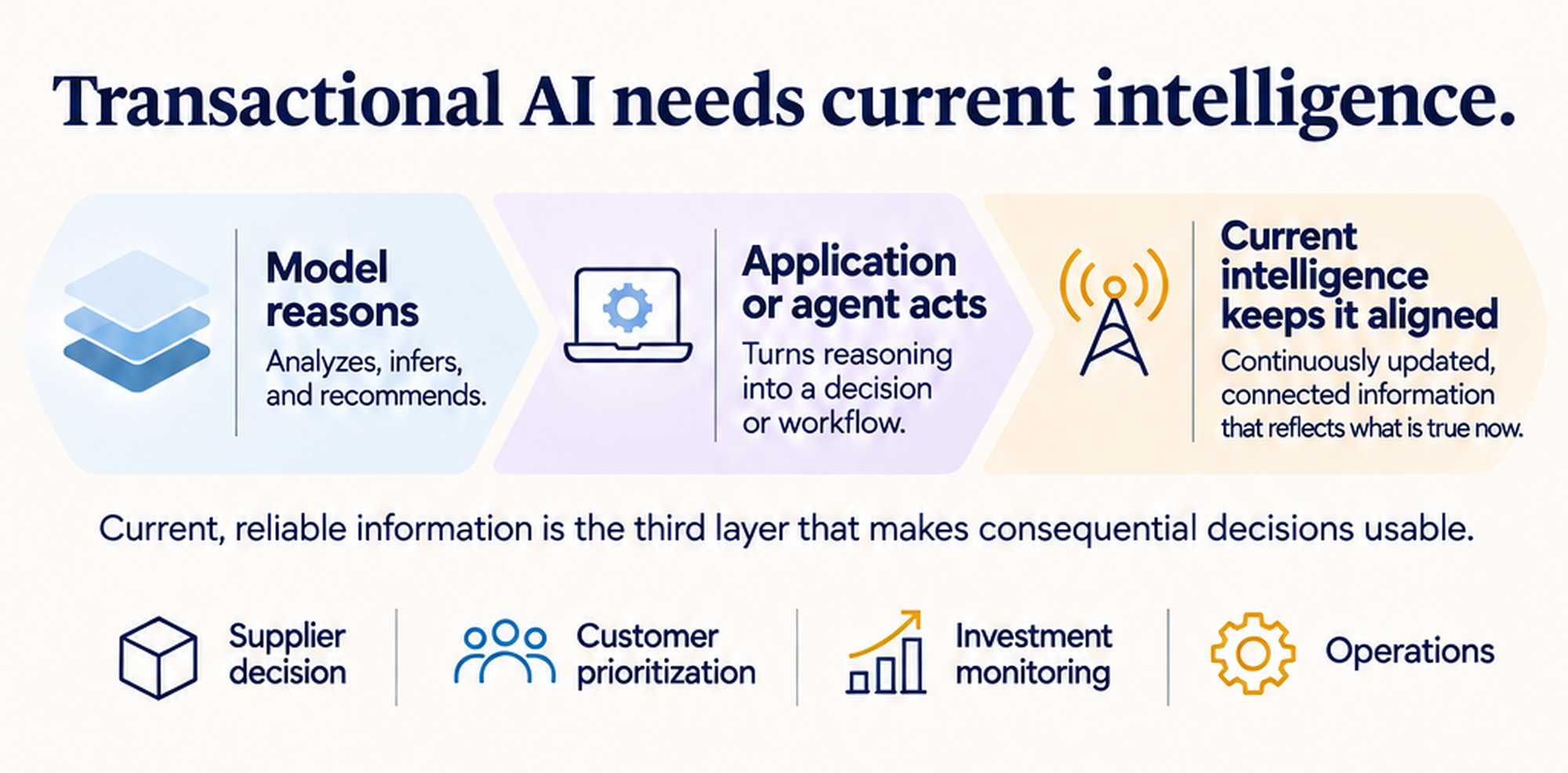
Transactional AI refers to AI systems that support or execute consequential decisions inside specific business workflows. General-purpose generative AI creates content and answers questions. Transactional AI applies intelligence to decisions involving customers, suppliers, investments, credit, procurement, and operations, where a wrong call carries a financial, operational, or security cost.
The difference shows up fast.
A generative model can explain how to evaluate supplier risk. A Transactional AI application tells you which supplier needs attention today, why its risk profile is shifting, and which alternatives deserve a look.
A language model can describe customer churn. A Transactional AI application tells you which customers are showing early signs of deterioration and where your account team should step in.
A model can explain investment diligence. A Transactional AI application tells you whether the external assumptions behind a portfolio company’s thesis are getting stronger or weaker this month.
In every case, the model provides the reasoning and the application connects it to a workflow. Both depend on current, reliable intelligence, the third layer of the enterprise AI stack we described in AI Models Are Becoming Commodities.
 Why Do AI Agents Make Bad Decisions?
In most cases, the information behind them is out of date.
AI is moving from answering questions to making decisions. Gartner predicts that by 2028, at least 15% of day-to-day work decisions will be made autonomously through agentic AI, up from zero in 2024, and that a third of enterprise software applications will include agentic AI.
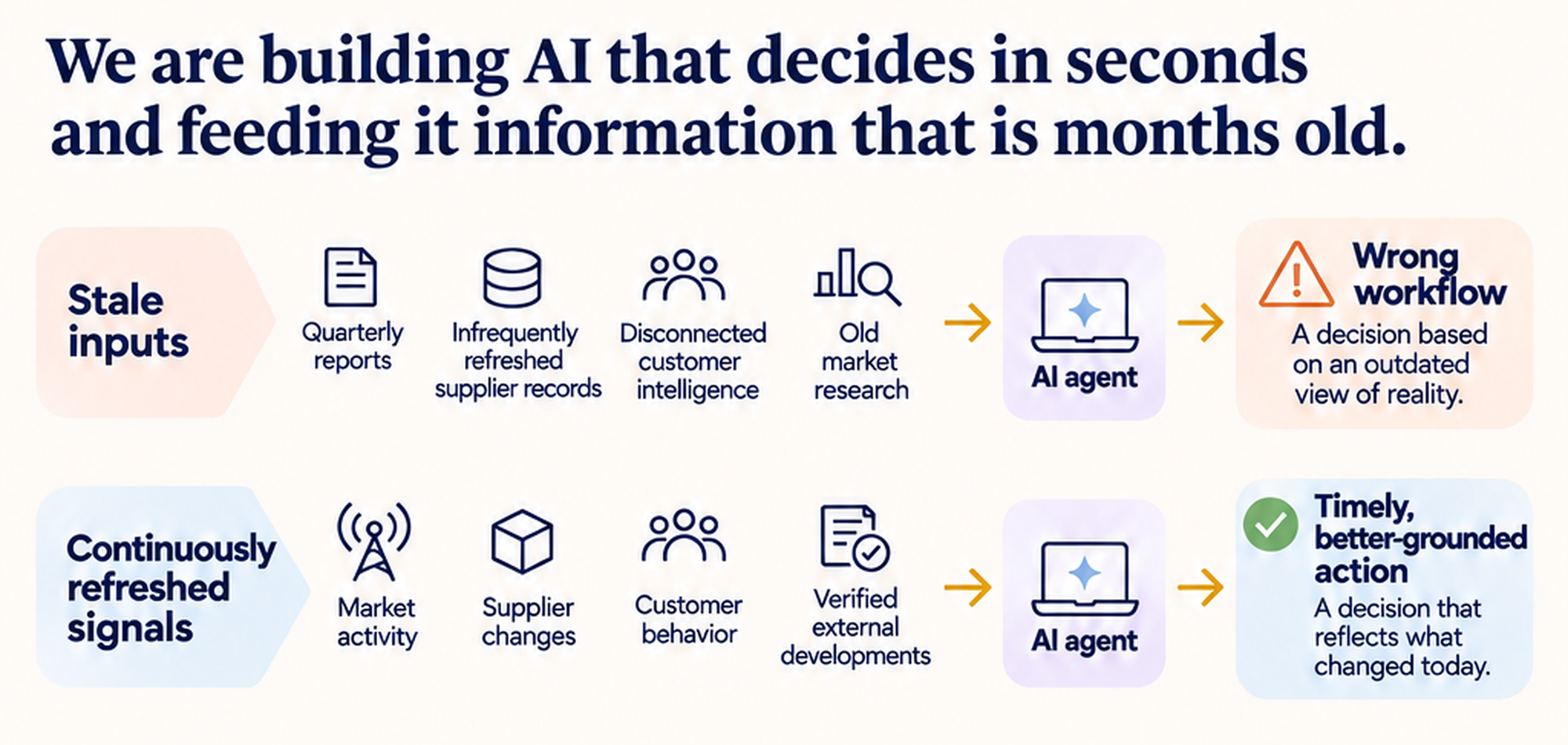
Now look at what is feeding those decisions. Quarterly reports. Supplier records refreshed a few times a year. Customer intelligence scattered across disconnected systems. Market research that describes last season. Board decks assembled from numbers that changed before the meeting started.
Business has been here before. A contract once traveled by mail and took a week to come back. Overnight delivery cut that to days. Fax cut it to hours. Electronic signatures cut it to minutes. Every leap in transaction speed forced the information infrastructure around it to catch up.
AI agents now evaluate and initiate decisions in seconds. The information infrastructure has not caught up.
We are building AI that decides in seconds and feeding it information that is months old.
Gartner has put a number on the cost of that gap: organizations will abandon 60% of AI projects that are not supported by AI-ready data through 2026. The fix is current, connected, decision-ready information, not more compute or a better model.
 How Does Polaris I/O Power Transactional AI?
Polaris I/O continuously monitors external signals and customer-provided data, identifies the changes that matter, connects them into developing patterns, and delivers intelligence tied to specific business decisions. Four capabilities make that work.
1. Always-on signal monitoring
Polaris I/O watches the organizations, people, markets, suppliers, and operating environments that matter to each customer. It does not treat every headline as equal. A customer expansion, a supplier’s financial deterioration, a leadership change, a new investment, a regulatory shift, a competitive move: each signal is evaluated against a specific business objective, with evidence and sources attached.
2. Persistent memory and pattern recognition
One signal rarely tells the story. A new executive appointment can be routine. Combine it with a hiring surge, new technology spend, an expansion announcement, and a change in supplier relationships, and a strategy starts to take shape.
The Polaris I/O Pattern Engine connects related signals over time and tells you whether a situation is emerging, accelerating, stabilizing, or fading. Today’s development often only makes sense when it is connected to something that happened six months ago. That history is what Polaris I/O keeps.
3. Evidence-backed decision intelligence
The goal is to show what changed, why it matters, what it affects, and where action is warranted, with the entities, relationships, and evidence connected so a human or an agent can trust the call.
4. Intelligence delivered where decisions happen
Polaris I/O delivers intelligence through its own applications, reports, alerts, and workflows, and through integrations with the enterprise systems customers already run. The result is a continuously operating intelligence capability instead of a periodic research exercise.
Speed matters here too. When Polaris I/O stood up a new monitoring instance covering AI governance across the Global 2000, it went live in one day and now adds roughly 2,300 new signals a day.
Polaris I/O shows you what is forming, before the outcome is obvious.
One Engine. Two Ways to Create Value.
The same signal engine supports many applications and many models.
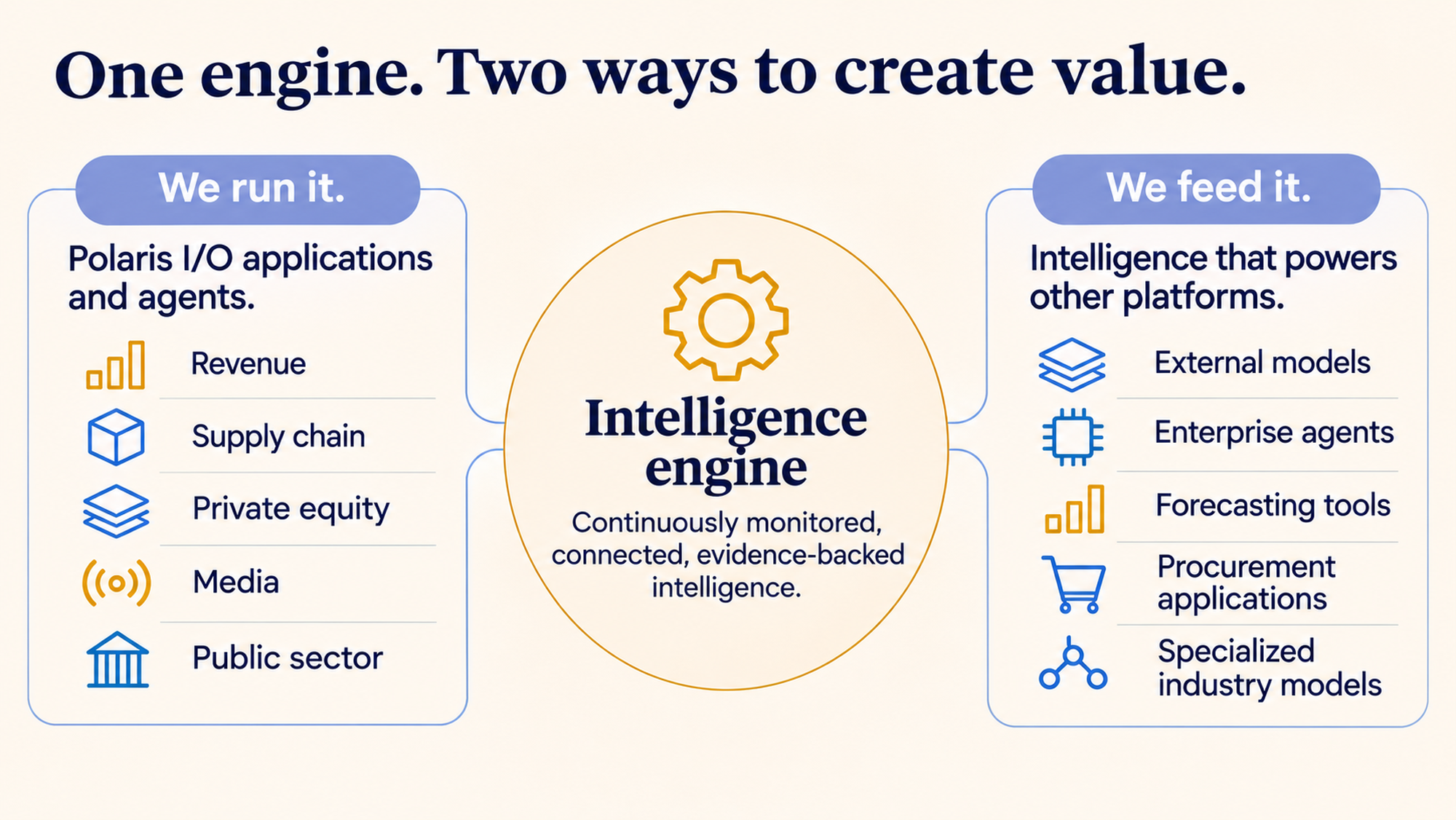 We run it: Polaris I/O applications and agents
Polaris I/O delivers decision intelligence through purpose-built applications for revenue teams, supply chain organizations, private equity investors, media companies, and the public sector. A revenue team monitors strategic accounts for emerging needs. A procurement team tracks changes at critical suppliers. An investment team watches the external assumptions behind a portfolio company’s plan. Same engine, different decisions.
We feed it: intelligence for other companies’ models
Polaris I/O also delivers its intelligence to external applications and models through integrations and APIs. That matters, because no enterprise is going to standardize on one model, and no one wants to rip out working systems to get fresher information.
A revenue forecasting model can take in changes in customer circumstances. A procurement application can weigh new supplier developments. An enterprise agent can get updated context on a company before it recommends an action. A specialized industry model can consume the signals relevant to its decisions.
Every specialized model an enterprise deploys becomes another consumer of decision intelligence.
What Does Transactional AI Look Like in Practice?
Revenue intelligence: T-Mobile and the changing small business market
T-Mobile serves millions of businesses whose needs change constantly. A business opens new locations, grows headcount, invests in technology, or enters a new market, and a commercial opportunity appears long before any intent data picks it up.
Polaris I/O supports T-Mobile teams with continuously updated company and industry intelligence that surfaces those changes early. The shift is from scoring a static list of businesses once a quarter to knowing, every day, which businesses are changing and why it matters.
Media intelligence: NBCUniversal Local and the next advertiser
Advertising markets move every day. Businesses open, expand into new geographies, launch products, and reposition against competitors. Each of those is a reason to advertise.
Polaris I/O’s MarketView platform is expanding across NBCUniversal Local, helping teams spot business developments that signal new advertiser opportunities, and supporting research into developing local business stories. The question becomes who has a reason to spend tomorrow.
Supply chain intelligence: the suppliers behind your suppliers
Your Tier 1 supplier can look perfectly healthy while a Tier 3 supplier two relationships away is under real pressure. A component shortage, a facility issue, or a regulatory change in one category can ripple up to a major industrial project with little warning.
Polaris I/O monitors supplier developments across tiers and maps the dependencies that affect operational readiness, so organizations see vulnerabilities while there is still time to evaluate alternatives.
Private equity: E78 Partners and continuous diligence
Private equity firms spend months on diligence before they close. The day after closing, the assumptions start to drift. Customer priorities shift. Competitors launch. Suppliers stumble. Regulations change.
Polaris I/O is working with E78 Partners on an intelligence-driven approach to monitoring accounts and spotting changes that affect commercial performance. The broader opportunity is continuous diligence: giving sponsors a live view of whether the external assumptions behind each investment still hold, instead of waiting for the next quarterly package.
Public sector: industrial readiness and national security
Defense readiness, critical infrastructure, procurement, and industrial base resilience all depend on understanding conditions that change daily across organizations, suppliers, and technologies. Polaris I/O applies the same signal engine to these missions, with a federal distribution pathway through Carahsoft and a live deployment in a national security use case.
The agencies need what every other customer needs: meaningful developments identified early, related evidence connected, and a clear view of what warrants investigation or response.
Across all five examples, the requirement is the same: current information, understood relationships, recognized patterns, and a direct line to the decision.
Why Does the Signal Engine Matter More Than the Data?
Amazon’s World Product Graph is a bet on organizing information into a connected asset. But collection is the easy part. News, filings, announcements, and public data are available to everyone.
The advantage is in what happens next. Can the system:
- Identify the right entities and validate and timestamp each development?
- Tell new information apart from the same story reported ten times?
- Connect events across companies and relationships, and keep the history?
- Recognize patterns as they evolve and explain why one matters to a specific customer?
- Deliver that intelligence to the applications and agents that act on it?
That is the Polaris I/O architecture. A competitor can buy access to similar public information. Rebuilding years of validated relationships, historical patterns, and decision context is a different problem entirely, and the gap widens every day the engine runs.
What Is the Business Impact of Acting on Signals Earlier?
Earlier this year, SBI Growth Advisory and Polaris I/O analyzed more than 58,000 business evolution signals across 46 enterprise accounts over 12 months. Compared with traditional account management on those same accounts, teams acting on signals generated four times as many qualified opportunities, converted 71% of them versus 20%, closed average deals of about $2.6 million versus $350,000, and closed in 144 days versus 272.
These results come from a specific research setting and are not a guarantee for every organization. The principle behind them holds everywhere: timing changes outcomes.
The sales team that sees an emerging need early helps shape the solution. The team that shows up months later answers an RFP someone else wrote and competes on price. The same logic applies to supplier disruptions, portfolio risk, and operational decisions.
Seeing meaningful change earlier buys you time to influence what happens next.
Why Does Every New AI Agent Raise the Stakes?
When an autonomous agent works from stale information, it can start the wrong workflow before anyone notices.
A procurement agent recommends a supplier whose capacity collapsed last month. A revenue agent prioritizes a customer whose business just changed direction. A portfolio monitoring agent misses a threat building around a core holding.
Better reasoning does not fix any of these. The agent needs information that reflects the world at the moment of the decision.
The future is an ecosystem of specialized models and agents, each needing the signals relevant to its decisions. As enterprises deploy more of them, a shared, continuously updated intelligence layer stops being a nice-to-have and becomes infrastructure.
Every new AI agent creates another need for fresh, reliable intelligence.
From a World Product Graph to a World of Intelligent Decisions
Amazon’s plan starts from a simple premise. If AI is going to transform shopping, it needs a complete, current understanding of products and how they relate.
The same is true across the enterprise.
If AI is going to transform revenue growth, it has to understand customers and their changing priorities. If it is going to transform procurement, it has to understand suppliers and their dependencies. If it is going to transform investing, it has to understand companies and the assumptions behind their performance. If it is going to transform public sector missions, it has to understand organizations, technologies, industrial capacity, and emerging risk.
And if agents are going to decide faster, the intelligence behind those decisions has to keep pace.
That is why we are building Polaris I/O: a continuously operating decision intelligence engine that turns changing information into decisions for Transactional AI.
We run it through our applications and feed it into other models and agents, and the more autonomous enterprise systems become, the more that engine is worth.
Amazon wants to map the world’s products. Polaris I/O maps how the world’s businesses are changing, and what to do about it.
See what matters. Spot what is forming. Steer the response.
Your turn: Which decision in your business is still running on information that is months old? Tell me in the comments. I read every one.
See it on your own accounts: Explore the Polaris I/O platform
Frequently Asked Questions
What is Transactional AI?
Transactional AI is AI that supports or executes consequential business and operational decisions, such as purchasing, lending, customer prioritization, supplier evaluation, and investment monitoring. Unlike general-purpose generative AI, it is built around specific decisions and workflows, and its output depends on current, reliable information.
What is Amazon’s World Product Graph?
World Product Graph is an Amazon initiative, described in an internal document reported by Reuters in November 2026, to collect data on nearly every product sold worldwide, including items Amazon does not sell. Amazon has described the document as an outdated brainstorm that may not reflect current plans.
Why do AI agents need real-time decision intelligence?
AI agents act on the information they are given. If that information is weeks or months old, an agent can prioritize the wrong customer, recommend a weakened supplier, or miss a portfolio risk. Continuously updated signals keep agent decisions aligned with current conditions.
How does Polaris I/O support Transactional AI?
Polaris I/O continuously monitors companies, suppliers, markets, and operating environments, identifies meaningful changes, connects them into patterns over time, and delivers that intelligence through Polaris I/O applications, enterprise integrations, and APIs that feed other models and agents.
How is Polaris I/O different from a traditional data provider?
Traditional data providers deliver datasets, company records, or periodic updates. Polaris I/O identifies meaningful changes, tracks how they relate and progress, preserves historical context, and delivers evidence-backed intelligence aligned with specific business decisions.
What industries use Polaris I/O?
Polaris I/O serves enterprise revenue teams, media and advertising, supply chain and procurement, private equity, and the public sector, including national security. The common need is understanding changing external conditions in time to act on them.
Related Reading
- AI Models Are Becoming Commodities. The Intelligence Feeding Them Won’t Be.
- We Don’t Have a Data Problem. We Have a Signal Problem.
- Five Questions Every Leadership Team Should Be Able to Answer Before It Becomes Obvious
- LLMs Made Work Faster. Pre-Intent Makes Revenue Teams Smarter.
- Human Judgment + AI Speed = The Control Point Advantage
- The Polaris I/O Decision Intelligence Platform
- Polaris I/O MarketView Expands Across NBCUniversal Local
Sources
- Reuters, “Amazon seeks to amass data on every item for sale worldwide to fight AI shopping agents,” November 13, 2026
- Gartner, “Lack of AI-Ready Data Puts AI Projects at Risk,” February 26, 2025
- Gartner, “Gartner Predicts Over 40% of Agentic AI Projects Will Be Canceled by End of 2027,” June 25, 2025
- SBI Growth Advisory and Polaris I/O, Pipeline in Plain Sight, 2026

Related Posts
Nothing found.