


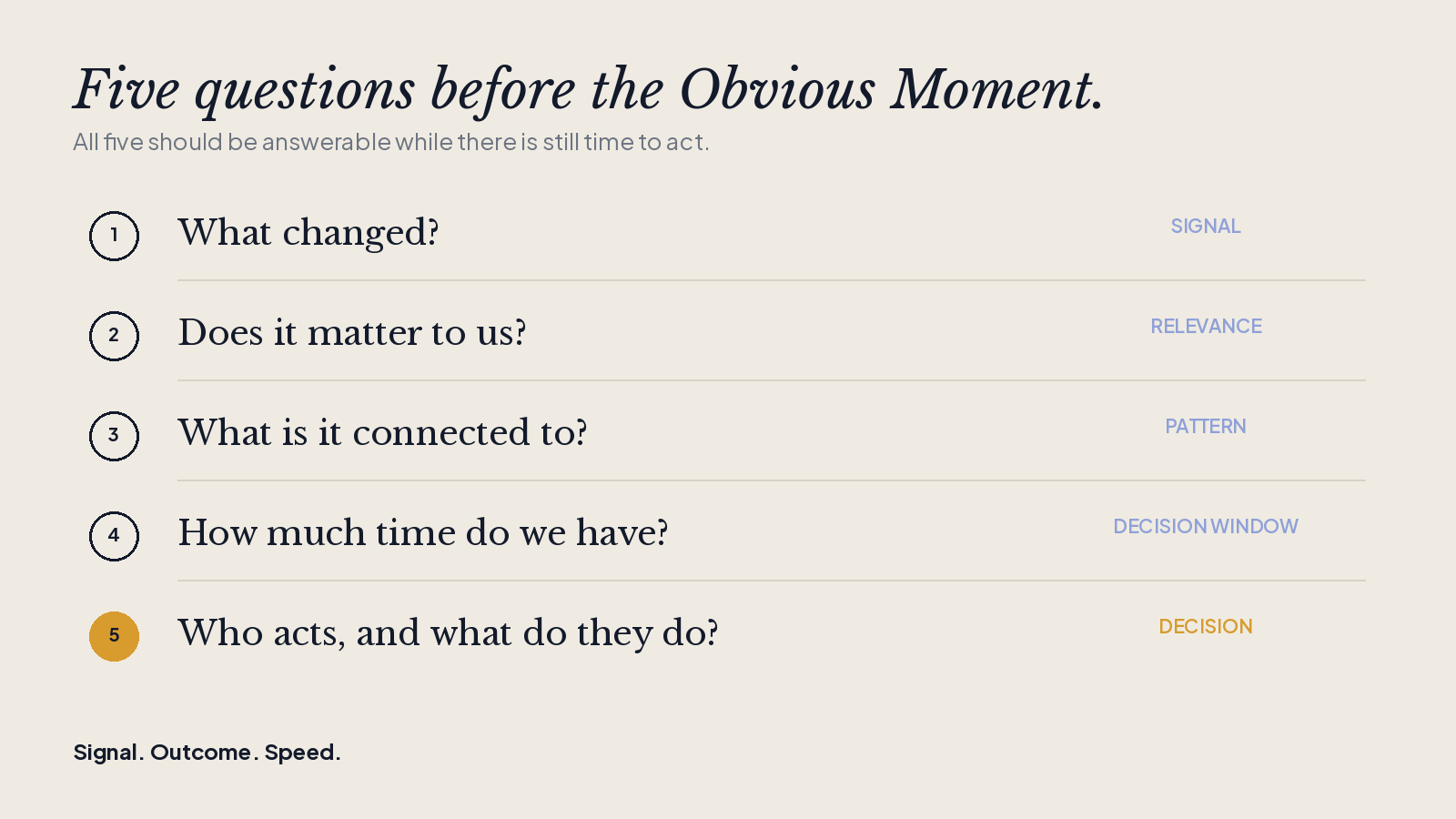
The short answer: Every leadership team should be able to answer five questions about the accounts, suppliers, markets, and programs that matter most. What changed? Does it matter to us? What is it connected to? How much time do we have? Who acts, and what do they do? We call these the Five Questions of Decision Intelligence. If your team can only answer them after a development shows up in standard reporting, the news or a competitor’s move, you are not early. You are already late.
Most organizations do not have an information problem.
They have a timing problem.
There is information in the CRM. In supplier scorecards. In earnings calls, job postings, permit filings, press releases, contract documents and local news. In the notes of the account manager who heard something at lunch. There is more information about the world than any team can read.
The problem is that the important changes rarely announce themselves. A new executive starts. A supplier quietly cuts a shift, a competitor files a permit, or a customer starts hiring for a capability you sell. On their own, each one looks small.
Together, they are a story. And the teams that read the story first get to shape the ending.
We believe there are five questions every leadership team should be able to answer about anything it cannot afford to be surprised by. They sound simple. Try answering all five, right now, for your most important customer or your most critical supplier.
The villain: the Obvious Moment
Every risk and every opportunity has an Obvious Moment: the point when it appears in a dashboard, a headline, a missed shipment or an RFP. By then everyone can see it, including your competitors, and most of the good options are gone.
The research says that moment comes later than most teams think:
Buyers decide before they call. In 6sense’s 2024 Buyer Experience Report, B2B buyers were nearly 70% of the way through their purchasing process before engaging sellers, and 81% already had a preferred vendor at first contact (6sense via Business Wire). If your first signal is a buyer raising their hand, the decision is mostly made.
Supply risk hides below the contract. McKinsey found 60% of supply chain leaders have comprehensive Tier 1 visibility, while visibility into deeper tiers fell for the second straight year. A Sphera survey of 250 procurement and supply chain chiefs found 85% of risk incidents occur at Tier 2 through Tier 4 (Polaris I/O Tier 2 and Tier 3 guide).
Disruption is routine, not rare. McKinsey Global Institute estimates companies face a supply chain disruption lasting a month or longer roughly every 3.7 years, with expected losses equal to about 42% of one year’s EBITDA over a decade (McKinsey Global Institute briefing,SupplyChainBrain).
The Obvious Moment is when everyone finds out. The goal is to find out first.
The five questions at a glance
| # | Question | What it produces | A strong answer looks like | The usual failure |
|---|---|---|---|---|
| 1 | What changed? | A Signal | A specific, sourced development with evidence and confidence | A flood of alerts nobody reads |
| 2 | Does it matter to us? | Relevance | A clear link to a priority, account, supplier or program | Interesting news with no owner |
| 3 | What is it connected to? | A Pattern | Several related Signals forming a direction over time | Each Signal judged on its own |
| 4 | How much time do we have? | A Decision Window | Days to impact versus days needed to respond | Finding out at the Obvious Moment |
| 5 | Who acts, and what do they do? | A decision | A named owner, recommended next step and deadline | A great insight in a slide nobody acts on |
Running through all five is the Polaris I/O operating principle: Signal. Outcome. Speed. A Signal only matters if it changes an outcome, and it only changes an outcome if you move while the window is open.
1. What changed?
The real question is what changed in the world that touches something you care about.
A Signal is a meaningful development: a leadership change, a funding round, a plant expansion or closure, a hiring surge, a contract award, financial pressure, a regulatory shift, a capacity change. A useful Signal explains what changed, why it matters, who or what is affected, and the evidence and confidence behind it (Polaris I/O Platform).
This is what we mean by pre-intent signal intelligence. Intent data tells you who is already researching a purchase. Pre-intent Signals tell you what is happening inside a company before anyone starts researching anything: the operating changes that come before a need, a failure or a decision.
From the field: A leading environmental services company needed a proactive way to find new opportunities across key accounts. Polaris I/O built an expansion pipeline across 25 problem categories and 7 buying centers. Within one month, target account pipelines grew by more than 100 opportunities each, the number of buying centers identified rose fivefold, and account research productivity doubled (case study).
Ask this Monday: What are the three most important things that changed at your top account in the last 30 days, and how do you know?
2. Does it matter to us?
Relevance matters more than volume. A Signal without a connection to your priorities is just noise with a timestamp.
Most teams already have more alerts than they can use. The question that separates the useful ones from the rest is simple: if this development continues, what outcome of ours does it affect?
That means starting from the outcome, not the data. Name the account you cannot lose, the program that cannot slip, the facility that cannot go dark. Then monitor the entities, people, markets and dependencies that outcome relies on.
In supply chain, we rank dependencies by Dependency Power: how much of your outcome stops if that dependency fails. Spend is a poor proxy. A supplier that represents 1% of procurement spend can matter more than one at 20% if losing it stops an entire program (Polaris I/O Tier 2 and Tier 3 guide).
Ask this Monday: Which of this week’s alerts would you be able to tie to a specific revenue, margin or mission outcome?
3. What is it connected to?
One Signal rarely tells you much. Several connected Signals, moving in the same direction, can tell you almost everything.
A single executive hire is a fact. A new CIO, a spike in cloud engineering job posts, a vendor consolidation comment on an earnings call and a delayed renewal is a Pattern. It is telling you that a buying decision, or a churn decision, is forming.
The same is true on the risk side. Three Tier 1 suppliers can all look healthy while depending on the same specialty foundry, material, port or power source. That is hidden concentration risk: three paths to the same failure. You cannot see it by watching suppliers one at a time. You have to connect the system.
The 2021 fire at Renesas Electronics’ Naka plant is the classic case. It destroyed 11 machines, about 2% of the plant’s equipment, at a company holding roughly 35% of the automotive semiconductor market. Its direct customers were mostly parts makers, so carmakers had to assess exposure to a supplier that sat below their own contracts (Polaris I/O Tier 2 and Tier 3 guide).
This is the job of a Pattern Engine: connecting related Signals and evidence over time to reveal what is forming, how it is progressing and what it may affect (Polaris I/O Pattern Engine).
Ask this Monday: For your most critical supplier, do you know what it depends on, and who else depends on the same thing?
4. How much time do we have?
Seeing something is only valuable if you see it while you can still change the outcome. That time is your Decision Window.
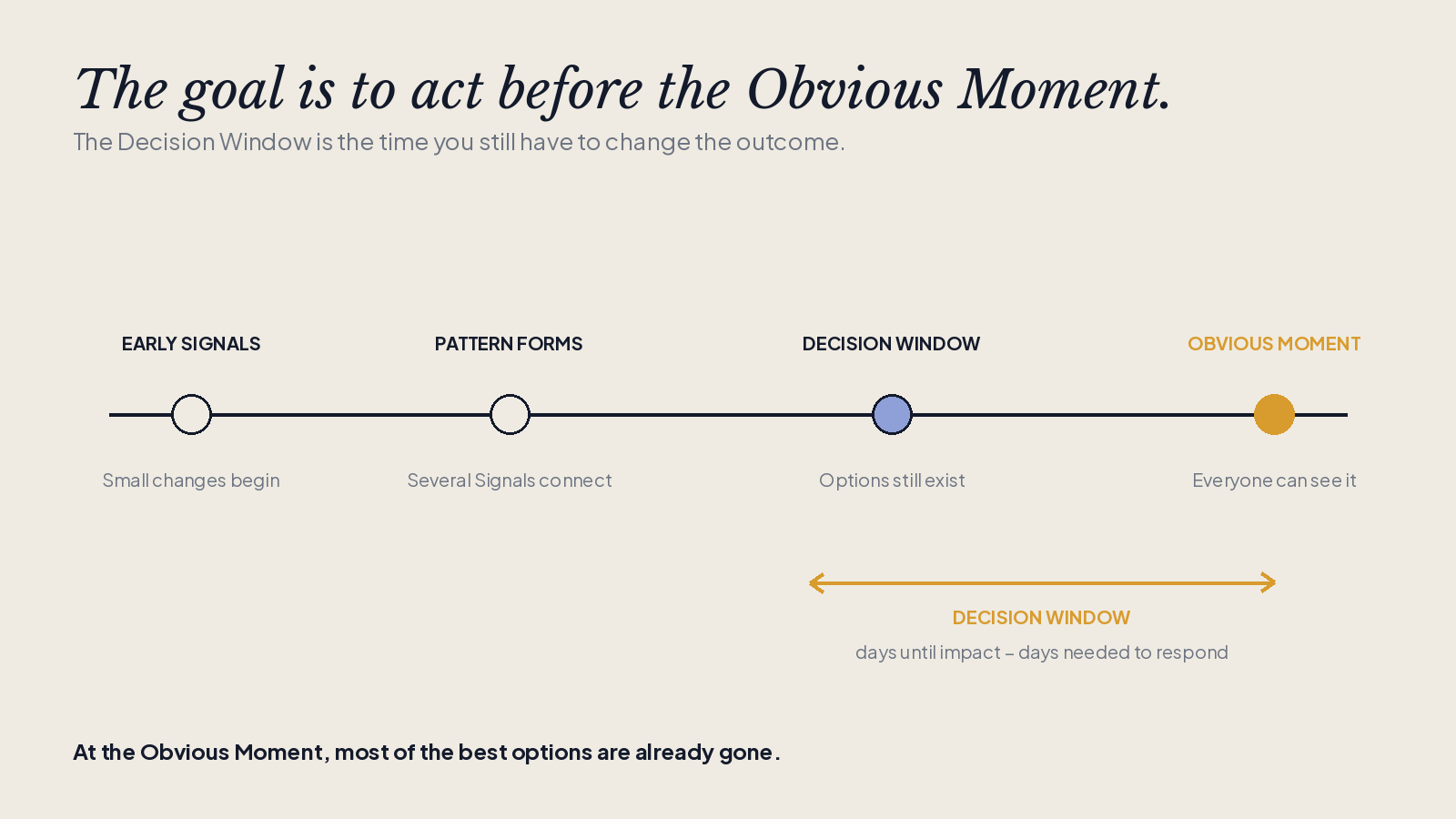 The Decision Window is easy to define:
Decision Window (days) = days until impact minus days you need to respond
If a key supplier is likely to miss deliveries in 90 days and qualifying an alternative takes 120, your window is not 90 days. It is negative 30. You are already late, and every day spent debating makes it worse.
The same math applies to revenue. If a strategic account’s new leadership will set vendor priorities in its first quarter, and your team needs eight weeks to build a credible point of view, the window closes long before the RFP appears.
Some lead times make this painfully concrete. Large power transformers that once arrived within 24 to 30 months can now take up to five years, while an AI data center can be built in under 18 months (Polaris I/O Tier 2 and Tier 3 guide). A project can have land, permits and a tenant and still miss its date because of one piece of equipment.
Ask this Monday: For your top five risks and opportunities, which ones have a Decision Window that is already shorter than your response time?
5. Who acts, and what do they do?
Intelligence that does not reach the right person, with a recommended next step, is just a better explanation of what went wrong.
This is where most programs break. The insight lands in a report. The report lands in an inbox. Nobody owns it. The Obvious Moment arrives anyway.
Decision Activation closes that gap by turning finished intelligence into reports, recommended next steps, alerts and workflows that help teams decide and carry out the response (Polaris I/O Decision Activation). Human judgment stays in the loop: Polaris I/O combines AI-driven processing with human review, user feedback, governed data access and data science oversight (Polaris I/O Platform FAQ).
The direction of travel is clear. Gartner expects that by 2027, half of business decisions will be augmented or automated by AI agents for decision intelligence (Gartner). The organizations that benefit will be the ones that already know which decisions matter and who owns them.
From the field: “We were able to get in front of key individuals as a result of Polaris I/O’s recommendations,” said Amanda McBride, Vice President, Global Revenue Office at Highspring. At T-Mobile, Leslie Lagan, Senior Director, Fraud Management, said Polaris I/O streamlined access to key industry data and helped the team make faster, smarter decisions (Polaris I/O customer stories).
Ask this Monday: For the last important Signal your team caught, who owned the response, and how long did it take them to act?
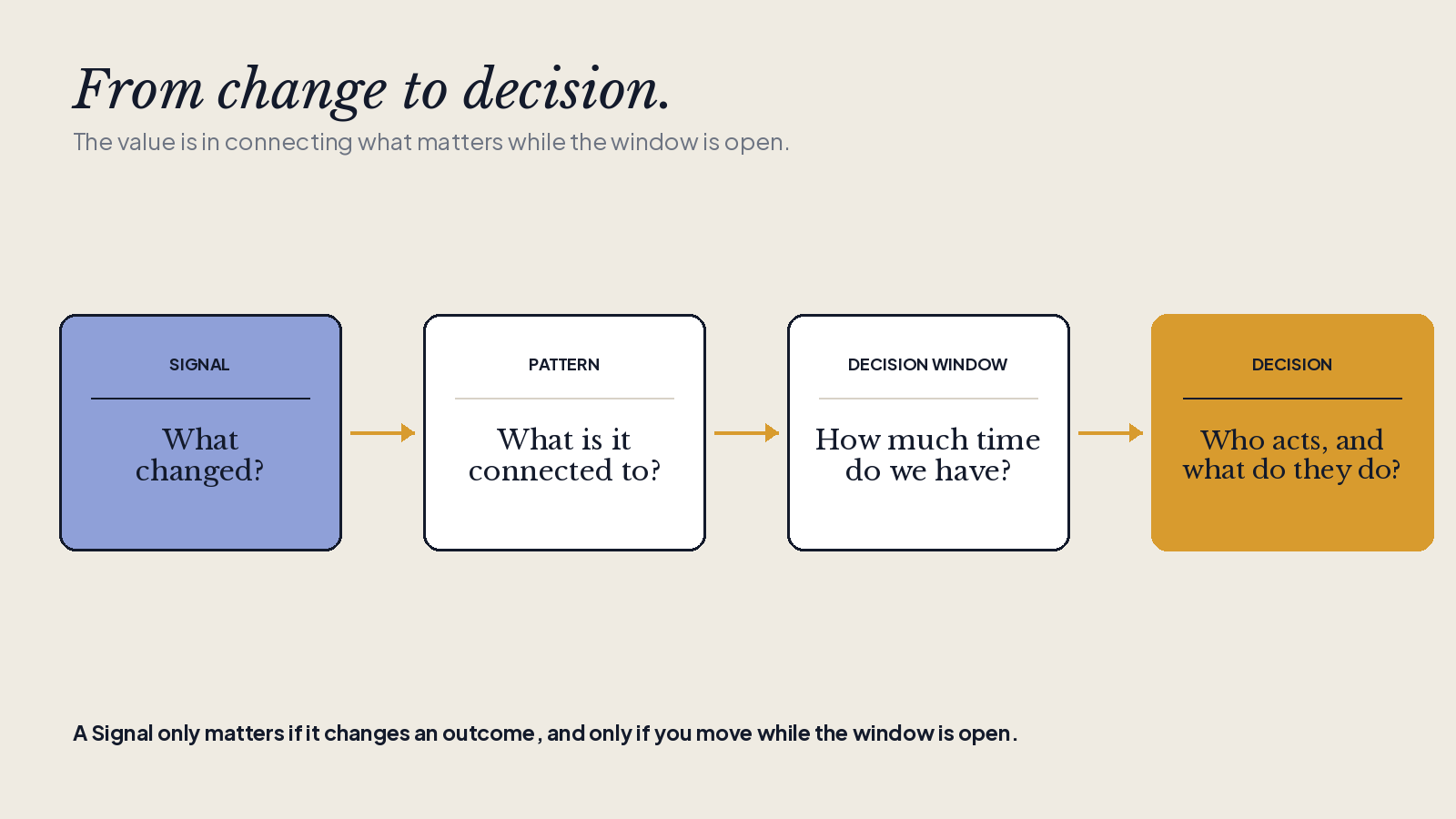 From visibility to decisions
It is tempting to treat visibility as the finish line. But visibility only shows the map. Decision Intelligence shows the options.
When a team can answer all five questions, the Monday meeting sounds different:
| Instead of | It becomes |
|---|---|
| “We just found out they picked another vendor.” | “Their new CIO started six weeks ago and is consolidating vendors. We have about a month to get in front of her.” |
| “Our supplier missed the shipment.” | “Two of our three suppliers rely on the same foundry, and it just cut a shift. We have time to reserve capacity elsewhere.” |
| “Why did that account churn?” | “Their budget owner left, their parent announced a cost program, and usage dropped. Here is the save plan and the owner.” |
| “Nobody saw it coming.” | “We saw it forming in March. Here is what we did about it.” |
Those are decisions, not explanations.
Take the five-question test (and score yourself)
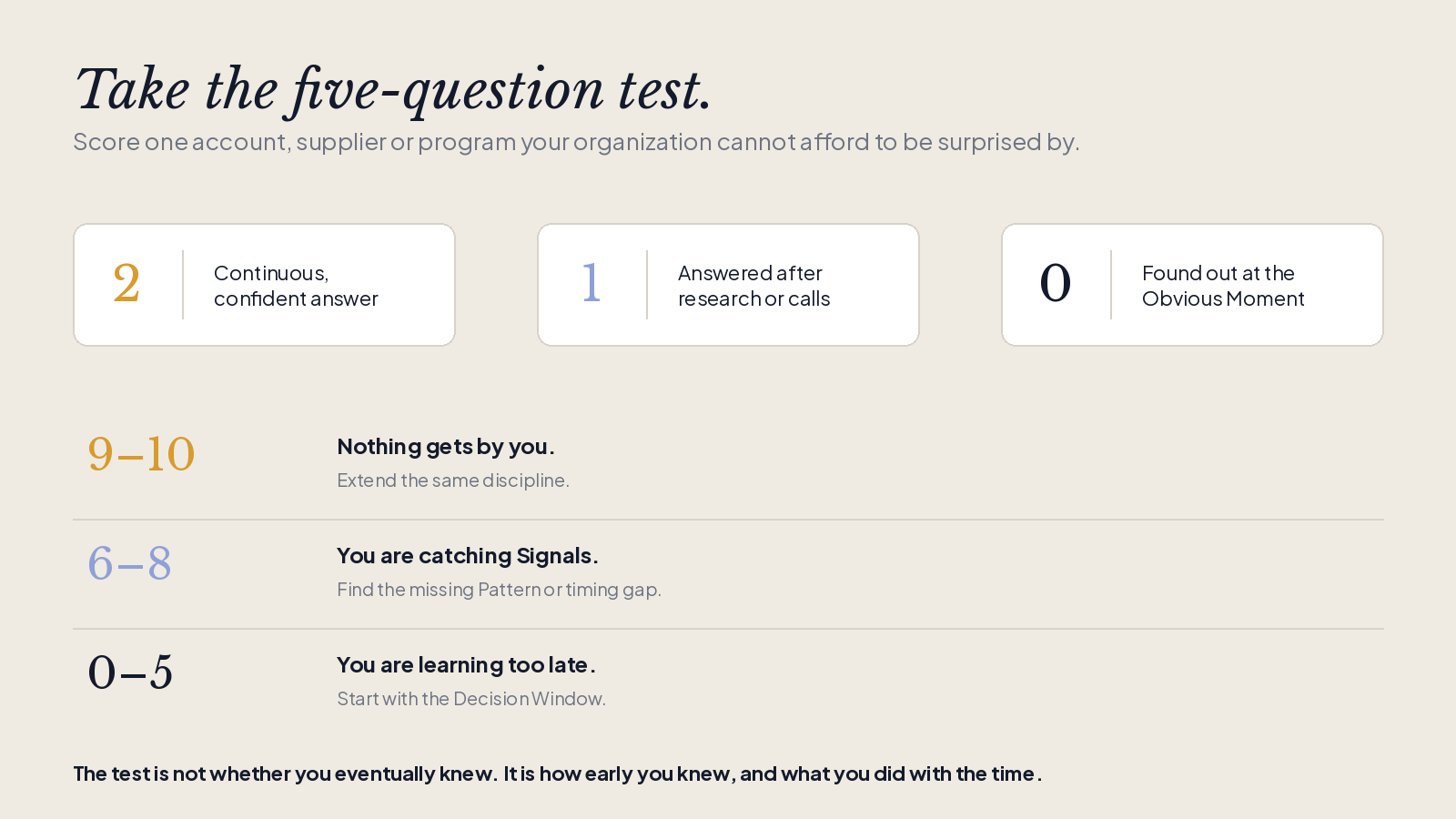 Pick one thing your organization cannot afford to be surprised by. Your largest customer. Your most critical supplier. A program with a date that cannot slip. Answer each of the five questions and score how you got the answer:
- 2 points: answered with confidence from a system that monitors it continuously
- 1 point: answered after research, calls or a round of emails
- 0 points: could not answer, or only found out at the Obvious Moment
Your score out of 10:
- 9 or 10: Nothing gets by you. Extend the same discipline to your next ten accounts or suppliers.
- 6 to 8: You are catching Signals but missing Patterns or timing. Find the question that cost you points.
- 5 or below: Your team is learning about change at the same time as everyone else. Start with question 4 and measure your Decision Window.
Don’t accept “we would have heard.” Don’t accept “it’s on the dashboard somewhere.” Ask how early you knew, and what you did with the time.
The real test of intelligence is whether you understood what was happening while you could still change the outcome.
Frequently asked questions
What is Decision Intelligence?
Decision Intelligence connects external information and your own data to identify meaningful Signals, reveal developing Patterns and support the decisions that follow. Business intelligence reports what happened. Decision Intelligence shows what is forming, what it could affect and how much time remains to act.
What is pre-intent signal intelligence?
Pre-intent signal intelligence reads the operating changes inside companies, such as leadership moves, capacity shifts, financial pressure, hiring, and plant openings and closures, that come before a need, a failure or a decision. It works earlier than intent data, which only appears once someone is actively researching.
What is the difference between a Signal and a Pattern?
A Signal is a single meaningful development tied to an entity you care about. A Pattern is a set of related Signals connected over time that shows a direction: something emerging, accelerating, stabilizing or fading.
What is a Decision Window?
A Decision Window is the time between when you can see a development and when it is too late to change the outcome. Calculate it as days until impact minus days needed to respond. A negative number means you are already late.
What is the Obvious Moment?
The Obvious Moment is when a risk or opportunity becomes visible to everyone, in a headline, a dashboard, a missed delivery or an RFP. Most of the best options disappear at that point.
How is Polaris I/O different from intent data platforms like 6sense?
6sense identifies accounts showing buying intent for sales and marketing teams. Polaris I/O detects pre-intent operating signals across companies and their dependencies, for revenue, supply chain, operations, strategy and investment teams. Some organizations use both. See our full comparison.
Does Polaris I/O keep humans in the loop?
Yes. Polaris I/O combines AI-driven processing with human review, user feedback, governed data access and data science oversight.
Who uses the five questions?
Revenue leaders use them on strategic accounts, procurement and supply chain leaders on critical suppliers, media and advertising teams on market and advertiser growth, and defense and national security teams on programs, organizations and geographies.
See what’s forming before it’s obvious
Pick one account, one supplier or one program. Run the five-question test. Then schedule a demo and we will show you what Polaris I/O sees for the same entity: the Signals, the Pattern and the Decision Window.
Because the most expensive surprise is the one that was forming in plain sight while nobody connected the dots.
Nothing gets by you.
Sources
6sense via Business Wire (2024). 6sense Launches 2024 Buyer Experience Report.
McKinsey Global Institute (Susan Lund). Risk, resilience and rebalancing in global value chains briefing.
SupplyChainBrain. Shocks to Supply Chains Can Erase a Year’s Profit, McKinsey Says.
Gartner (2025). Gartner Announces the Top Data and Analytics Predictions.
Polaris I/O, Leo Sayavedra (2026). Tier 2 and Tier 3 Supplier Risk: How to Find the Hidden Dependencies Beneath Your Supply Chain, including McKinsey, Sphera, Renesas and transformer lead time sources.
Polaris I/O. Platform, Pattern Engine, Decision Activation, Case Studies, Environmental services case study.

Related Posts
Nothing found.