
Every industry has a favorite metric that shows up too late to matter.
In B2B software, it is the deal that appears in the pipeline the same week the buyer already has a shortlist. The rep did not lose the deal in the demo. They lost it months earlier, when the buyer was researching quietly, and nobody on the vendor side was watching for it. By the time it became a pipeline metric, the outcome was already mostly decided.
Supply chains and energy operators have the same problem, just with higher stakes.
Freight rates, war risk insurance premiums, and spot prices are all metrics. They are useful, but they are lagging indicators dressed up as leading ones. By the time a metric moves, the event that caused it has already been underway for days, sometimes weeks. The tanker was already rerouting. The insurer had already repriced the risk. The supplier three tiers down had already missed a shipment window. The metric is just the industry finally catching up to something that started happening quietly, out of view, earlier.
Take the Strait of Hormuz. When shipping through the strait was disrupted earlier this year, energy prices moved first, and coverage of the disruption followed. But the actual signal- vessel rerouting, insurance repricing, changes in naval posture- was visible days before either the price moved or the story ran. Fertilizer buyers who had already mapped their exposure to Gulf supply moved before the shortage hit their contracts. Everyone else found out the same way they always do, from a headline describing something that had already happened.
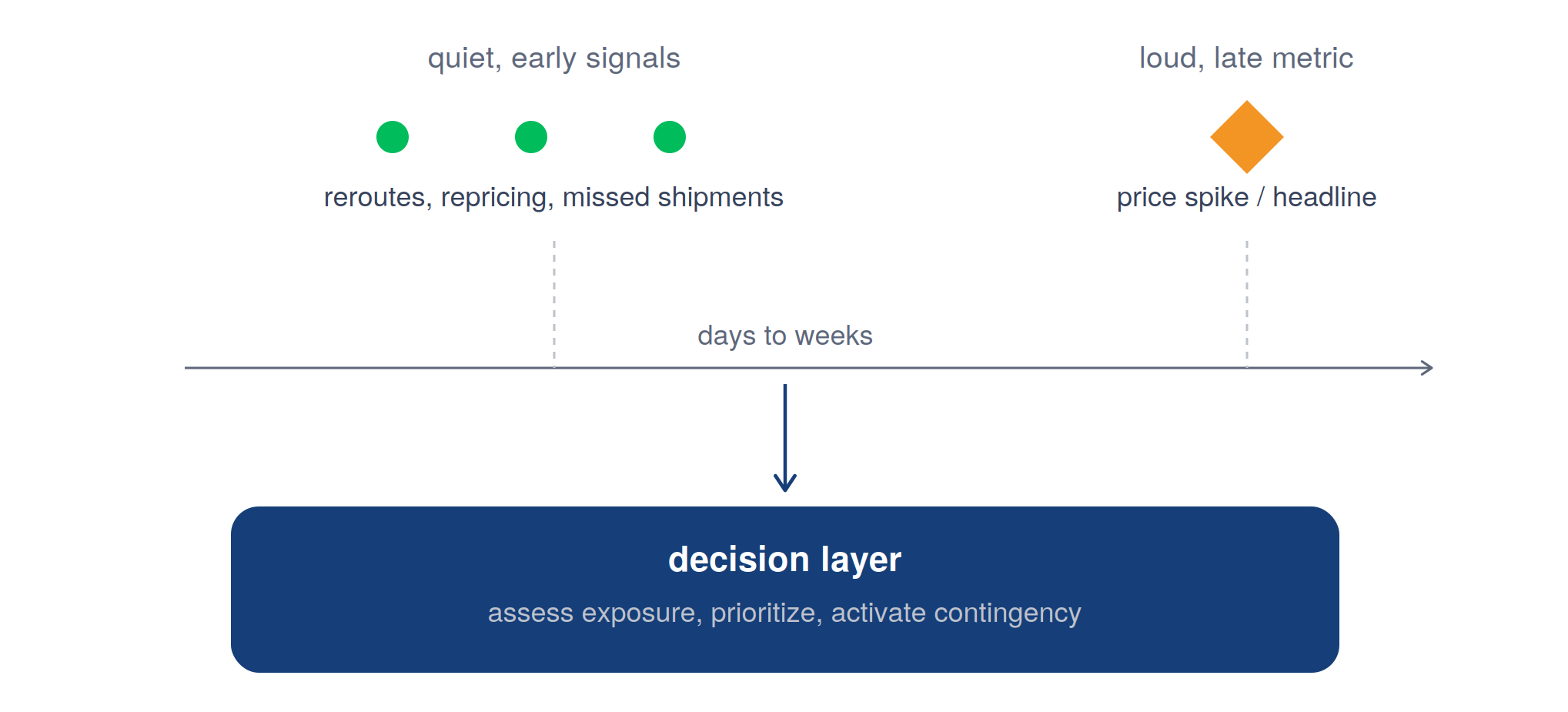 This is not just a Hormuz problem. It is not even just an oil and gas problem. Any operator whose supply chain, contracts, or compliance posture depends on a chokepoint, a single-source supplier, or a region prone to disruption is making the same mistake every time they wait for the metric instead of watching for the signal. The exposure gets missed because it sits three or four tiers down, invisible to anyone tracking the usual dashboards.
Somewhere in Go to Market, a tool like Clay figured out that the more interesting question is never who filled out the form. It is everything that was true about a buyer before they ever showed up as a lead. Enrich the account, enrich the contact, enrich the behavior, and suddenly a cold list turns into a ranked list of people who were already halfway to buying before anyone on the sales team knew they existed.
A supply chain deserves the same treatment. A supplier is not just a name on a contract; it is a company with its own suppliers, its own ports, its own insurers, its own exposure to weather, politics, and everyone else’s problems. A shipment is not just a line on a manifest; it is a vessel with a route, a flag, an insurer, and a naval situation developing somewhere it has to pass through. Polaris I/O enriches every one of those nodes the same way, with first-party signal instead of a static record, so a supplier is never just a name and a shipment is never just a date on a spreadsheet. Enrich the chain the way GTM enriches the funnel, and the chain starts telling you things before they become problems instead of after.
That enrichment feeds straight into the decision layer. Polaris I/O continuously monitors thousands of pre-intent signals across shipping patterns, insurance markets, supplier behavior, and geopolitical activity, the same category of early movement that shows up long before a price spike or a headline does. From there, it determines which suppliers, contracts, projects, and operations are actually exposed, prioritizes those risks by business impact, urgency, safety, and compliance, and works through the contingency options that follow: reposition inventory, activate an alternate supplier, accelerate or reroute a shipment, flag a contract for review. Then it keeps watching, because exposure is not a one-time assessment; it shifts as the situation evolves.
That is the difference between a monitoring tool and a decision layer. A monitoring tool tells you the metric moved. A decision layer tells you what to do before it does.
The organizations that manage the next disruption well, whether it is a chokepoint, a single-source supplier, or a region sliding into instability, will not be the ones with the most dashboards. They will be the ones who already know exactly where they are exposed, understand which decisions matter most, and have a plan ready before the first headline reaches the market.
Nothing gets by you. That is not a tagline. It is what happens when you stop waiting for the metric and start enriching everything that leads to it.
If your supply chain runs through a chokepoint, a single-source supplier, or a region carrying more risk than your dashboards currently show, the time to find out is before it becomes a number everyone else is reacting to.
Reach out to Polaris I/O to see what a review of your supplier and contract exposure looks like, and what it would take to turn that exposure into a plan you can act on.