


The suspect description already doesn’t match across reports. One news outlet has the location wrong. Two of the responding agencies are on different radio channels. Somewhere in a records system, a detective has prior arrest intelligence on a name that just came up, information that could matter enormously to the people who need it and shouldn’t reach anyone else.
The clock is moving. And before a single additional unit arrives on scene, someone, or something, has to decide who is entitled to know which part of this picture, and when.
The problem no single tier can solve alone
An active-threat response isn’t one audience. It’s five, all reading the same unfolding event through a different lens, at different speeds, with different consequences if they get the wrong slice of it.
An incident commander needs the full picture, suspect history included, to make tactical calls. A patrol sergeant needs enough to run their unit, but not necessarily a full criminal background. An officer walking into the scene needs a verified description and a safety alert, not an investigative file that could compromise the case or endanger them with information they can’t act on safely. EMS needs to know where it’s safe to stage and how many casualties to expect, not tactical detail that isn’t theirs to carry. And the public needs one thing: clear, verified guidance on whether to shelter in place or evacuate, with nothing else attached to it.
Get any one of those wrong, in either direction, and something breaks. Too much information reaching the wrong tier can compromise an investigation or put an officer at risk. Too little reaching the right one costs time nobody has.
Polaris I/O is built to make that call automatically, tagging every piece of intelligence against a five-tier access model the instant it comes in, and carrying that same structure through to whatever radio or comms system each agency is already using.
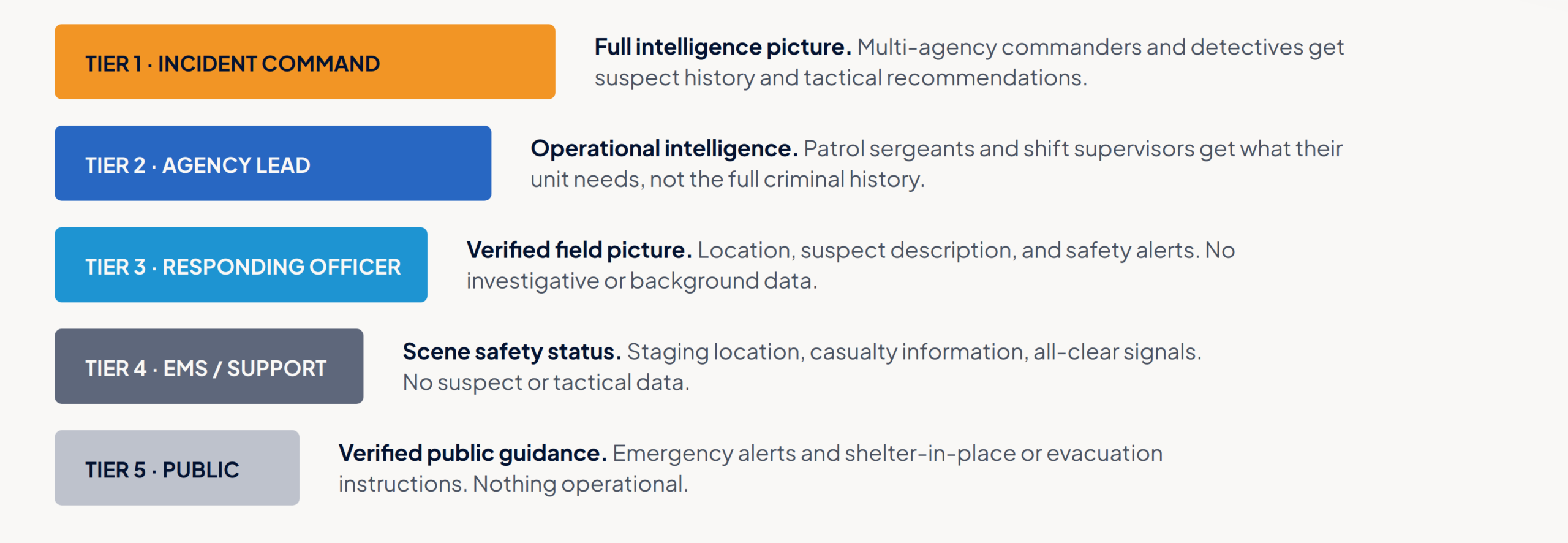 How it would play out
Here’s how that architecture would carry a response like this from the first 911 call to a verified briefing on every tier:
The first signal. The moment the initial report comes in, Polaris starts pulling from every available feed at once: social posts, scanner traffic, body camera streams, 911 transcripts. Within seconds, 47 raw, often conflicting signals are in the system.
Resolution. Rather than 47 separate, contradictory accounts circulating across five different audiences, the system resolves them into one verified incident record, then filters that single record five ways, once for each tier, stripping or including detail based on who’s receiving it. A detective’s prior intelligence on the suspect routes straight to Tier 1 and stays there. It never touches a patrol channel, an EMS radio, or a public alert.
Delivery. Every tier receives exactly its version of the picture, permission-aware by design, nothing beyond what that role is cleared to see. From the first signal landing in the system to a verified, tier-appropriate briefing reaching all five groups: under 2 minutes. Responding officers get a confirmed description and safety alerts without wading through a raw, misidentified location that a headline already got wrong. EMS gets a scene safety status and a staging location, nothing tactical, nothing that isn’t theirs to act on. The public gets shelter-in-place guidance the moment it’s verified, not the moment somebody manually clears it for release.
No manual sorting, at any point. Nobody sat between the incoming signal and the outgoing briefing deciding, tier by tier, what could move where. The architecture did that the instant each piece of intelligence arrived.
What changes when access sorts itself
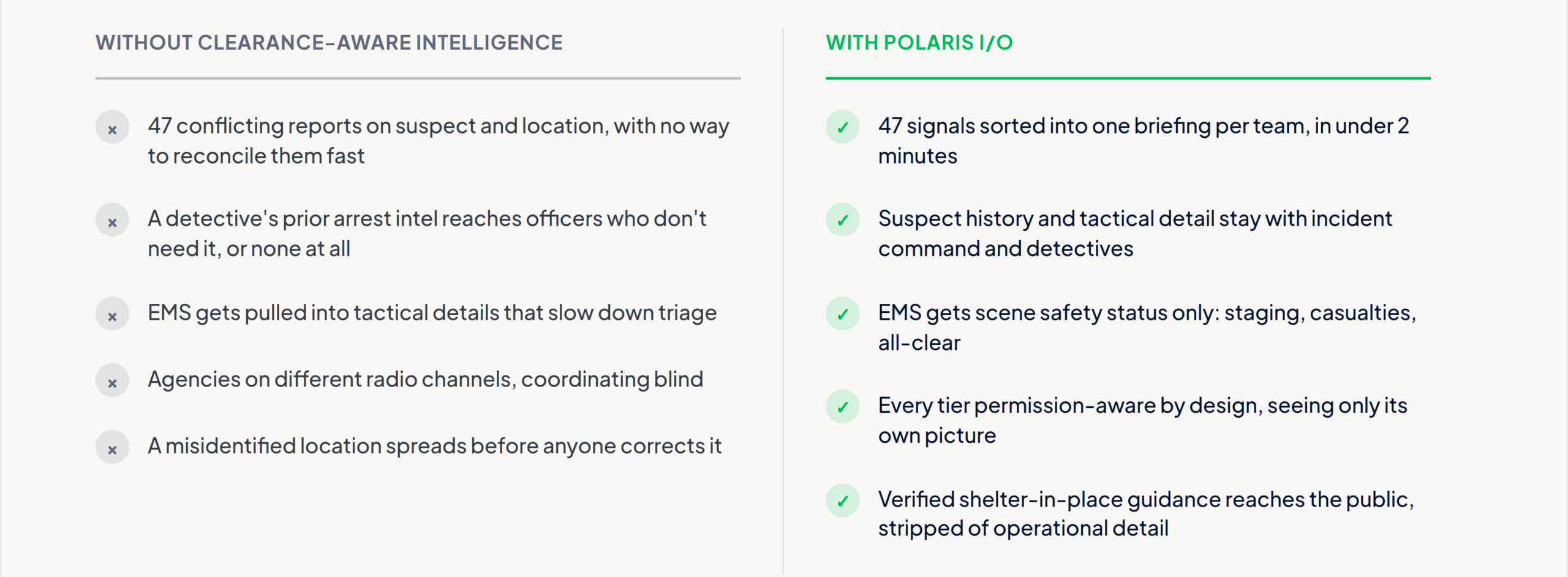 Take the tiering away, and this is the version most watch commanders have lived through: 47 conflicting reports on the suspect and the location, with nothing resolving them into one account fast enough to matter. A detective’s prior intelligence reaching officers who didn’t need it, or never reaching the ones who did. EMS pulled into tactical detail that has nothing to do with getting to the wounded safely. Agencies on separate channels, coordinating on faith. A misidentified location spreading before anyone can correct it.
With it: 47 signals resolve into one briefing per team in under 2 minutes. Investigative intelligence never leaves the tier it belongs to. EMS gets exactly what it needs to stage safely, nothing more. Every tier is permission-aware by design, seeing only what it’s cleared to see. And the public gets guidance they can trust, the moment it’s confirmed, with nothing operational attached.
The question worth asking
Most agencies running a response like this already have the radios, the mutual aid agreements, the training. What’s harder to build is a layer that decides, correctly and instantly, who gets which slice of a fast-moving picture, without a person in the loop making that call under pressure.
If you’ve run or supported an active-threat response, you already know where it usually breaks down. Is it the flood of conflicting reports? The risk of the wrong information reaching the wrong tier? Or just getting a verified answer to the right person before they’ve already made a decision without one?
Composite scenario demonstrating Polaris I/O capabilities.
Related Articles




Related Posts
Nothing found.