The problem isn’t lack of data. It’s lack of context.
Most operational systems tell you what’s happening inside your organization, while more critical risks are emerging outside your four walls and long before they show up in an internal report and dashboard. The organizations building resilient supply chains aren’t just monitoring transactions. They’re watching the ecosystem around them.
Here are five external signals every supply chain leader should be paying attention to.
1. Your biggest risk may not be your supplier. It may be one of their suppliers.
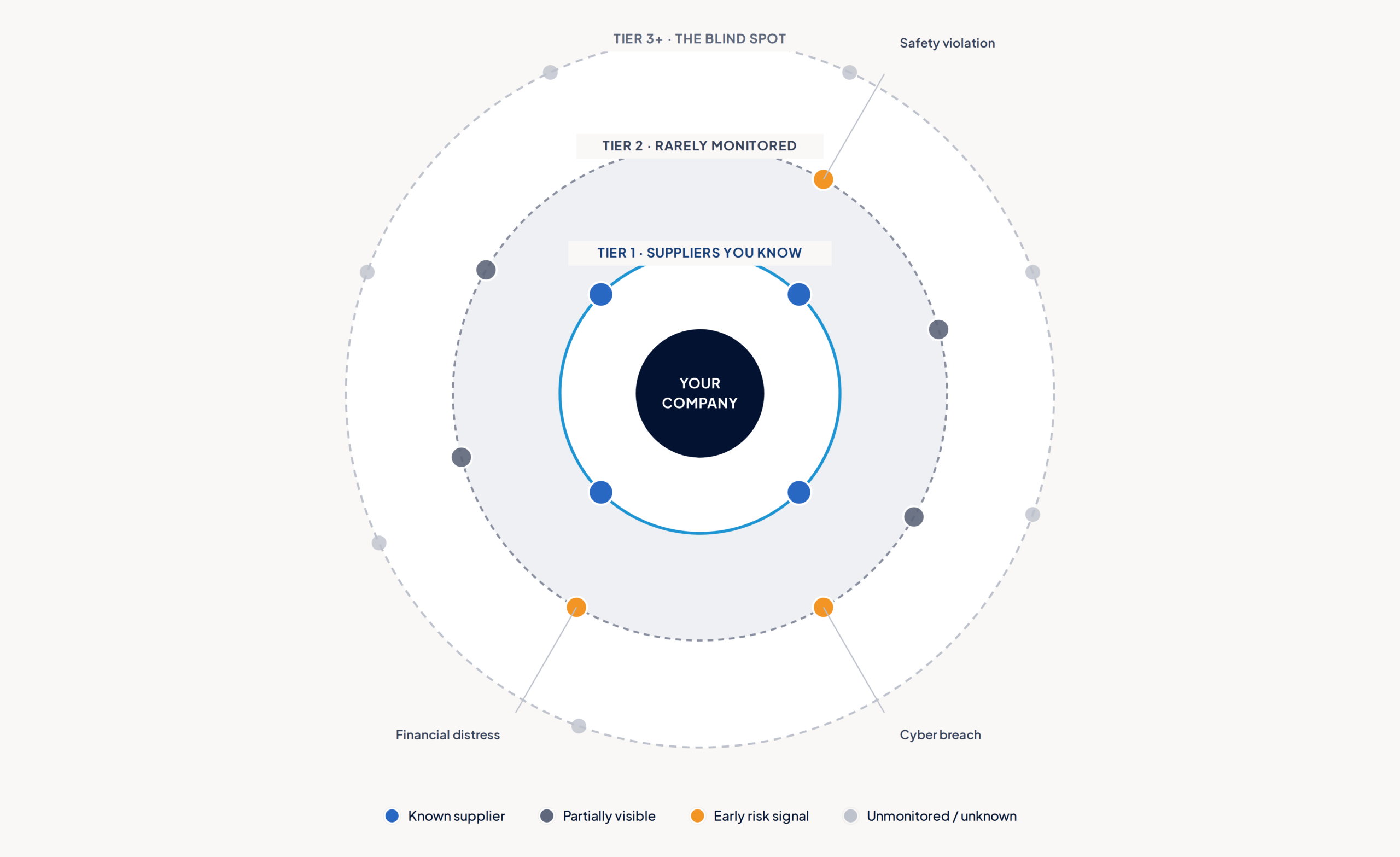
Most organizations monitor their Tier 1 suppliers closely. Far fewer understand the health of the deeper supplier ecosystem.
Imagine one of your strategic suppliers depends on 50 subcontractors.
One receives a health and safety violation. Another suffers a cybersecurity breach. A third starts laying off production workers. A fourth loses an environmental certification. A fifth shows early signs of financial distress.
None of these events touches your company directly.
But together, they paint a picture of rising operational risk. One that can hit your production, quality, delivery, or cost months later.
The strongest supply chains don’t just understand their suppliers. They understand the network that supports those suppliers too.
2. Leadership changes are often operational signals
Supplier risk hides beneath the surface. Leadership risk doesn’t, if you know where to look.
A new Chief Procurement Officer. A new Head of Manufacturing. A new VP of Supply Chain.
These aren’t just HR announcements. They frequently trigger:
- New sourcing strategies
- Supplier consolidation
- Factory investments
- Inventory policy changes
- Automation initiatives
- Shifts in capital allocation
Organizations that catch these changes early can anticipate movement in supplier relationships, demand patterns, and competitive behavior before it becomes obvious to the rest of the market.
3. Regulatory and safety events rarely stay isolated
A health and safety violation isn’t simply a compliance issue.
It can be an early indicator of something much larger:
- Operational disruptions
- Production slowdowns
- Labor shortages
- Equipment failures
- Insurance challenges
- Reputational damage
- Regulatory investigations
The event itself isn’t always the risk. The downstream operational consequences often are.
Companies that connect these seemingly isolated signals gain a real head start on emerging supply chain risk, before it reaches their own operations.
4. Hiring patterns often predict capacity changes
Leadership changes hint at strategy. Hiring data hints at operations, and it usually moves faster than earnings reports.
A manufacturer aggressively recruiting production workers may be preparing for expansion. A logistics provider freezing warehouse hiring may signal slowing demand. An electronics manufacturer searching for procurement specialists may indicate a new sourcing initiative.
These workforce signals often emerge months before production increases, shortages, pricing changes, or supplier constraints become visible through traditional reporting.
The market is constantly communicating. The question is – are you listening and can you see the patterns being presented.
5. Your internal data is only half the story
Every organization has valuable first-party operational data:
- Purchase orders
- Inventory levels
- Supplier scorecards
- Transportation milestones
- Production schedules
All useful. None of it complete.
Internal data only explains what has already happened inside your business. The real advantage comes from enriching that data with external intelligence, real time: supplier ecosystem health, regulatory actions, financial indicators, competitive activity, labor trends, and market demand.
Combine the two and leaders gain something more valuable than visibility. They gain context.
And context leads to better decisions.
The bottom line
Supply chain resilience isn’t built by collecting more data. It’s built by connecting the right signals before disruption reaches your business.
The companies that consistently outperform aren’t reacting faster than everyone else. They’re seeing change earlier, because they’re looking beyond their own operations.
That’s the promise of Decision Intelligence: enriching first-party operational data with outside-in market, supplier, regulatory, and competitive signals, so organizations can spot risk sooner, respond with more confidence, and act before small issues become major disruptions.
In today’s supply chains, the biggest competitive advantage isn’t knowing what happened yesterday. It’s understanding what’s changing today.