


“Everyone is struggling to isolate signal from noise.”.
That is how Peter Freed, Meta’s former director of energy strategy, described the data center power rush (Latitude Media). He was talking about tech companies getting the same project pitched to them several times. Utilities live the mirror image: the same data center shows up in several utility queues at once, and each one has to decide whether to build for it.
In our first two posts we covered the rearview grid and the vendors who now set the calendar. This post is about the other end of the wire: the customers. Or, more precisely, the customers who may never arrive.
Data center load forecasts have never moved this fast
The five-year U.S. load growth forecast rose sixfold in four years. Utility filings imply about 90 GW of new data center load by 2030, while market analysts see closer to 65 GW (Grid Strategies).
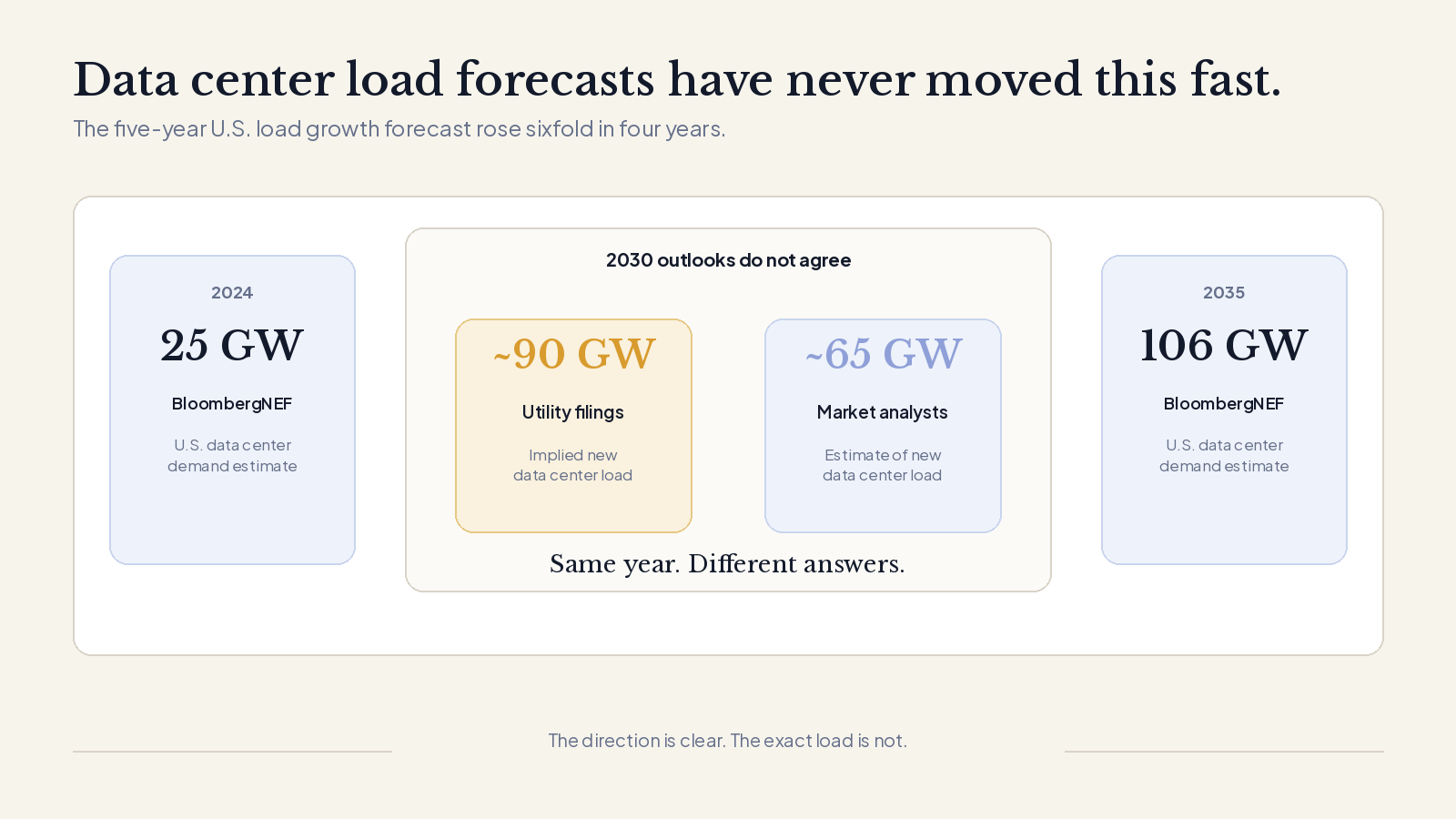 BloombergNEF now expects U.S. data center demand to reach 106 GW by 2035, up from about 25 GW in 2024 and 36% higher than its own estimate from April 2025. More than 150 significant U.S. data center projects were announced in a single year, and over a quarter of them exceed 500 MW. PJM alone could add 31 GW of data center load in five years, about 3 GW more than the new generation it expects (Utility Dive). McKinsey expects data centers to add about 460 TWh of U.S. demand from 2023 to 2030 (McKinsey).
Some of that demand is very real. The problem is that nobody can say with confidence which part.
Much of the large load queue is phantom load
Phantom load is demand that shows up in a utility’s queue but never shows up on the meter. The evidence that it is widespread keeps growing:
- Camus Energy CEO Astrid Atkinson estimated speculative interconnection requests at five to 10 times the number of data centers actually being built (Utility Dive).
- In the Minneapolis and St. Paul area, utilities received proposals for at least 11 data center campuses since 2020. By early 2025, only one had begun construction.
- In an EPRI survey of 25 large utilities, 10 had data center requests equal to at least half their current peak load. None expected actual five-year demand to exceed 35% of peak.
- One major utility saw nearly 30% of its 2024 large load applications canceled, and many utilities still manage load queues with “spreadsheets and project binders” (Latitude Media).
- Exelon narrowed its outlook to about 11 GW of “high probability” data center load over 10 years.
The same pattern shows up on the supply side. Only 13% of the generating capacity that asked to connect from 2000 through 2020 was ever built (LBNL).
Why phantom load is so expensive
Phantom load costs money in both directions.
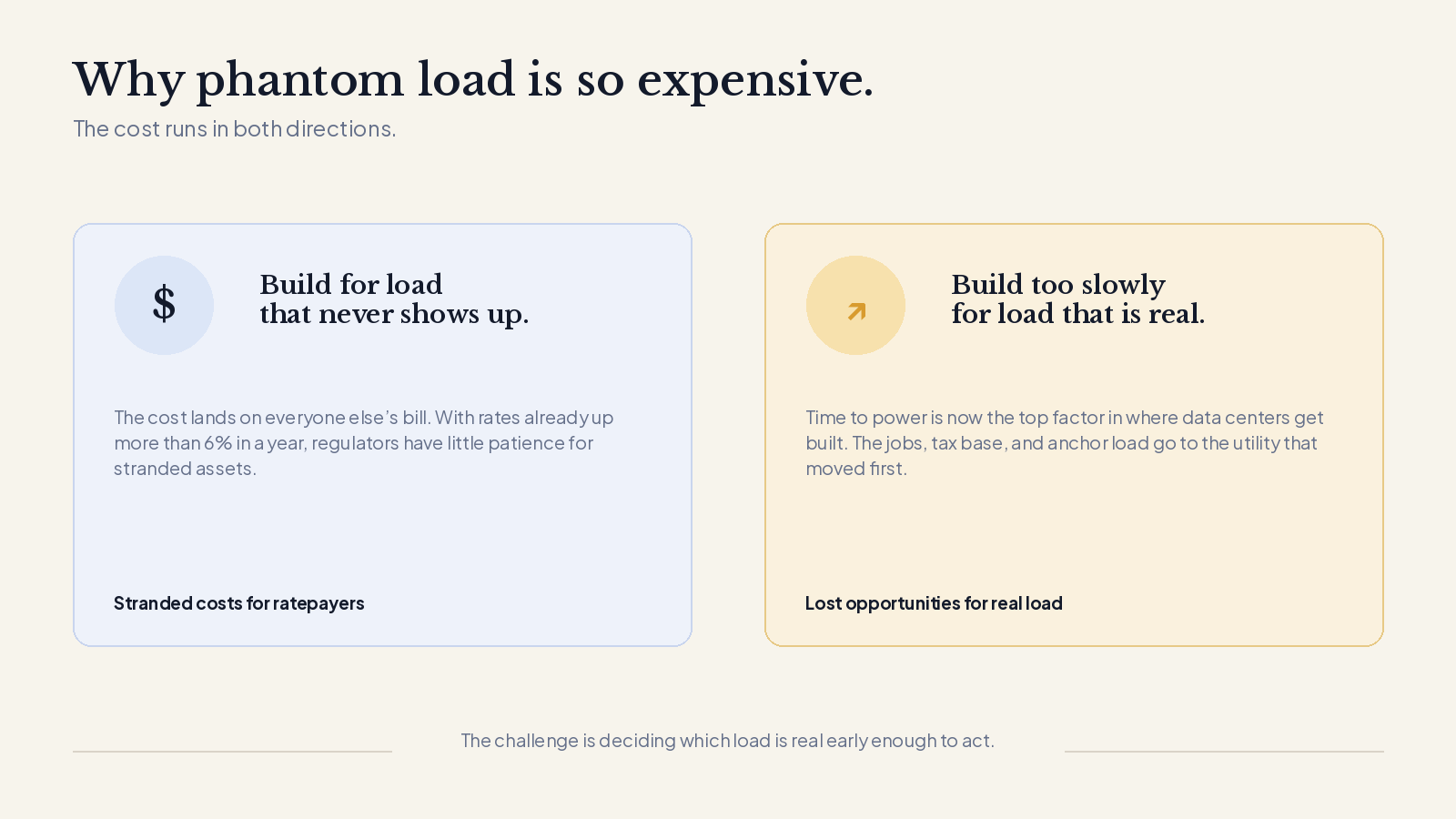 Build for load that never shows up, and the cost lands on everyone else’s bill. Brattle’s Long Lam has warned that households could pay for infrastructure built for projects that never materialize (Latitude Media). With rates already up more than 6% in a year (Pew), regulators have little patience for stranded assets.
Build too slowly for load that is real, and the customer goes elsewhere. McKinsey finds that time to power is now the top factor in where data centers get built (McKinsey). The jobs, the tax base, and the anchor load go to the utility that moved first.
Large load tariffs help, but they work at the end of the process
Utilities and regulators are fighting back. SEPA tracks 77 large load tariffs and service rules across 60 utilities in 36 states. About two-thirds of the tariffs approved in 2025 set minimum loads of 50 to 150 MW. Pennsylvania’s proposed model includes a five-year minimum term, a three- to five-year ramp, minimum billing at 80% of contracted demand, and financial security for network upgrades. FERC has also taken up large load interconnection reform (SEPA).
These are the right tools. But a tariff filters a project at the moment of contract, after the utility has already spent months studying it. The signals that separate real load from phantom load show up much earlier, and they show up outside the utility.
Seven signals that separate real data center load from phantom load
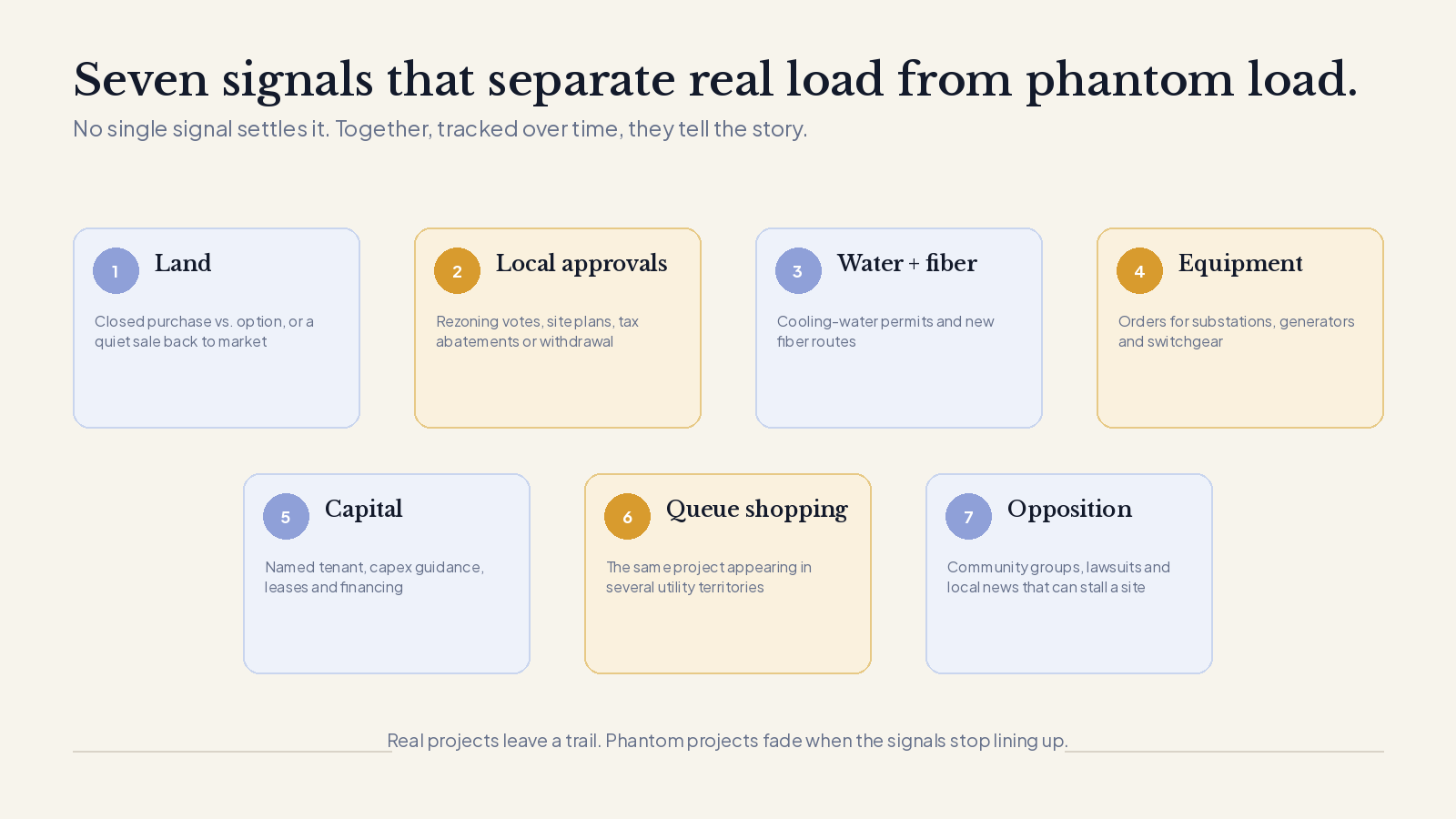
No single signal settles it. Together, tracked over time, they tell a clear story about which projects are accelerating and which are fading.
How Polaris I/O helps utilities read the large load queue
Polaris I/O turns those scattered public signals into a running read on every large load request. Signal Monitoring tracks each developer, site, and hyperscaler tenant behind the queue. The Pattern Engine connects signals over time to show what is emerging, accelerating, stabilizing, or fading. Decision Activation delivers a ranked, explainable view to the large load, planning, and regulatory teams, so they can prioritize studies, set tariff terms, and defend load forecasts with evidence.
This is the same account intelligence Polaris I/O runs today for B2B revenue teams: knowing which companies are really expanding, before they announce it. For a utility, the account is a data center developer, and the stakes are measured in gigawatts.
The same view works on the supply side too, flagging which queued generators have the financing, the permits, and the tax credit timing to actually reach operation.
The cheapest megawatt is the one you were smart enough not to build for.
Frequently asked questions
What is phantom load?
Phantom load is electricity demand that appears in a utility’s interconnection or load request queue but is never built, often because developers file the same project with several utilities to find the fastest path to power.
How many data center load requests actually get built?
Estimates vary, but one industry executive put speculative requests at five to 10 times the data centers actually being built, and several utilities have cut their data center forecasts after screening their queues.
What is a large load tariff?
A large load tariff sets special terms for very large customers, such as data centers, including minimum demand, contract length, minimum billing, and financial security, to protect other customers from stranded costs.
How can utilities verify data center demand?
By tracking outside signals such as land closings, zoning and incentive approvals, water and fiber permits, equipment orders, tenant commitments, and financing, and by watching for the same project in other utility queues.

Related Posts
Nothing found.