


In 2024, the average U.S. electricity customer went 11 hours without power. That is double the average of the decade before.
The U.S. Energy Information Administration traced 80% of those lost hours to major events, led by three hurricanes. Beryl cut power to 2.6 million customers in Texas. Helene knocked out 5.9 million across 10 states. Milton took out 3.4 million in Florida. South Carolina customers averaged nearly 53 hours in the dark (EIA).
Outside of major events, the grid performed about the same as it always has: roughly two hours of interruptions per customer per year. The difference is weather. And weather, unlike a vendor’s balance sheet, announces itself days in advance.
So far in this series we have looked at the rearview grid, the vendors who set the calendar, and the load that may never arrive. This post moves to where customers feel the grid most: the distribution system, in a storm.
Grid resilience is now a distribution problem
Most of the wires, and most of the exposure, sit on the distribution system. In the Northwest, nearly 90% of investor-owned utility power lines in high-wildfire-risk areas are distribution lines (Sightline Institute). Distribution transformers were already running about 10% short of demand in 2025 (Wood Mackenzie), which matters most on the day after a storm, when every utility in the region is calling the same suppliers.
Wildfire turned a reliability problem into a balance sheet problem
For utilities in fire country, resilience is no longer only about restoration times. It is about survival.
Northwest investor-owned utilities plan to spend $735 million on wildfire mitigation in 2026, and their annual spending more than doubles from $279 million to $711 million between 2023 and 2027. PacifiCorp has already settled more than $2 billion in damages from the 2020 Labor Day fires and faces as much as $55 billion more in potential liability. Avista’s wildfire insurance premiums rose from about $3 million in 2021 to nearly $12 million in 2026 (Sightline Institute).
Every one of those dollars will be examined by regulators, insurers, and courts. Beyond how much a utility spent, they will ask whether it knew where the risk was and acted on it.
More money alone does not buy resilience
Hardening budgets are rising, but the resources to use them are not.
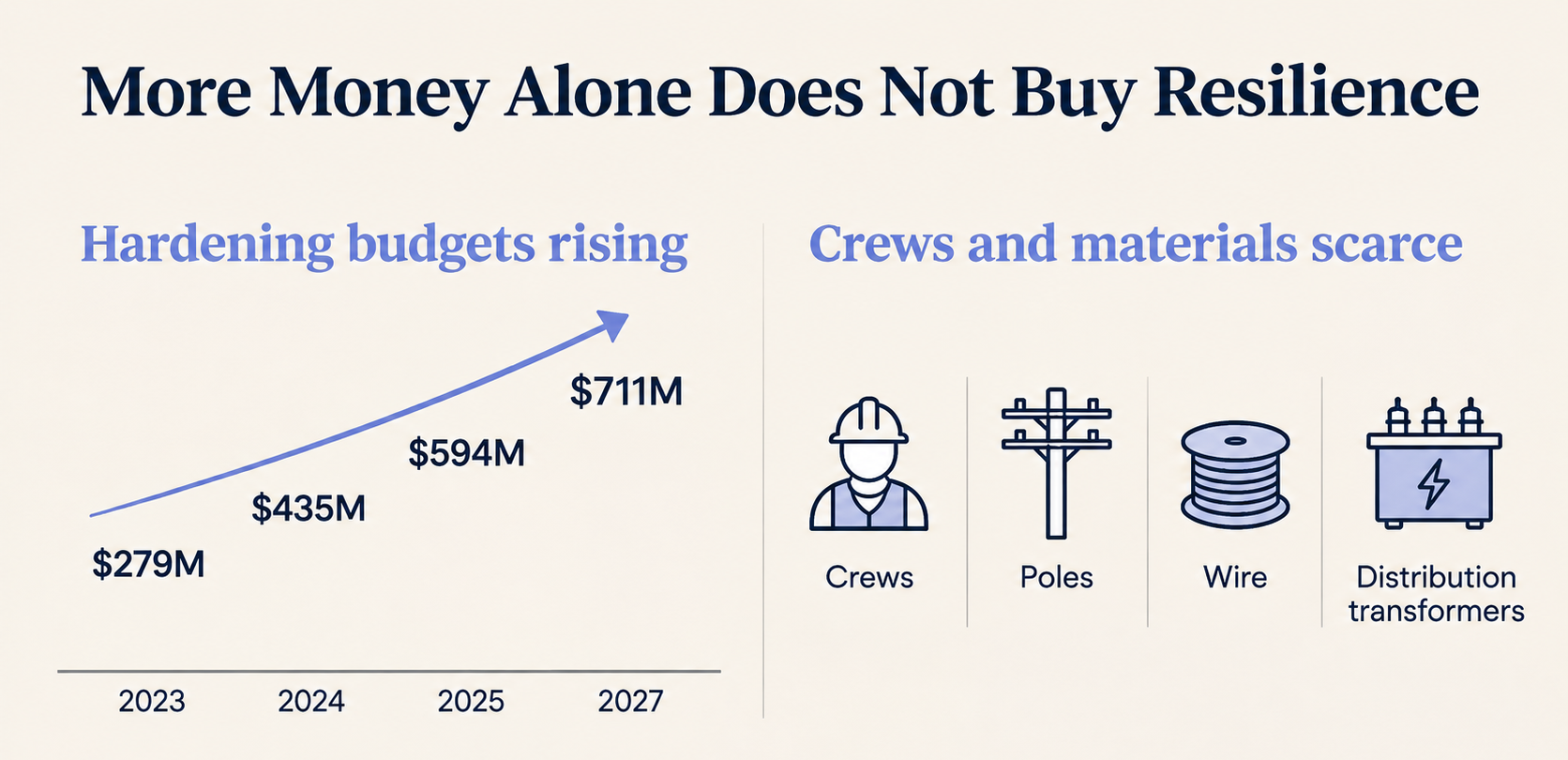 Crews are scarce. In 2024, 59% of utility employers reported trouble hiring line workers, and data center construction is bidding up electrician wages in the same regions that face the worst storms (EnergyNow). Mutual aid helps, but when a hurricane hits several states at once, every utility is asking for the same trucks.
Materials are scarce too. Poles, wire, and distribution transformers have to be in the right yard before the storm, not on a truck behind it.
The utilities that restore fastest stage the right crews and materials in the right places first, and aim their hardening dollars at the circuits most likely to fail.
Every storm leaves a trail of signals
Storms and fires feel sudden. They rarely are. Each one leaves a trail of signals that a utility can follow, if it is watching:
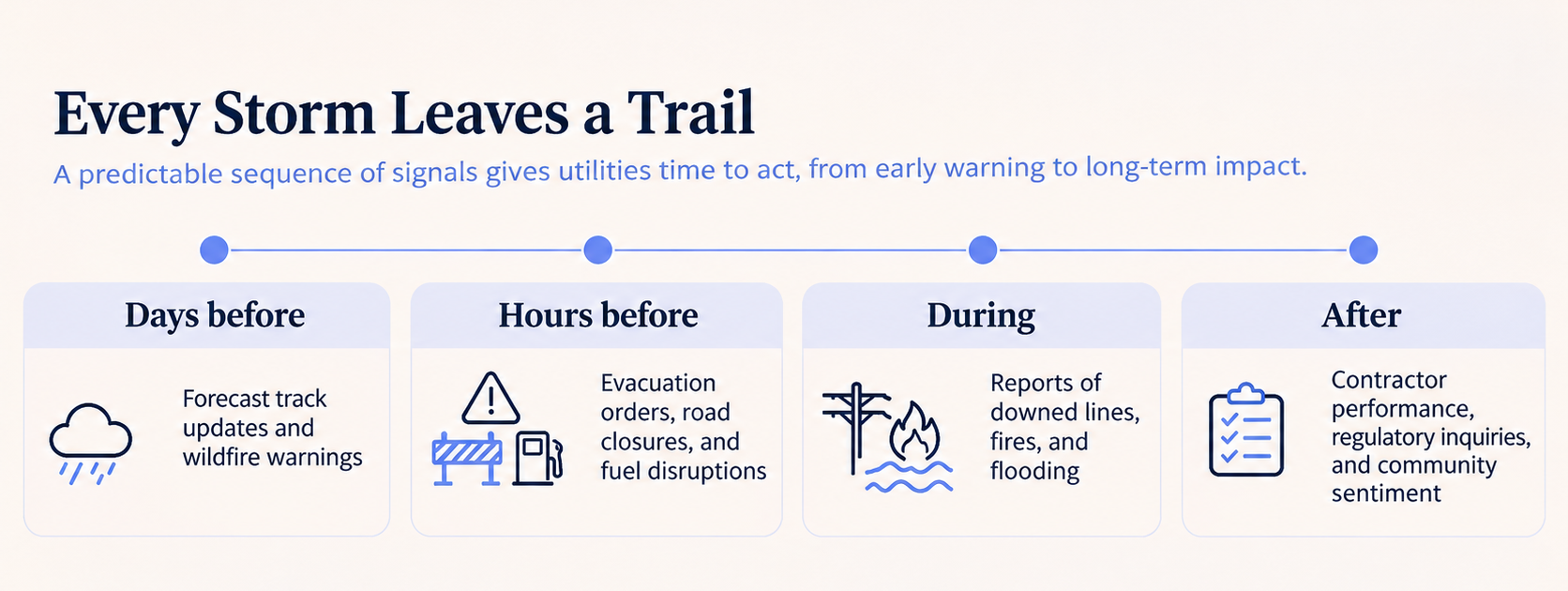
Utilities already have excellent weather services and outage management systems. What they often lack is one view that connects the weather to everything else: the contractors, the suppliers, the communities, and the circuits that sit in the path.
How Polaris I/O helps utilities see the storm coming
Polaris I/O connects physical risk signals to the operational decisions that follow. Signal Monitoring tracks weather, fire, and public reports alongside contractor and supplier health. The Pattern Engine connects those signals to the circuits, crews, and material yards they affect. Decision Activation turns them into ranked, explainable actions for operations, logistics, and communications teams: where to stage, what to move, and who to call.
Polaris I/O has already demonstrated wildfire operational risk monitoring for a public safety use case, drawing on the same capabilities we deliver for defense, intelligence, and national security customers. The same supply chain risk monitoring tells a utility when the distribution transformers it is counting on are stuck behind a closed port or a struggling distributor.
And over time, that record of signals becomes something else: an evidence base for the hardening plan. When a regulator asks why one circuit was undergrounded before another, the utility can show exactly what it knew and when.
Reliability is not about spending more. It is about knowing where to send the next truck.
Frequently asked questions
How many hours did Americans lose power in 2024?
The average U.S. customer experienced about 11 hours of interruptions in 2024, roughly double the average from 2014 to 2023, with 80% of the total caused by major events such as hurricanes.
What is grid resilience?
Grid resilience is the ability of the power system to anticipate, withstand, and recover quickly from disruptions such as storms, wildfires, and equipment failures.
How much are utilities spending on wildfire mitigation?
Spending is rising fast. Northwest investor-owned utilities alone plan about $735 million for wildfire mitigation in 2026, more than double their 2023 level.
How can utilities improve storm response?
By connecting weather and fire forecasts to crew, contractor, and material availability, staging resources before landfall, and using public reports to find damage faster.

Related Posts
Nothing found.