


AI can now reason in seconds. Much of what it reasons about was last checked in the spring. The next enterprise AI advantage belongs to whoever closes that gap.
Key takeaways
- By 2028, Gartner expects 33% of enterprise software to include agentic AI, yet data leaders say 26% of their data is untrustworthy. Agents will soon make decisions at scale on information their own companies do not fully trust. Fix the inputs before scaling the agents.
- Gartner predicts more than 40% of agentic AI projects will be canceled by the end of 2027 over cost, unclear value, or weak risk controls. Projects that tie each agent decision to a current, sourced business signal give leadership a value case and an audit trail before the budget review.
- Amazon’s reported World Product Graph, a planned catalog of nearly every product sold online, shows where leverage is moving: to whoever holds the most current facts. Treat external intelligence as shared infrastructure you secure once, not a feature rented separately inside every application.
- Federal agencies reported 3,611 AI use cases in 2025, up 105% in one year, while members of Congress press for oversight of federal equity stakes in critical minerals companies. Public sector AI now needs continuous supplier and ownership monitoring, not point-in-time vetting.
- In SBI Growth Advisory research covering more than 58,000 signals across 46 enterprise accounts, teams acting on business change signals converted 71% of opportunities versus 20% and closed in 144 days versus 272. The gain came from timing. Reaching the decision before competitors see the change is where the return lives.
The short answer: AI agents are only as good as what they know about the world right now. Models are getting cheaper and smarter every quarter, but most of the business information feeding them is stale, scattered, or unverified. The durable advantage in enterprise AI is shifting from the model to decision intelligence, the layer that tells the model what changed, why it matters, and what to do about it.
Picture a brilliant analyst. Top of the class, works around the clock, never asks for a raise. One catch: they have been in a windowless room since April. Ask them which supplier to trust or which account to chase, and you will get a confident, articulate, well-reasoned answer about a world that no longer exists.
That is the enterprise AI agent in 2026.
 Why are AI agents only as good as what they know?
Because reasoning is becoming a commodity, and news is not.
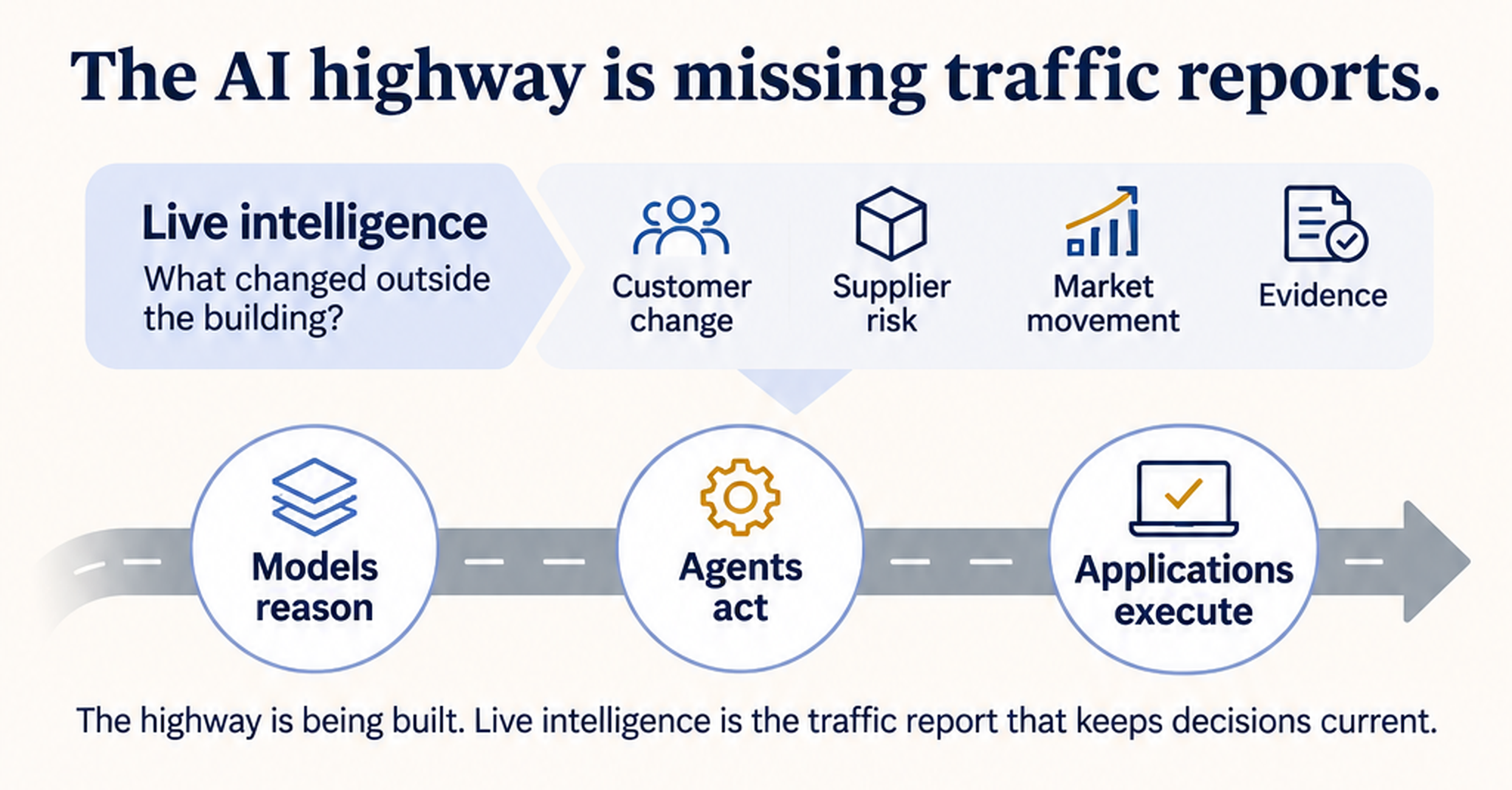
The industry is building an extraordinary highway. Foundation models supply the reasoning, agents do the work, and enterprise applications are where decisions get executed. Gartner expects that by 2028, 33% of enterprise software applications will include agentic AI and at least 15% of day-to-day work decisions will be made autonomously by agents.
Now look at the fuel. In Salesforce’s State of Data and Analytics survey of nearly 8,000 executives, data and analytics leaders said 26% of their data is untrustworthy, and that they lack the real-time data AI depends on. A quarter of the tank is bad gas, and we are about to hand the keys to a driver that never sleeps.
The market is already sending the bill. Gartner predicts more than 40% of agentic AI projects will be canceled by the end of 2027 over cost, unclear value, or weak risk controls. It also estimates that only about 130 of the thousands of vendors calling themselves agentic are the real thing. Somewhere, a chatbot from 2019 just got a new business card.
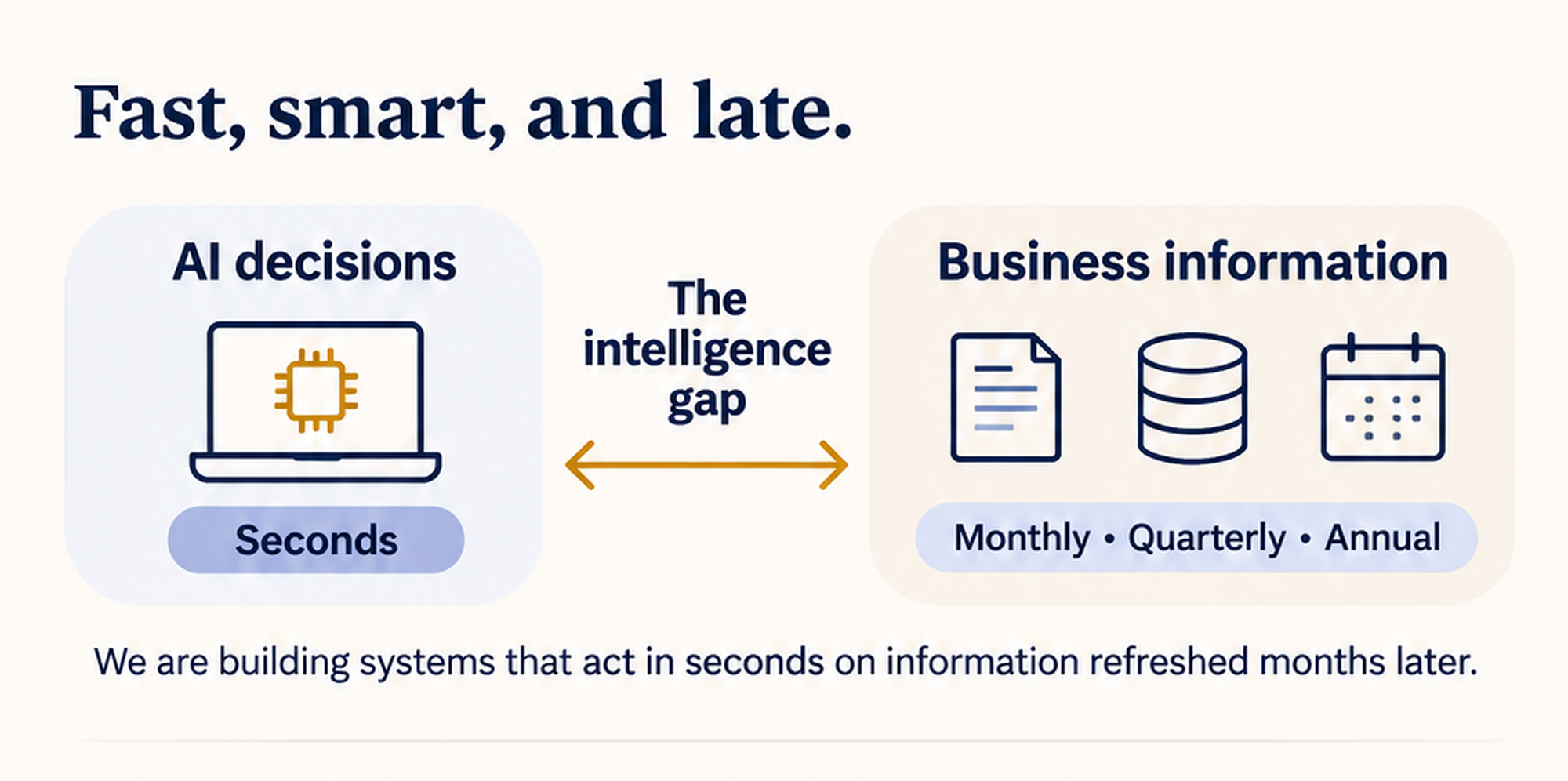
A model can analyze a supplier’s balance sheet. Does it know the supplier’s largest customer walked last week? A sales agent can rank your accounts. Does it know one of them announced an expansion yesterday? We are building systems that act in seconds on information refreshed monthly, quarterly, or annually.
What is the AI highway missing?
Exits, on-ramps, and traffic reports. Everybody is pouring asphalt. Far fewer people are telling the cars what is happening on the road.
 Look at who is quietly trying to own the traffic reports. Reuters reported on November 13 that an internal Amazon planning document describes a “World Product Graph,” a catalog of nearly every product sold online, including items Amazon does not sell, with an aspirational launch date of October 2027. An Amazon spokesperson said that draft, outdated documents often paint an incomplete picture and that a brainstorming document does not necessarily reflect its current plans. Fair enough. But you do not brainstorm a catalog of every product on Earth unless you believe the agent that knows the most current facts wins the transaction. We unpacked that idea in Amazon’s World Product Graph and Transactional AI.
Meanwhile, the plumbing for agents to talk to each other is being standardized. The Linux Foundation took on Google’s Agent2Agent protocol in June 2025 so agents from different vendors can find each other and collaborate, and in December 2025 it formed the Agentic AI Foundation around Anthropic’s Model Context Protocol, OpenAI’s AGENTS.md, and Block’s goose. Enterprises will not run one agent. They will run fleets.
Government is moving too. Federal agencies reported 3,611 AI use cases in 2025, up 105% in a year, according to Nextgov, and 445 of them were labeled high-impact.
More agents, more vendors, more consequential decisions. Every one of them faces the same question: what changed outside the building, does it matter, and is the evidence good enough to act on? As we argued in AI Models Are Becoming Commodities. The Intelligence Feeding Them Won’t Be, the advantage is moving from the model to what feeds it.
One intelligence engine, many decisions
At Polaris I/O, we continuously monitor changes across companies, markets, industries, suppliers, and operating environments. We connect those developments to organizations, people, relationships, and history. We find the patterns that matter to a specific decision, and we deliver them to the people, applications, and models making it.
The architecture stays the same. The value changes with the buyer. Three examples.
Media and advertising: one signal, two decisions
A company announces a new facility. For an advertising sales team, that is a prospect with a fresh reason to build awareness, spotted before anyone fills out a form. For a newsroom, it is the first paragraph of a story about jobs and local investment. Same signal, two decisions, and nobody had to rebuild the research.
Our MarketView platform has expanded across NBCUniversal Local, supporting both commercial and editorial workflows. The lesson: intelligence gets more valuable every time another workflow can use it.
Private equity and professional services: continuous diligence
Diligence is a photograph taken the week before close. Ownership is a movie that runs for five years. Between investment committee meetings, customers restructure, competitors raise capital, industries consolidate, and suppliers wobble.
Continuous diligence means watching the external conditions that drive growth and risk instead of waiting for the next quarterly deck. Bad news is only part of it. An acquisition creates a new buying center. A new executive brings new priorities. A competitor’s stumble opens a door. An expansion signals demand before a formal buying process begins.
Your CRM knows your history. It does not know what happened to your accounts this morning. A continuously updated intelligence layer tells a commercial platform which of thousands of accounts are changing, what the change suggests, and which deserve attention now.
Federal markets: what happens after the check clears
The United States is investing heavily in AI, defense technology, critical minerals, and advanced manufacturing. The government has even taken equity stakes in mining companies such as MP Materials and Lithium Americas, and members of Congress have pressed agencies for documents and asked GAO to review how those risks are assessed. Whatever your view of the policy, winning a contract does not guarantee execution, and funding does not guarantee production capacity.
A supplier’s softening finances may mean little on their own. Add a leadership departure, slower hiring, a delayed facility, and a growing concentration of government contracts, and the picture changes. No single signal proves the supplier will fail. Together, they justify a closer look while there is still time to act. That is the difference between collecting information and producing decision intelligence. Polaris I/O is extending these capabilities into federal markets, where suppliers, ownership, and industrial dependencies all matter.
Where the intelligence goes
The same intelligence runs inside Polaris I/O’s own applications and flows into other enterprise systems, specialized models, and AI agents through integrations and APIs. We explained that model in Amazon’s World Product Graph and Transactional AI. Some of these applications and integrations are in use today, and broader agentic workflows are the expanding opportunity.
A model that recommends a supplier is useful. An agent that can place the order is powerful. An agent that knows the supplier’s financial condition, ownership, capacity, and emerging risks before it places the order is the one you can actually trust.
The next valuable AI platform may be the one whose intelligence makes the most agents useful.
Why does intelligence compound when models do not?
Data alone rarely sets a company apart. Most of it comes from public sources, filings, announcements, and commercial providers anyone can buy. The hard part is turning fragments into something you can act on. Is the company in today’s article the same one we tracked six months ago? Does a new investment confirm an earlier expansion signal? Is a supplier’s trouble a blip or a trend? Can we show the evidence behind the recommendation?
Answering them takes connected entities, history, validated developments, and pattern recognition. A new executive appointment is routine. The same appointment after an acquisition, alongside a hiring surge, a new market entry, and fresh technology investment, is a story. Our Pattern Engine connects those developments over time so customers can tell isolated events from real change.
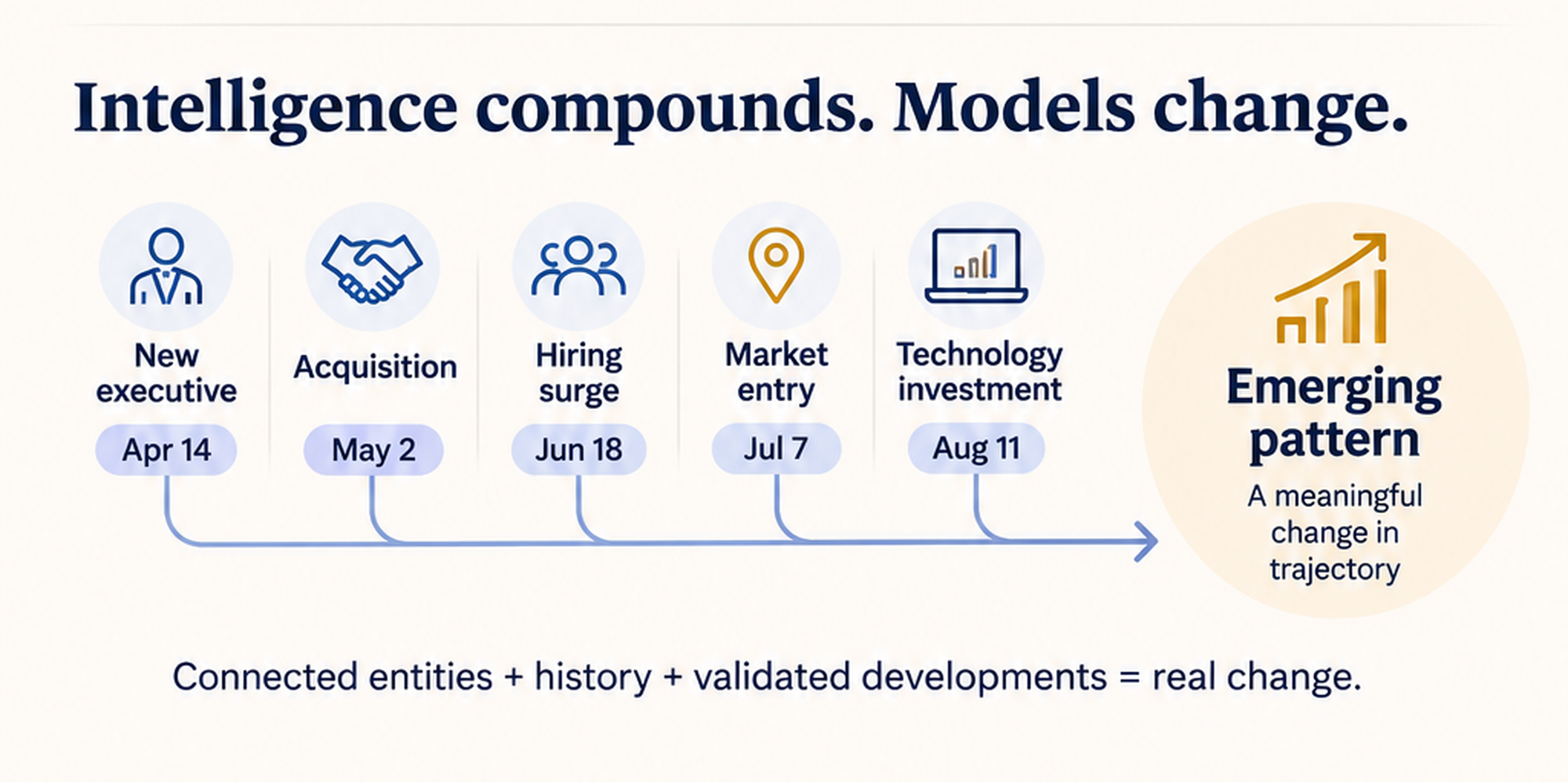 Models, applications, and agents will keep changing. The need for current, contextual, evidence-backed intelligence stays, and every new agent is another customer for it.
Does acting on signals actually pay?
In research conducted with SBI Growth Advisory, Polaris I/O analyzed more than 58,000 business evolution signals across 46 enterprise accounts over 12 months. Teams acting on those signals converted 71% of opportunities, compared with 20%, and closed deals in 144 days, compared with 272.
Those findings reflect a specific research setting, but the direction is hard to ignore. What matters is whether intelligence changes the timing and quality of a decision. In revenue, that means reaching the customer before the deal turns into a bake-off. In private equity, spotting the opening before the next quarterly review. In media, finding the advertiser or the story first. In government, catching the dependency while there is still time to respond.
The next AI advantage is knowing what changed
When a person decides on stale information, someone usually catches it in review. When an autonomous system makes thousands of decisions on stale information, the mistakes compound before anyone notices. The answer is to make sure the systems doing the deciding know what is happening in the world they are deciding about.
The highway is being built. The cars are getting faster and the drivers smarter. Someone still has to tell them what changed, why it matters, and where the opportunity or the risk is forming. That is the intelligence layer, and that is where Polaris I/O intends to lead.
See what matters. Spot what is forming. Steer the response.
Frequently Asked Questions
What is decision intelligence?
Decision intelligence connects current information, relationships, history, and emerging patterns to a specific business decision so an organization knows what changed, why it matters, and what to do next.
Why do AI agents need real-time business intelligence?
AI agents need real-time business intelligence because they act on whatever they are given, and a well-reasoned decision based on stale facts is still a wrong decision. Current, evidence-backed signals let agents act on today’s conditions instead of last quarter’s.
How does Polaris I/O support AI agents?
Polaris I/O supplies continuously updated, evidence-backed intelligence through its own applications and through integrations and APIs that feed external models, enterprise systems, and AI agents.
What is continuous diligence in private equity?
Continuous diligence is the practice of monitoring an investment thesis throughout the ownership period by tracking external developments that affect customers, competitors, suppliers, and markets, rather than relying only on the diligence done before close.
How can decision intelligence help federal agencies?
Decision intelligence helps federal teams track developments affecting contractors, suppliers, ownership, industrial capacity, and technology dependencies, while keeping the evidence and context needed for human review.

Related Posts
Nothing found.