


What GE Aerospace’s $12 billion deal, a new cruise missile maker, and a US intelligence advisory on Chinese AI all reveal about decision intelligence.
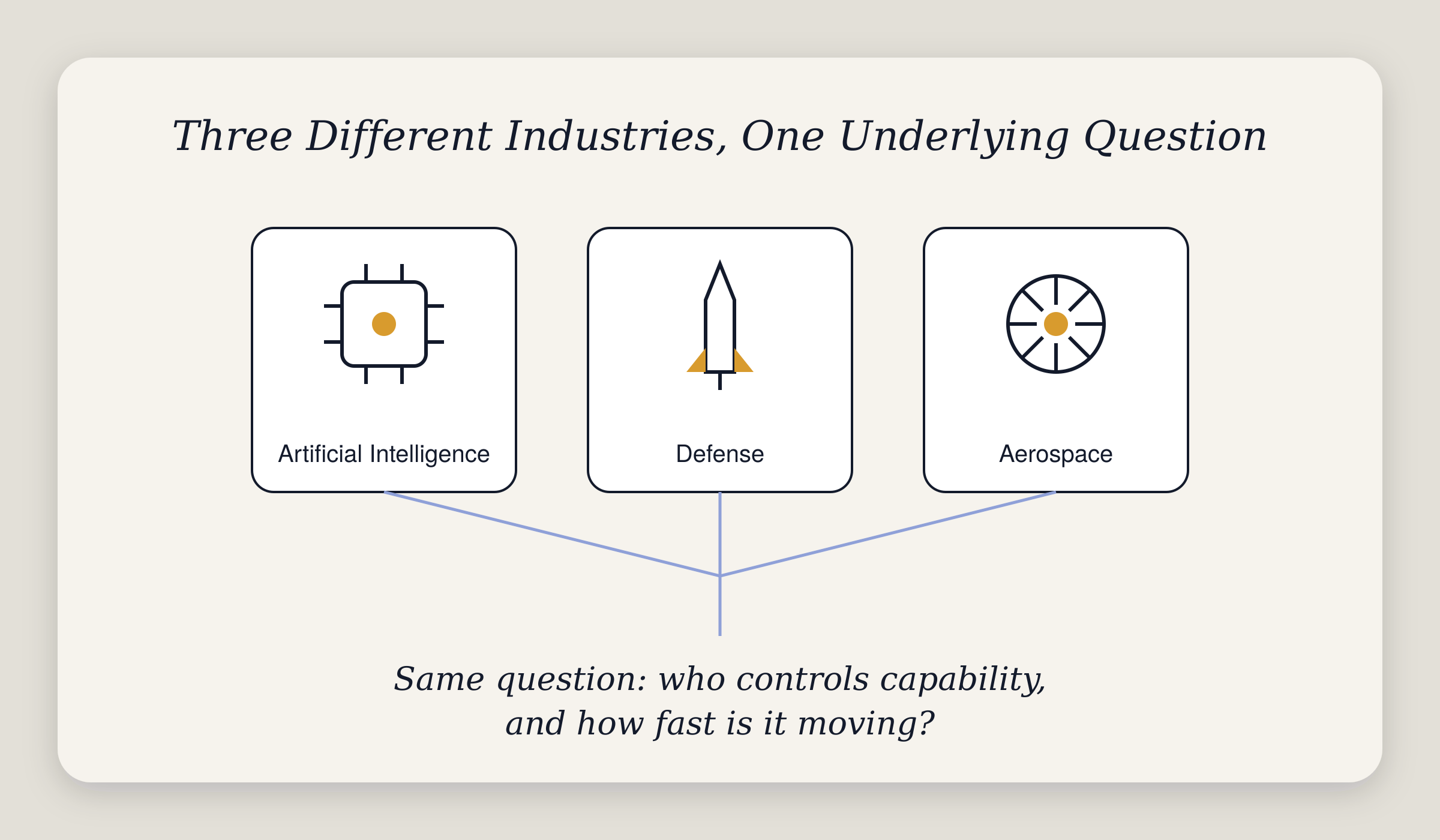
Three stories broke within 24 hours of each other this week. On the surface, they belong to three different industries.
US intelligence agencies accused six Chinese AI companies of systematically extracting the capabilities of leading American AI models. A two-year-old defense startup unveiled a mass-producible cruise missile and opened its first factory. And GE Aerospace agreed to pay nearly $12 billion for a supplier that makes one especially difficult engine part.
Artificial intelligence. Missiles. Jet engines. Different markets, different regulators, different customers.
Underneath all three is the same question: what actually creates capability, and who controls it?
 Quick answer
Capability is not the same thing as technology, and it is not owned by a single company. It is produced by a network of suppliers, talent, capital, facilities, and dependencies. The organizations that understand that network, and can see it changing before a failure forces the issue, hold a structural advantage. We call that discipline Capability Intelligence. We call the specific concept of identifying which nodes in that network have outsized control over the outcome Dependency Power.
Key takeaways
Capability can move between organizations without the underlying technology changing hands. Distillation is the clearest current example.
A demonstrated technology and a scalable production system are not the same achievement. Covenant’s missile works. Whether it can be built at the volume the company describes is a separate, ongoing question.
The most strategically important supplier is not always the one you spend the most money with. GE Aerospace just paid $11.75 billion to prove that point.
Traditional supplier and competitor monitoring tells you what changed. Decision intelligence adds what that change means and what to do about it before the rest of the market catches up.
You do not need to steal the technology to acquire the capability
On September 9, 2026, the National Security Agency (NSA), the FBI, and the Cybersecurity and Infrastructure Security Agency (CISA) published a joint advisory titled “China Based Artificial Intelligence Companies Conducting Industrial Scale Distillation Campaigns Against US AI Companies.” The advisory names six firms: DeepSeek, Moonshot AI, Alibaba, MiniMax, StepFun, and Z.AI. It alleges these companies have used distillation, the practice of training a smaller model on the outputs of a more advanced one, to extract proprietary capabilities from US frontier models since at least late 2024. The agencies describe distillation as “the core, not merely a supplement” of how these companies build their systems, and say the activity is likely known to the Chinese government. China’s government has rejected the allegations. (Bloomberg; CNN)
Anthropic disclosed its own findings alongside the advisory. The company said three Chinese AI labs ran an industrial-scale campaign against its Claude models, generating more than 16 million exchanges through approximately 24,000 fraudulent accounts. (CNN)
The advisory also challenges one of the most cited claims in AI, DeepSeek’s reported $5.6 million training cost, arguing that figure excludes the cost of data obtained through distillation. (The Next Web)
What makes this a genuinely new intelligence problem is that a company can gain meaningful ground on a rival’s capability without ever touching the rival’s source code, model weights, training data, or engineers. Access to a system’s outputs, at scale and over time, can be enough to compress a competitor’s development cycle.
That changes the question an intelligence function has to ask. The old question was: who owns the technology. The more useful question is: who is acquiring the capability, and how fast is the gap closing.
We think of the variables worth tracking here as Capability Transfer signals: model access patterns, API usage anomalies, distillation evidence, benchmark convergence, research citations, talent movement, compute acquisition, and open-source release activity. No single signal proves a capability gap has closed. Watched together over time, they can show something more useful than a single accusation: whether a competitor that was two years behind is now six months behind. That is the kind of change worth knowing about before it becomes public.
This is not only an AI problem. The same logic applies to semiconductors, autonomous systems, electronic warfare, robotics, and advanced manufacturing. It applies anywhere capability can move faster than the underlying technology does.
A working missile is not the same as a missile you can build at scale
On September 9, 2026, defense startup Covenant came out of stealth and opened a 105,000-square-foot factory in Dallas, Texas. The company unveiled Anthem, a ground-launched, long-range cruise missile carrying a payload of more than 200 kilograms, built specifically to be cheaper and faster to manufacture than legacy systems from primes like RTX and Lockheed Martin.
Covenant, founded in 2024 by CEO Michael Kaufman and backed by roughly $250 million from Andreessen Horowitz, Founders Fund, Lux, 8VC, Aleph, and Lightspeed, says Anthem has completed more than 200 test flights, including a live-fire demonstration in Morocco in August 2026, and has booked approximately $150 million in orders covering qualification, research and development, and production work. The company holds an Other Transaction Agreement with the US Army and a roughly $70 million contract with the Navy’s Rapid Capabilities Office to develop a maritime variant. (Reuters via Aerotime; CNBC)
On production, the company’s own numbers are more measured than the ambition suggests. The Dallas plant is expected to build 1,000 missiles in its first year of serial production, beginning in the first quarter of 2027, scaling toward 5,000 units annually. Covenant is also building capacity outside the US: a 110,000-square-foot site in Saxony, Germany, targeting roughly 1,000 missiles a year, and a smaller 32,000-square-foot facility in northern Israel focused on engineering and manufacturing support. Covenant says it deliberately built multiple qualified suppliers for critical components specifically to avoid the single-supplier bottlenecks that have slowed other weapons programs. (Aerotime; Jerusalem Post)
The distinction that matters here has nothing to do with whether the missile works. It works. The distinction is between a demonstrated technology and a demonstrated production system.
Two companies can show the same capable weapon. If one can build 400 a year and the other can build 5,000, they are not delivering the same military capability. Production scale changes inventory depth, war reserve requirements, unit economics, and ultimately what a military planner can actually promise to deliver.
For a claim like this, the variables worth watching are not really about the missile at all. They are about the system underneath it: supplier count for each critical component, rocket motor and engine capacity, electronics availability, facility expansion, capital expenditure, production and supplier hiring, purchase commitments, test cadence, qualification timelines, and observed monthly output. Put together, those signals answer a more useful question than “does the technology work.” They answer: what has to be true for the stated production number to become real, and is the evidence actually showing up.
Sometimes the smallest supplier controls the biggest outcome
The clearest example this week came from aerospace, not defense tech.
On September 8, 2026, GE Aerospace announced it had agreed to acquire Consolidated Precision Products, a Cleveland, Ohio-based maker of precision castings, for $11.75 billion in cash and new debt. The seller is a partnership between private-equity firms Warburg Pincus and Berkshire Partners. It is GE Aerospace’s largest acquisition since the former General Electric split into three independent companies, and the deal is expected to close in the second half of 2027 pending regulatory approval. (GE Aerospace press release via SEC 8-K; CNBC)
CPP is the world’s third-largest maker of the metallic castings used in jet engine turbine blades, a process that is notoriously difficult to run at consistent quality and can take years to qualify a new supplier for. GE Aerospace CEO Larry Culp called the capability “mission critical,” and said the deal reflects strong simultaneous demand across commercial engines, the aftermarket, and defense heading into the 2030s. CPP is expected to generate roughly $2 billion in revenue in fiscal 2027, about 60 percent of it from commercial aerospace customers including Honeywell, RTX, and Lockheed Martin. (Reuters via Global Banking and Finance; The Daily Upside)
This deal is worth studying closely because it is vertical integration for a different reason than the usual one. GE Aerospace is not buying CPP mainly to cut costs. It is buying control over a bottleneck.
Castings have been one of the aerospace industry’s most persistent supply-chain constraints since the pandemic, and GE Aerospace’s own order backlog has grown large enough that fulfilling seven-to-ten-year order books, not winning new orders, is now the industry’s central operating challenge. (Reuters via Global Banking and Finance)
That reframes how a company should evaluate its own supply chain. The standard question asks where a company spends the most money. A more useful one asks what stops working if a single supplier goes down.
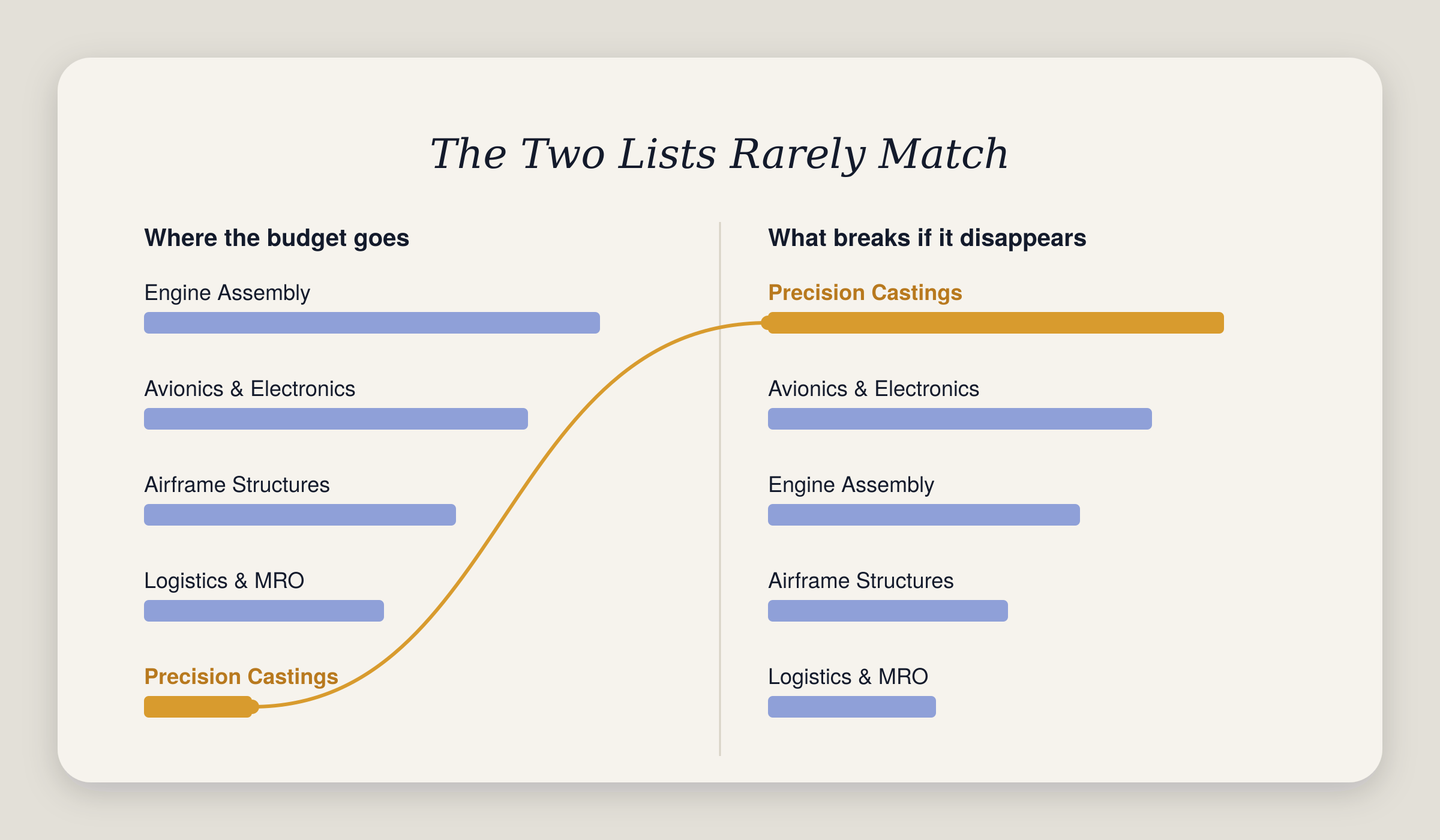 Those two lists rarely match. A relatively small line item, in dollar terms, can carry disproportionate control over whether a much larger revenue stream keeps moving. We call that concept Dependency Power. It combines four things: how critical the component is, how concentrated the supply is among qualified vendors, how long it would take to replace or requalify a substitute, and what actually breaks downstream if the dependency disappears.
GE Aerospace’s $11.75 billion answer is that, for jet engine castings, all four of those were high enough to justify owning the constraint directly rather than continuing to manage it as a vendor relationship.
Capability is a network, not an asset
Put the three stories together and a pattern emerges. An AI model does not define the full AI capability any more than a missile defines the full military capability or an engine defines the full production capability. Each sits inside a network of technology, people, suppliers, capital, facilities, intellectual property, manufacturing know-how, logistics, and policy.
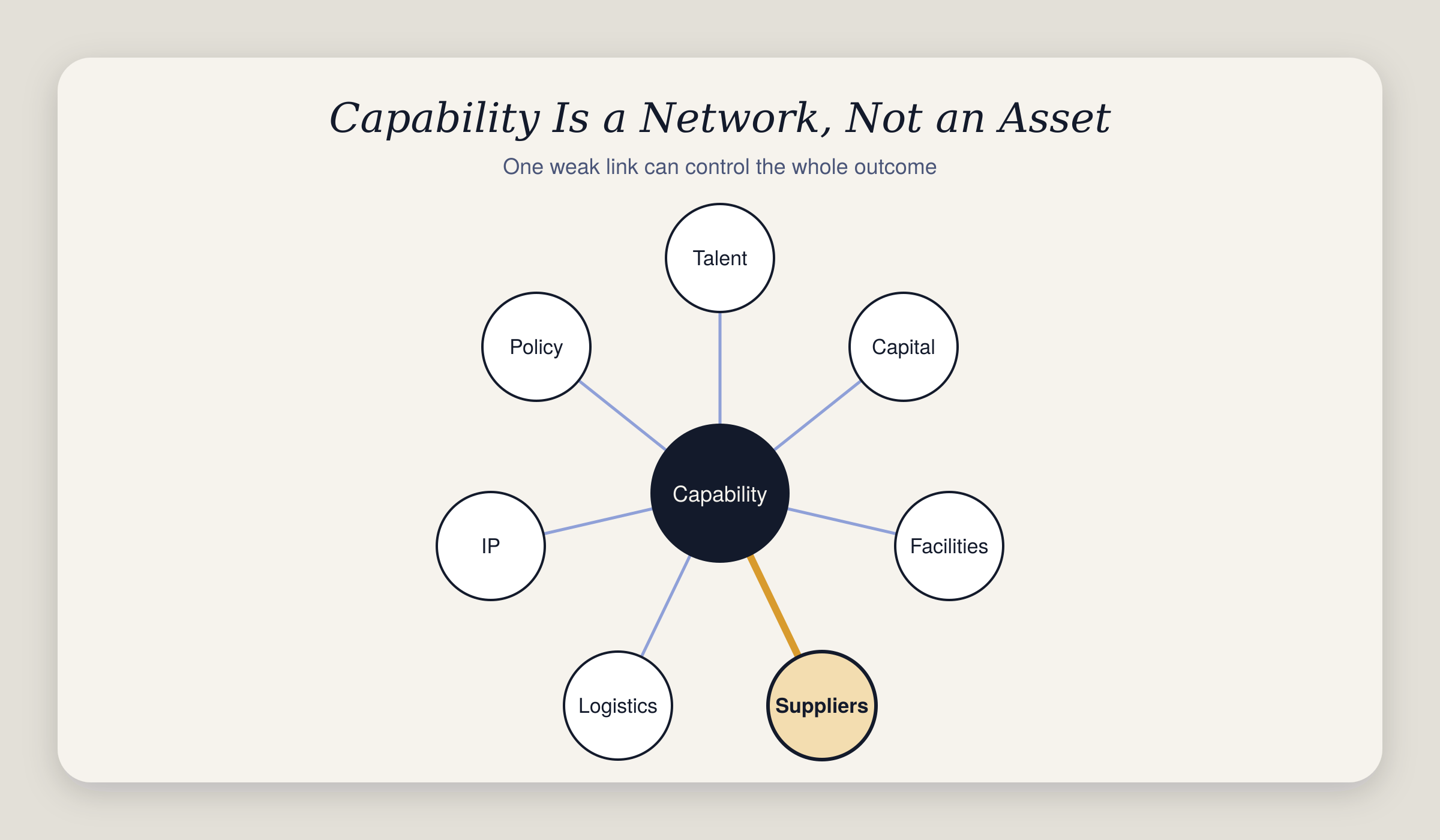 The advantage goes to the organization that understands how those pieces interact, and the questions worth asking rarely stop at “does this capability exist.” They extend to how mature it is, how fast it is improving, how easily it can transfer to a competitor, whether it can actually scale, what constrains it, and what happens if one dependency in the chain disappears.
That is the shift we think about at Polaris I/O as the move from company monitoring to Capability Intelligence. A company database tells you about organizations, a news feed tells you about events, and a supply-chain database tells you about vendors. Each is useful on its own, but none of them answers the question an executive actually has: what determines whether this capability will exist when I need it.
Answering that requires connecting signals that normally live in separate systems. A hiring surge can point to a production ramp. A new patent can signal an emerging technical capability. A supplier acquisition often marks a shift in who controls a critical dependency, and a financing round can be the clearest evidence that a capacity expansion is becoming real rather than aspirational. Individually, these are just signals. Connected over time, they show how a capability is actually changing, not just that something happened.
AI governance and supply-chain monitoring are the same problem wearing different clothes
Peter Sondergaard, strategic advisor to Polaris I/O, has written about what he calls the autonomous organization, and the discipline leaders need to manage it: see it, spot it, steer it. That framework applies just as directly to supply-chain and competitive intelligence as it does to AI governance.
Seeing it means knowing what is changing in the environment you depend on. Spotting it means recognizing which individual signals are forming a meaningful pattern rather than noise. Steering it means knowing what decision or intervention should follow. Whether the subject is an AI agent’s emerging behavior or a supplier’s deteriorating financial health, the operating discipline is the same: notice early, connect the dots, and act before the constraint becomes a failure.
By the time a production line actually stops, the intelligence opportunity has already passed. The useful signals show up earlier: a supplier starts hiring aggressively, a factory expansion gets permitted, a funding round closes, patent activity shifts, a competitor gains new model access, a specialized supplier’s financials start to slip, a buyer acquires the bottleneck outright. Those are the moments that are worth watching, and the hard part is knowing which combination of them actually matters.
The strategic question has changed
For decades, the operating question was simple: who has the technology. That still matters, but on its own it is no longer enough. Executives now also need to know who can acquire the capability, who can scale it, what it depends on, where the constraint actually sits, how quickly that is changing, and what should be done before everyone else sees the answer.
That is what we mean by Capability Intelligence. Whether the industry is artificial intelligence, aerospace, defense, or advanced manufacturing, the organizations that see the next constraint early are the ones with time to do something about it.
Frequently Asked Questions
What is Dependency Power? Dependency Power is a way of identifying which suppliers or components in a system have outsized control over an outcome, based on how critical the component is, how concentrated the supply is, how long a replacement would take to qualify, and what breaks downstream if the dependency disappears.
Why did GE Aerospace buy Consolidated Precision Products for $12 billion? GE Aerospace agreed to pay $11.75 billion for CPP, a maker of precision jet engine castings, to secure a persistent aerospace supply-chain bottleneck and support demand across commercial engines, the aftermarket, and defense through the 2030s.
What did US intelligence agencies accuse Chinese AI companies of doing? On September 9, 2026, the NSA, FBI, and CISA jointly accused DeepSeek, Moonshot AI, Alibaba, MiniMax, StepFun, and Z.AI of running industrial-scale distillation campaigns to extract proprietary capabilities from US frontier AI models since at least late 2024.
How many cruise missiles a year does Covenant plan to build? Covenant’s factory in Dallas, Texas, is targeting 1,000 missiles in its first year of serial production starting in early 2027, scaling toward 5,000 units annually, with additional smaller-scale production planned in Germany and Israel.
What is Capability Intelligence? Capability Intelligence is the practice of monitoring the full network behind a strategic capability, including technology, suppliers, talent, capital, and dependencies, rather than tracking a single company or technology in isolation, in order to see constraints and shifts before they become visible failures.
Sources
- NSA, FBI, CISA joint advisory coverage, The Next Web
- US intelligence advisory on Chinese AI distillation, Bloomberg
- Chinese AI distillation advisory and Anthropic disclosure, CNN
- Covenant Anthem missile factory opening, CNBC
- Covenant Anthem missile production targets, Aerotime
- Covenant Anthem missile and Israel facility, Jerusalem Post
- GE Aerospace to acquire Consolidated Precision Products, press release via SEC 8-K
- GE Aerospace CPP acquisition details, CNBC
- GE Aerospace CPP acquisition analysis, Reuters via Global Banking and Finance
- GE Aerospace CPP deal financial details, The Daily Upside

Related Posts
Nothing found.