T-Mobile
Identifying enterprise opportunities before vendor evaluation begins
What we accomplished together:
234
Opportunities
234
Opportunities
234
Opportunities
T-Mobile’s enterprise account teams manage a large portfolio of strategic accounts, each with complex buying structures, multiple stakeholders, and long sales cycles. The challenge wasn’t closing deals. It was finding them early enough to matter.
Impact highlights
- Earlier opportunity identification across strategic accounts, before competitors were engaged
- More executive-level conversations initiated during the initiative-formation stage
- Faster pipeline creation driven by proactive outreach rather than reactive bidding
The challenge
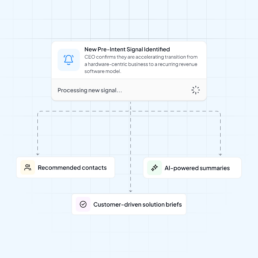
By the time a technology initiative surfaced in CRM data or showed up in a competitor’s pipeline, vendor conversations had often already started. Account teams needed a way to detect buying signals at the organizational level before procurement was involved and before RFPs were issued.
Pre-Intent Signals Polaris I/O Monitored Across Strategic Accounts
Examples of signals monitored across strategic accounts:
- New executive appointments (CIO, CFO, CTO) signaling strategic or operational change
- Digital transformation language appearing in earnings calls and investor communications
- Technology partnerships, acquisitions, and integration announcements
- Expansion into new business units or product lines requiring infrastructure support
Each of these signals indicated that a technology initiative was forming, often weeks or months before formal vendor evaluation began.
Use case 01
Title of the use case
T-Mobile’s enterprise account teams manage a large portfolio of strategic accounts, each with complex buying structures, multiple stakeholders, and long sales cycles. The challenge wasn’t closing deals. It was finding them early enough to matter.
Our impact
With earlier visibility into account activity, T-Mobile’s enterprise teams were able to engage decision-makers during the initiative-formation stage rather than the vendor-selection stage. That shift changed the nature of the conversations from reactive responses to competitive bids, to proactive discussions about shaping the solution itself. Results included:
- Earlier opportunity identification across strategic accounts, before competitors were engaged
- More executive-level conversations initiated during the initiative-formation stage
- Faster pipeline creation driven by proactive outreach rather than reactive bidding
Data to Validate with Jenny
To strengthen this case study, please confirm
Number of opportunities identified from signals
Total pipeline created from those opportunities
Time advantage compared to traditional pipeline discovery
Win rate comparison between signal-driven opportunities and normal pipeline