


When sellers owned the information
Early in my sales career, the internet was in its infancy. Sellers owned the information. We did the research, formed a hypothesis about a need the customer hadn’t recognized yet, and walked in with a reason to talk before buyers knew they had a problem.
Then information became available to everyone. The playing field leveled, and buyers used that access to push sales out later and later in the process. The industry called the part we couldn’t see the “dark funnel.”
With engagement pushed later, most sellers became reactive. They race to an MQL or an intent signal to be first among the vendors who engage once the buyer is already more than halfway through the journey. Technology made us more efficient at that race, yet the first late arrival is still late.
The more I’ve focused on this, talked with my circle, and lived it myself, the clearer it is that what’s old is new again. The early work good sellers once did by hand can now happen at scale.
Change comes before their search
In our prospects’ world, things change, and those changes send them looking to fix something, accomplish something, or avoid something. A new CFO with a mandate. A potential acquisition being weighed. A regulator asking harder questions. A tariff reshaping an industry. As Polaris I/O founder Dave Irwin writes in Go to Customer, every customer initiative, “especially those that secure funding, is driven by a critical internal or external event.” The path looks like this:
Change → impact → need → research → intent signal
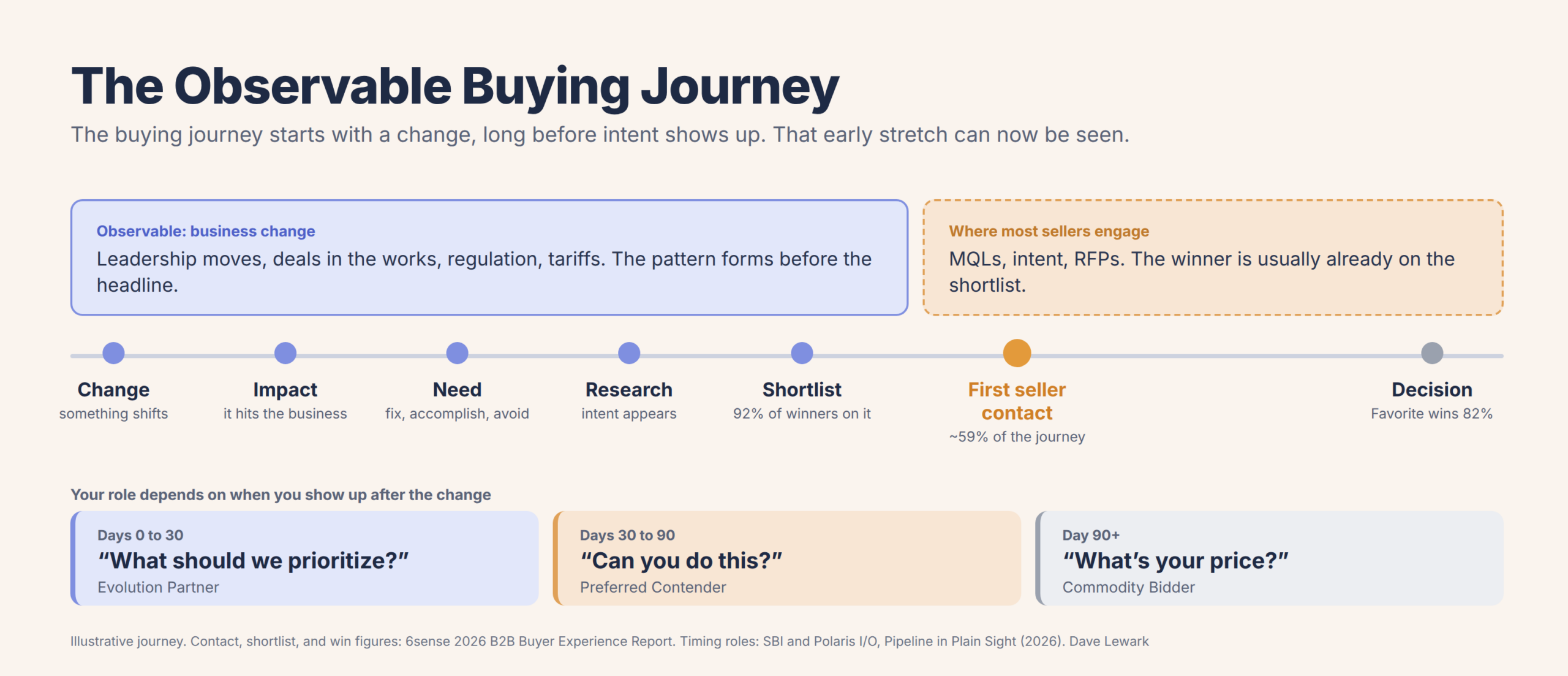 Intent shows up last, months after something already happened. It’s the part we’ve spent a decade buying. Even the change itself can arrive too late: by the time an acquisition hits the press release, you’re already behind. My friend Brian Shea of Lucrum Partners said it best in his TEDx talk: “Signals don’t scream, signals whisper. They whisper before they scream.”
AI has made finding signals the easy part. The hard part is understanding a growing volume of them over time, and what they mean to each other. That means reading signals big and small, seemingly important or insignificant, from six months ago to six hours ago, through the lens of what you sell. That’s what tells you a prospect is moving into the market rather than already sitting in it.
That’s the idea behind what I call the Observable Buying Journey. The first 50% to 70% of a purchase has never really appeared in your CRM or web analytics. Yet it does appear in the world around the buyer, if you know how to read it.
The research points the same way
Forrester’s State of Business Buying 2026 found an average of 13 internal stakeholders and 9 external participants influencing a purchase. Behind them sit the buyers behind the buyer: the board member, the CFO who never takes the meeting, the advisor whose opinion quietly settles it. We’ve all lost a deal because of someone we never got to meet. You can’t engage all of them, but you can see the conditions they’re reacting to.
Gartner found that 61% of B2B buyers prefer a rep-free buying experience (67% in Gartner’s newest survey), and 73% actively avoid suppliers who send irrelevant outreach. Yet that same 2025 survey shows buyers still want seller input where “contextual intelligence” matters, and Gartner’s 2026 research found buyers who spent more time with supplier reps had the least dysfunction in their buying groups. What buyers avoid is the pitch. A seller who arrives with a point of view on the buyer’s own change doesn’t feel like a rep at all.
The shortlist is set before the first conversation. In the 6sense 2026 Buyer Experience Report, 92% of winning vendors were already on the buyer’s initial shortlist, and the vendor the buyer favored before talking to sales won 82% of the time. Buyers first contacted sellers about 59% of the way through the journey. Pause and read that again! Any plan to engage buyers differently has to start from that fact.
Leadership feels it. In SBI’s Q4 2025 CEO Survey (cited in Pipeline in Plain Sight), 71% of CEOs rated market penetration and expansion as critical, but only 49% were confident their teams could execute. I’d push on that 49%. The survey was fielded in Q4 2025, before a year that reshaped how buyers research and how GTM teams work. I suspect the honest number today is lower.
Seeing the 5% before they surface
The LinkedIn B2B Institute’s 95:5 rule says roughly 5% of buyers are in market at any given time. I’d make one important shift in that. Inside the 95%, another 5% already has change underway that will move them into the market. That makes it roughly 90% not in market, 5% on their way in, and 5% already in market, taking demos, and comparing pricing on their way out. Intent data finds the last group. The entering 5% is what Polaris I/O calls pre-intent, and it’s where the work pays off, because the problem is still being defined.
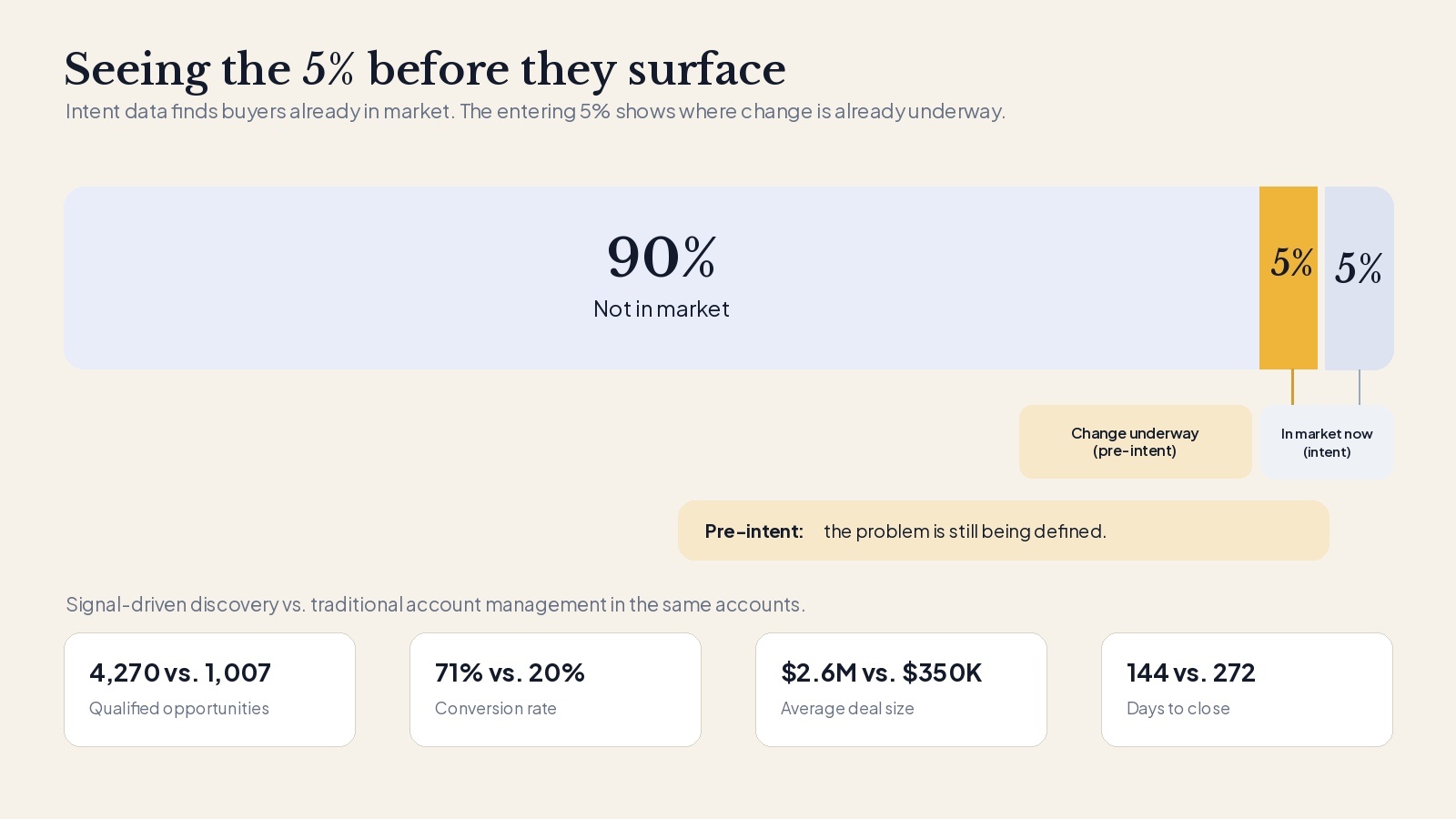 SBI and Polaris I/O put numbers on this where it’s easiest to measure: inside existing enterprise accounts. Pipeline in Plain Sight tracked 58,825 business evolution signals across 46 accounts for 12 months, comparing signal-driven discovery with traditional account management in the same accounts. If you read one piece of research on this shift, make it this one.
Three kinds of change (strategic transformation, growth and restructuring, environmental disruption) drove 82% of closed deals, so you don’t have to watch everything. And signal-driven teams reached eight buying centers per account versus three. As SBI puts it, “When your account team knows three people in a Fortune 500 account, the pipeline they can’t see is larger than the pipeline they can.”
The study measured expansion, and I’d read it that way. I haven’t seen research of the same rigor on new logos. But the mechanism travels: the acquisition that opens a buying center inside a customer opens one inside a prospect too. And 6sense’s 2026 report found that in 79% of purchases, the buyer’s organization already had experience with the winning vendor. New business tends to go to vendors who got known before the cycle started. The observable journey is one way to get known in time.
Guiding without selling
Here’s the part most of us aren’t ready for. Getting in early only pays off if you help the buyer think through the change, and most sellers have not been trained for that. Irwin describes an account leader whose main job had become shielding her customers from her own company’s product sellers. Most of us were trained to qualify, demo, and close. In the first 30 days after a change, there’s nothing to qualify yet. The buyer is still asking “what should we prioritize?” and that’s the window where a seller becomes what SBI calls an Evolution Partner.
SBI’s research with nearly 600 buyers found the teams that earn that role focus on the customer’s change rather than their own solution. Pipeline in Plain Sight builds each play around three questions:
- What does this change mean for the buyer’s business? Help them think it through. Don’t qualify a deal.
- Who else in the account is affected?
- Who on our team engages? The AE, the CSM, and the executive sponsor agree on who has the strongest path in.
Gartner’s analysts say sellers should act as “a sounding board for buyers.” That means sharing what you’ve seen elsewhere, naming roadblocks before the buyer hits them, and leaving the first meeting without a next step that involves your product.
Signal to action
Seeing the change is half the job. Irwin also says that without the other half, a signal hits a brick wall “because there’s no integrated workflow.” His standard: “Surfacing insights isn’t good enough. Tell me what decisions to make.” (The Intelligence Record)
That’s the step I care most about. A signal that arrives with what changed, why it matters to this account, who’s affected, and a suggested next step can be acted on by anyone on the account team, from a seasoned AE to a new CSM. A timely, imperfect action beats a perfect one never taken.
Here’s how I think about the full loop:
Observe → correlate → contextualize → interpret → prioritize → activate → act → learn
The human stays in it. As Deb Kammer, Polaris I/O’s Chief Commercial Officer, puts it: “Sales is not about finding pain points, it’s finding partnership points.” (The Intelligence Record)
Context also lets one pattern drive several motions. Say a customer’s signals start pointing to consolidation: a new CFO talking about vendor rationalization, a hiring freeze in the team that uses your product, a board addition with an acquisition track record. Months before any announcement, the account manager sees buying centers about to form. Renewals sees a contract that may soon be reviewed by people who never chose you. The CSM sees risk: if the other company already runs a tool that does what yours does, your value has to be proven again, and early.
From signal to operating model
Brian also puts the diagnosis well: “Most organizations think they have a demand-generation problem. … In reality, they have an organizational sensing problem.” He wants executives focused less on created pipeline and more on “what caused pipeline to form.” (The Intelligence Record)
Lucrum’s Signal-Led GTM™ makes that an executive operating system. Their Signal Blindness Index™ measures the gap between when a growth signal emerges and when the organization acts on it. Polaris I/O makes the change observable. Lucrum builds the rhythm that turns it into action.
Three moves to start this quarter
- Run a look-back on every deal, won and lost, from the last eight quarters. Trace each one to the business change that created the need. The patterns become your signal thesis. For the wins, ask SBI’s question: how many did your team find, and how many came to you? For the losses, ask when the change happened and when you first showed up. Most deals are decided long before the final mile.
- Add a forward-looking review to the cadence you already run. Give part of the pipeline review to what’s changing in your top accounts that hasn’t become a need yet.
- Measure time from signal to first conversation, and route each signal to sales, renewals, and CS together.
One caution. Better signals won’t fix seller behavior trained to wait for a form fill. Early and generic is still generic.
Where this is heading
Earning a spot on that initial shortlist, before it’s written, should be every GTM team’s north star.
The best time to show up is right after the old plan breaks and before the new one is written. Good sellers used to find that window by hand. Now it’s observable at scale.

Related Posts
Nothing found.