Polaris I/O continuously evaluates global activity and your own data against your priorities—surfacing evidence-backed changes with the context, strength, and confidence your team needs to understand them early.
Evidence-backed signals
The challenge is not finding more information. It is knowing what matters.
Tens of thousands of events occur every day across organizations, markets, suppliers, industries, and strategic environments. Traditional alerts surface content. Polaris I/O evaluates whether the underlying change is relevant to your objectives.
Built Around Your Priorities
Monitoring configured for your business—not a generic keyword list.
Configure Polaris I/O around the objectives, entities, markets, suppliers, topics, conditions, and exclusions that matter to your organization. Focused Intelligence Agents evaluate activity through that specific strategic lens, helping your team identify relevant change without manually sorting through disconnected updates.

Your Objectives
Monitor the risks, opportunities, priorities, and developments your team cares about.

Your Entities
Focus on specific organizations, accounts, suppliers, people, markets, industries, or strategic environments.

Your Criteria
Include the developments that matter and exclude the activity that creates unnecessary noise.
Separate Signal From Noise
Surface the evidence others overlook.
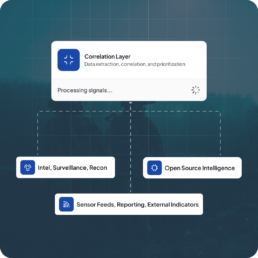
Polaris I/O evaluates potential developments against your configured strategy, identifies the affected entities, reviews the supporting evidence, and qualifies meaningful change as a Signal.
Each Signal is assessed for strategic strength and confidence, helping your team distinguish an important early indicator from routine activity or information that still requires investigation.
Signal assessment criteria:
- Strategic relevance: How directly the development relates to your monitoring objective.
- Material change: Whether the development represents a meaningful shift rather than routine activity.
- Evidence quality: How well the underlying information is supported and corroborated.
- Strength and confidence: How much the Signal matters—and how certain Polaris I/O is that the assessment is justified.
Tangible Outcomes
Build a stronger evidence base without the manual monitoring burden.
Reduce monitoring effort
Spend less time searching, sorting, and reviewing information across disconnected sources.

Surface relevant evidence earlier
Identify developments that may contribute to an emerging risk, opportunity, market shift, or operational issue.

Improve downstream analysis
Provide Pattern Detection with a clearer, more relevant set of Signals to connect and interpret over time.
More Relevant Monitoring
Evaluate outside developments in the context of your business.

External information
Monitor relevant reports, filings, news, press releases, blogs, interviews, organizational developments, and other unstructured sources.

First-party context
Incorporate available customer, account, supplier, operational, program, or historical information through supported integrations and uploads.

Strategy-aligned evaluation
Assess external activity through the priorities and context specific to your organization.
Built for Multiple Intelligence Needs
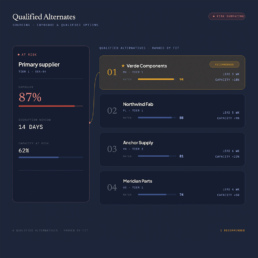
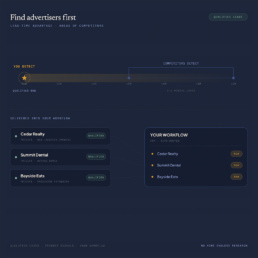
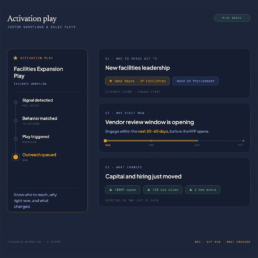
Monitor the entities and environments that matter to your organization.
We were able to get in front of key individuals as a result of Polaris I/O's recommendations.
Amanda McBride, Vice President, Global Revenue Office

Polaris I/O has streamlined our access to key industry data, helping us make faster, smarter decisions.
Leslie Lagan, Sr Director, Fraud Management

Signal monitoring FAQs
A Signal is a qualified piece of evidence representing a relevant event, observation, or development. It retains the source, timing, associated entities, classification, strength, and confidence needed for further analysis.
Keyword alerts surface content containing specific terms. Polaris I/O evaluates events against a configured strategy, determines their relevance, identifies associated entities, reviews the supporting evidence, and qualifies the most meaningful events as Signals.
Polaris I/O can monitor developments related to organizations, accounts, suppliers, people, markets, industries, geographies, topics, and strategic environments. The scope depends on the customer’s objectives, configuration, and available data.
Signals are assessed for strength and confidence. Strength indicates how relevant the evidence is to the configured strategy. Confidence reflects how certain Polaris I/O is that the Signal is supported by reliable evidence and has been correctly classified.
Yes. Polaris I/O supports structured and unstructured client data through methods such as APIs, SFTP, and supported uploads. This information can provide additional context when evaluating external activity.
Qualified Signals become inputs to Pattern Detection. Pattern Detection connects related evidence over time to develop the larger explanation or narrative, which can then support prioritization and recommendations through the Decision Engine.
The Next Layer
Signals are the first clue. Patterns reveal the bigger story.
A single Signal may be easy to overlook. Connected over time, related Signals can expose the larger risk, opportunity, market shift, or operational issue taking shape. Polaris I/O Pattern Detection reveals the narrative hidden across the evidence.